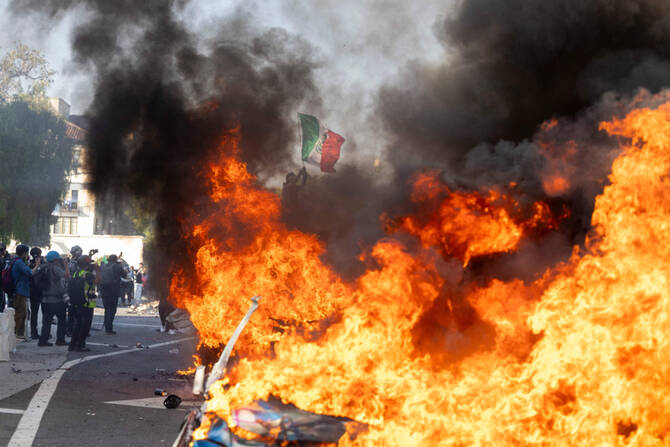

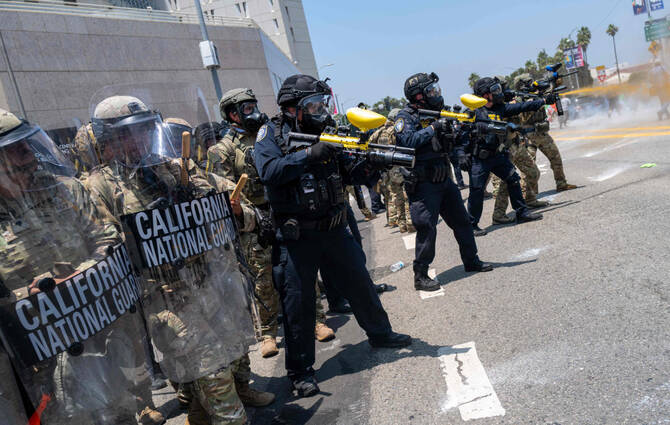

LOS ANGELES: Tensions in Los Angeles escalated Sunday as thousands of protesters took to the streets in response to President Donald Trump’s extraordinary deployment of the National Guard, blocking off a major freeway and setting self-driving cars on fire as law enforcement used tear gas, rubber bullets, and flash bangs to control the crowd.
Some police patrolled the streets on horseback while others with riot gear lined up behind Guard troops deployed to protect federal facilities including a detention center where some immigrants were taken in recent days. Police declared an unlawful assembly, and by early evening many people had left. Some protesters who remained grabbed chairs from a nearby public park to form a makeshift barrier between themselves and police and throw objects at them.

A woman is arrested, as protesters clash with law enforcement in the streets surrounding the federal building during a protest following federal immigration operations in Los Angeles, California, on June 8, 2025. (AFP)
It was the third day of demonstrations against Trump’s immigration crackdown in the region, as the arrival of around 300 federal troops spurred anger and fear among some residents. Sunday’s protests in Los Angeles, a city of 4 million people, were centered in several blocks of downtown.
Outside the Metropolitan Detention Center in downtown Los Angeles, crowds chanted “shame” and “go home” at members of the National Guard, who stood shoulder to shoulder, carrying long guns and riot shields. After some protesters closely approached the guard members, another set of uniformed officers advanced on the group, shooting smoke-filled canisters into the street.
Minutes later, the Los Angeles Police Department fired rounds of crowd-control munitions to disperse the protesters, who they said were assembled unlawfully. Much of the group then moved to block traffic on the 101 freeway until state patrol officers cleared them from the roadway by late afternoon, while southbound lanes remained shut down.
Flash bangs echoed out every few seconds into the evening as some protesters threw objects down at the roadway and state patrol officers fired back.
Nearby, at least four self-driving Waymo cars were set on fire, sending large plumes of black smoke into the sky and exploding intermittently as the electric vehicles burned. By evening, police had issued an unlawful assembly order shutting down several blocks of downtown Los Angeles.
Democratic Gov. Gavin Newsom requested Trump remove the guard members in a letter Sunday afternoon, calling their deployment a “serious breach of state sovereignty.” He was in Los Angeles meeting with local law enforcement and officials. It wasn’t clear if he’d spoken to Trump since Friday.
Their deployment appeared to be the first time in decades that a state’s national guard was activated without a request from its governor, a significant escalation against those who have sought to hinder the administration’s mass deportation efforts.
Mayor Karen Bass echoed Newsom’s comments.
“What we’re seeing in Los Angeles is chaos that is provoked by the administration,” she said in an afternoon press conference. “This is about another agenda, this isn’t about public safety.”
Their admonishments did not deter the administration.
“It’s a bald-faced lie for Newsom to claim there was no problem in Los Angeles before President Trump got involved,” White House spokesperson Abigail Jackson said in a statement in response.
Deployment follows days of protest
The arrival of the National Guard followed two days of protests that began Friday in downtown Los Angeles before spreading on Saturday to Paramount, a heavily Latino city south of the city, and neighboring Compton.
Federal agents arrested immigrants in LA’s fashion district, in a Home Depot parking lot and at several other locations on Friday. The next day, they were staging at a Department of Homeland Security office near another Home Depot in Paramount, which drew out protesters who suspected another raid. Federal authorities later said there was no enforcement activity at that Home Depot.
Demonstrators attempted to block Border Patrol vehicles hurling rocks and chunks of cement. In response, agents in riot gear unleashed tear gas, flash-bang explosives and pepper balls.
The weeklong tally of immigrant arrests in the LA area climbed above 100, federal authorities said. Many more were arrested while protesting, including a prominent union leader who was accused of impeding law enforcement.
The protests did not reach the size of past demonstrations that brought the National Guard to Los Angeles, including the Watts and Rodney King riots, and the 2020 protests against police violence, in which Newsom requested the assistance of federal troops.
The last time the National Guard was activated without a governor’s permission was in 1965, when President Lyndon B. Johnson sent troops to protect a civil rights march in Alabama, according to the Brennan Center for Justice.
Trump says there will be ‘very strong law and order’
In a directive Saturday, Trump invoked a legal provision allowing him to deploy federal service members when there is ”a rebellion or danger of a rebellion against the authority of the Government of the United States.”
He said he had authorized the deployment of 2,000 members of the National Guard.
Trump told reporters as he prepared to board Air Force One in Morristown, New Jersey, Sunday that there were “violent people” in Los Angeles “and they’re not gonna get away with it.”
Asked if he planned to send US troops to Los Angeles, Trump replied: “We’re gonna have troops everywhere. We’re not going to let this happen to our country. We’re not going to let our country be torn apart like it was under Biden.” He didn’t elaborate.
About 500 Marines stationed at Twentynine Palms, about 125 miles (200 kilometers) east of Los Angeles were in a “prepared to deploy status” Sunday afternoon, according to the US Northern Command.
Former Vice President Kamala Harris, who lives in Los Angeles, said the immigration arrests and Guard deployment were designed as part of a “cruel, calculated agenda to spread panic and division.”
She said she supports those “standing up to protect our most fundamental rights and freedoms.”
Defense secretary threatens to deploy active-duty Marines ‘if violence continues’
In a statement Sunday, Assistant Homeland Security Secretary Tricia McLaughlin accused California’s politicians and protesters of “defending heinous illegal alien criminals at the expense of Americans’ safety.”
“Instead of rioting, they should be thanking ICE officers every single day who wake up and make our communities safer,” McLaughlin added.
The troops included members of the California Army National Guard’s 79th Infantry Brigade Combat Team, according to a social media post from the Department of Defense.
In a signal of the administration’s aggressive approach, Defense Secretary Pete Hegseth also threatened to deploy active-duty Marines “if violence continues” in the region.
Vermont Sen. Bernie Sanders said the order by Trump reflected “a president moving this country rapidly into authoritarianism” and “usurping the powers of the United States Congress.”
House Speaker Mike Johnson, a staunch Trump ally, endorsed the president’s move, doubling down on Republicans’ criticisms of California Democrats.
“Gavin Newsom has shown an inability or an unwillingness to do what is necessary, so the president stepped in,” Johnson said.