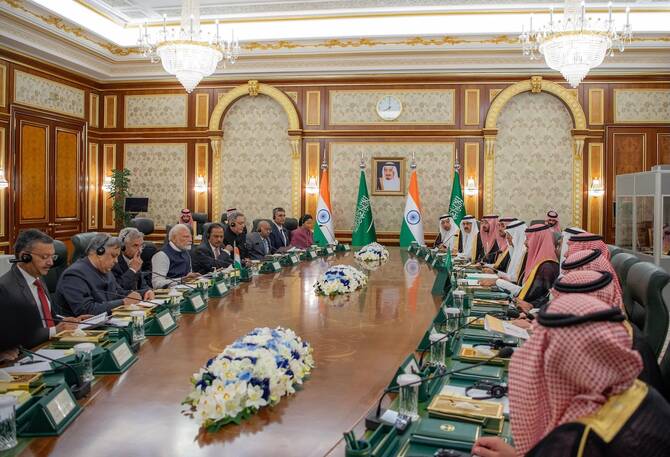

Ties with Gulf countries have become a key focus of India’s foreign policy over the past 10 years, the latest report by the Council for Strategic and Defence Research shows, highlighting New Delhi’s special focus on Saudi Arabia and the UAE.
Headquartered in the Indian capital, the CSDR is a think tank specializing in research on geopolitics, foreign policy, and military strategy. Its report published last month, “From Trees to Forests: The Evolution of India-Middle East Ties post 2014,” highlights India’s investment in bilateral relations with Gulf Cooperation Council countries, which are independent of larger global frameworks.
The effort to strengthen the connection started before Prime Minister Narendra Modi took office in 2014, but it has gained momentum with his frequent visits to the six-member bloc comprising Saudi Arabia, the UAE, Qatar, Kuwait, Bahrain and Oman.
“In the last 10 years, India has substantiated this effort by filling crucial gaps in political, economic, and military contact with key states, with a special focus on Saudi Arabia and the UAE,” Bashir Ali Abbas, senior research associate at CSDR and the report’s author, told Arab News.
“In the last 10 years, the Middle East has also emerged as a strategic space for India, with new defense relationships, and economic visions which also fit with the Gulf’s own focus on economic diversification.”
While India’s relations with the Gulf region span centuries, it currently has the largest concentration of the Indian diaspora — about 9.7 million people.
“And India’s top oil suppliers at any point in time inevitably are at least three Gulf states. This alone necessitates that India pay close attention to the region,” Abbas said.
“In India, policy makers and official decision-making institutions have updated their understanding of the region, but more importantly its changing nature. This evolved understanding has enabled the rise of new strategic partnerships, and PM Narendra Modi is the only Indian PM to have officially visited all six states of the Gulf Cooperation Council.”
By 2018, the GCC became India’s largest regional trading bloc, with an annual trade value of $104 billion in FY2017-2018. The volume that year surpassed India-ASEAN trade of $81 billion, and India-EU trade — $102 billion.
Currently, it is even higher, with the Indian government estimating it at $162 billion in FY2023-24.
In 2019, India became only the fourth state to establish a Strategic Partnership Council with Saudi Arabia, following Crown Prince Mohammed bin Salman’s visit to New Delhi.
During the Kingdom’s presidency of the Group of 20 largest economies in 2020, the two countries started to forge partnerships and bilateral programs that saw further development as India took the G20 presidency in 2023.
Over the past four years, the countries have since also engaged in a series of bilateral navy, air force and army exercises.
“Today, India sees Saudi Arabia as a strategic partner, with political and economic ties robust enough to also substantial cooperation in defense and security,” Abbas said.
“Given both India’s own Viksit Bharat 2047 development vision and (the crown prince’s) Vision 2030, India and Saudi Arabia are now driven by shared economic and strategic goals.”
With the UAE, India signed a Comprehensive Economic Partnership Agreement in 2022, following which their bilateral trade grew to $85 billion in just over a year. The number of multi-sectoral memoranda of understanding between Indian and Emirati public and private entities has since reached over 80, according to the CSDR report.
“India also sought to reframe other bilateral relationships where fresh opportunities had arisen,” it said, adding that New Delhi was “closing the Gulf circle,” with strategic partnerships signed with Kuwait during Modi’s visit in 2024, and with Qatar during Sheikh Tamim bin Hamad Al-Thani’s state trip to New Delhi in early 2025.
The relations “will certainly see a positive trajectory in the near and distant future — especially if it is backed up by greater avenues of intellectual contact,” Abbas said.
“Greater intellectual contact and an evolved popular understanding will enhance the strategic relationships between India and its Arab partners, through the injection of more ideas, perspectives, and actors who can work as champions for closer ties.”