

Pakistan economy to grow 2.7 percent in FY25, economic survey shows

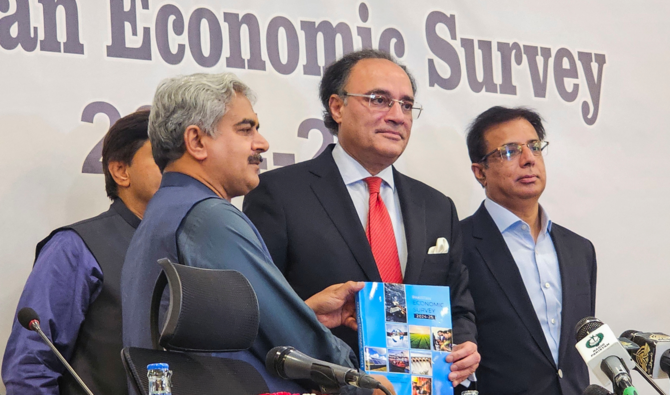
Pakistan Finance Minister Muhammad Aurangzeb shows a copy of the economic survey of fiscal year 2024-2025 during a news conference in Islamabad, Pakistan June 9, 2025. (REUTERS)
Short Url
Updated 09 June 2025
Follow

Pakistan economy to grow 2.7 percent in FY25, economic survey shows

  • The government initially targeted 3.6 percent GDP growth, but lowered it last month
  • Pakistan’s finance chief says the national economy is on an upward trajectory

ISLAMABAD: Pakistan’s economy is likely to expand 2.7 percent in the fiscal year ending June 2025 after growing 2.5 percent during the previous year, the government’s economic survey showed on Monday, a day before the country’s federal budget is unveiled.

The government initially targeted 3.6 percent GDP growth, but lowered it to 2.7 percent last month. The IMF expects real GDP to grow by 2.6 percent in FY25 and for the economy to grow 3.6 percent in FY26.

Prime Minister Shehbaz Sharif’s government aims for 4.2 percent GDP growth next year, the country’s planning minister said last week, amid competing priorities, including stimulating investment, maintaining a primary surplus, and managing defense expenditure amid heightened tensions with India.

Pakistan’s central bank, in a bid to encourage growth, cut its policy rate by more than 1,000 basis points in the current fiscal year. Its latest cut last month brought the key rate to 11 percent, resuming an easing cycle that had brought rates down from 22 percent after a brief pause in March.

Pakistan had a current account surplus of $1.9 billion in the July to April period of the current fiscal year compared to a deficit of $200 million in the same period last year, the survey showed.

“Pakistan’s economy has been globally acknowledged for achieving macroeconomic stabilization in the outgoing fiscal year,” Finance Minister Muhammad Aurangzeb said in his foreword to the survey.

“Pakistan is consistently advancing on an upward trajectory, built upon investment friendly reforms, enhanced domestic savings, and increased foreign direct investment, with GDP growth projected at 5.7 percent over the medium term,” he said.

The economic survey, a key pre-budget document, comes at a time when Pakistan’s economy is stabilizing but remains fragile as the country navigates reforms under a $7 billion International Monetary Fund program.

Pakistan’s federal budget for the next fiscal year starting July will be released on Tuesday.

The government’s total revenue for the first three quarters of the current year stood at 13.37 trillion rupees, the survey showed.

Increasing revenue to trim the fiscal deficit, a key demand of the IMF program, is considered challenging for Islamabad.

Other key performance indicators mentioned in the economic survey include fiscal deficit at 2.6 percent of GDP during the first three quarters of the fiscal year.

Inflation was seen at 4.6 percent for the year.


Pakistan says ensuring interfaith harmony key priority as nation marks Christmas

Updated 7 sec ago
Follow

Pakistan says ensuring interfaith harmony key priority as nation marks Christmas

  • Pakistan is home to over 3 million Christians, making it the third-largest religion in the country
  • PM Sharif economic well-being, equal opportunities for all in message to nation on Christmas

ISLAMABAD: Prime Minister Shehbaz Sharif on Thursday identified ensuring interfaith harmony and freedom of rights for all citizens, especially minorities, as his government’s key priorities as the nation marks Christmas today. 

Millions of Christians worldwide celebrate Dec. 25 as the birth of Jesus Christ, marking the day with religious and cultural festivities. The Christian community in Pakistan marks the religious festival every year by distributing gifts, decorating Christmas trees, singing carols and inviting each other to lavish feasts. 

Christianity is the third-largest religion in Pakistan, with results from the 2023 census recording over three million Christians, or 1.3 percent of the total population in the country. 

However, Christians have faced institutionalized discrimination in Pakistan, including being targeted for blasphemy accusations, suffering abductions and forced conversions to Islam. Christians have also complained frequently of being reserved for jobs considered by the masses of low status, such as sewage workers or brick kiln workers. 

“It remains a key priority of the Government of Pakistan to ensure interfaith harmony, protection of rights and freedoms, economic well-being, and equal opportunities for professional growth for all citizens without discrimination of religion, race, or ethnicity,” Sharif said in a statement issued by the Prime Minister’s Office (PMO). 

The Pakistani premier said Christmas was not only a religious festival but also a “universal message of love, peace, tolerance, and goodwill” for all humanity. 

Sharif noted the Christian community’s contributions to Pakistan’s socio-economic development were immense.

“Their significant services in the fields of education, health care, and other walks of life have greatly contributed to the promotion of social harmony,” the Pakistani prime minister said. 

Despite the government’s assurances of protection to minorities, the Christian community has endured episodes of violence over the past couple of years. 

In May 2024, at least 10 members of a minority Christian community were rescued by police after a Muslim crowd attacked their settlement over a blasphemy accusation in eastern Pakistan.

In August 2023, an enraged mob attacked the Christian community in the eastern city of Jaranwala after accusing two Christian residents of desecrating the Qur’an, setting Churches and homes of Christians on fire. 

In 2017, two suicide bombers stormed a packed church in southwestern Pakistan just days before Christmas, killing at least nine people and wounding up to 56. 

An Easter Day attack in a public park in 2016 killed more than 70 people in the eastern city of Lahore. In 2015, suicide attacks on two churches in Lahore killed at least 16 people, while a pair of suicide bombers blew themselves up outside a 130-year-old Anglican church in the northwestern city of Peshawar after Sunday Mass in 2013. 

The Peshawar blast killed at least 78 people in the deadliest attack on Christians in the predominantly Muslim country.