

Indian FM starts week-long EU trip in new cooperation push

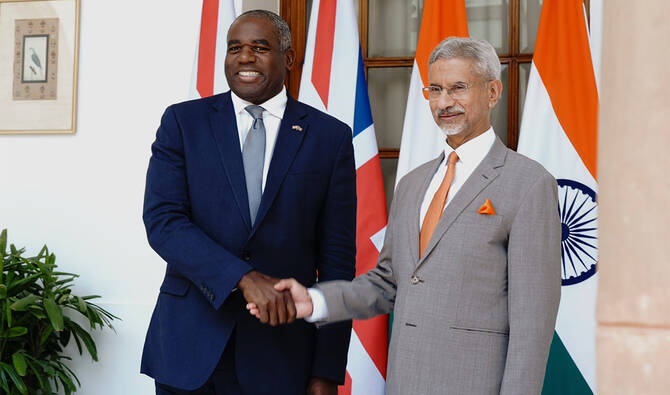
India’s External Affairs Minister S. Jaishankar (right) meets UK Foreign Secretary David Lammy in London, UK, on June 7, 2025. (MEA India)
Short Url
Updated 08 June 2025
Follow

Indian FM starts week-long EU trip in new cooperation push

  • Jaishankar will inaugurate the first edition of the Mediterranean Raisina Dialogue in Marseille
  • India and EU are negotiating a free trade deal, which is expected to be finalized this year

NEW DELHI: India’s External Affairs Minister S. Jaishankar has embarked on Sunday a week-long trip for talks with the top diplomats of the EU, France and Belgium in a new push for cooperation with Europe, his office said.

Jaishankar is set to meet his French counterpart, Jean-Noel Barrot, Belgian Deputy Prime Minister Maxime Prevot, and “will be holding a Strategic Dialogue with the EU High Representative and Vice President Ms. Kaja Kallas, and will engage with the senior leadership from the European Commission and the European Parliament,” the Ministry of External Affairs said in a statement.

“The visit of EAM is expected to further deepen India’s friendly relations with the European Union, France and Belgium and give renewed momentum to ongoing cooperation in diverse areas.”

The foreign minister will also inaugurate the first edition of the Mediterranean Raisina Dialogue in Marseille.

The Raisina Dialogue is a premier multilateral conference on geopolitics and geo-economics held annually in New Delhi and organized by the Observer Research Foundation in collaboration with the Ministry of External Affairs.

The dialogue in Marseille “is a new initiative involving both government and non-government officials from both from India and various parts of the world to converge and talk about issues pertaining to the Mediterranean,” Prof. Harsh V. Pant, vice president of the Observer Research Foundation, told Arab News.

During EU Commission President Ursula von der Leyen’s New Delhi visit in February, India and the EU committed to conclude negotiations on a comprehensive free trade agreement in December.

During last week’s talks in Paris, nearly half the agenda — covering areas like customs, trade facilitation, rules of origin, and intellectual property — has been agreed on.

“The partnership between India and France, and India and the EU continues to evolve dramatically,” Pant said, adding that Jaishankar’s trip is also about conveying “how India feels about the changing strategic realities, as well as what has happened with Pakistan.”

Last month, India and Pakistan engaged days-long cross-border fire. Indian forces launched a series of strikes across the Line of Control — the de facto border that separates the Indian-controlled and Pakistani-controlled parts of the disputed Kashmir territory. They also hit other sites on the Pakistani mainland, targeting what New Delhi claimed were militant positions.

Pakistan retaliated with strikes on Indian military targets before a US-brokered ceasefire took effect on May 10. According to the Pakistani military, its forces had downed six Indian warplanes, including several French aircraft Rafale and a Mirage 2000.

The escalation between the nuclear-armed neighbors took place as India blamed Pakistan for a deadly militant attack, in which 26 tourists were killed in Indian-administered Kashmir — Islamabad denied any involvement.


EU should consider forming combined military force: defense chief

Updated 4 sec ago
Follow

EU should consider forming combined military force: defense chief

  • Kubilius floated creating a “powerful, standing ‘European military force’ of 100,000 troops” that could eventually replace US forces
  • Trump has heightened fears among NATO allies over Washington’s reliability by insisting he wants to take over Greenland

BRUSSELS: EU countries should weigh whether to set up a combined military force that could eventually replace US troops in Europe, the bloc’s defense chief said Sunday.
EU defense commissioner Andrius Kubilius floated creating a “powerful, standing ‘European military force’ of 100,000 troops” as a possible option to better protect the continent.
“How will we replace the 100,000-strong American standing military force, which is the back-bone military force in Europe?” he asked in a speech in Sweden.
The suggestion comes as US President Donald Trump has heightened fears among NATO allies over Washington’s reliability by insisting he wants to take over Greenland.
Worries over Trump’s commitment to Europe have already spurred countries to step up efforts to bolster their militaries in the face of the threat posed by Russia.
Ideas about establishing a central European army have floated around for years but have largely failed to gain traction as nations are wary of relinquishing control over their militaries.
The US has pushed its European allies to increasingly take over responsibility for their own security, and raised the prospect it could shift forces from Europe to focus on China.
“In such times, we should not run away from the most pressing questions on our institutional defense readiness,” said Kubilius, a former Lithuanian prime minister.
In his speech Kubilius also advocated for the creation of a “European Security Council” of key powers — including potentially Britain — that could help the continent take decisions over its own defense quicker.
“The European Security Council could be composed of key permanent members, along with several rotational members,” he said.
“In total around 10-12 members, with the task to discuss the most important issues in defense.”
He said the first focus of such a body should be trying to change the dynamics in the war in Ukraine to ensure that Kyiv does not end up losing.
“We need to have a clear answer — how is the EU going to change that scenario?,” he said.
“This is the reason why we need to have a European Security Council now!“