

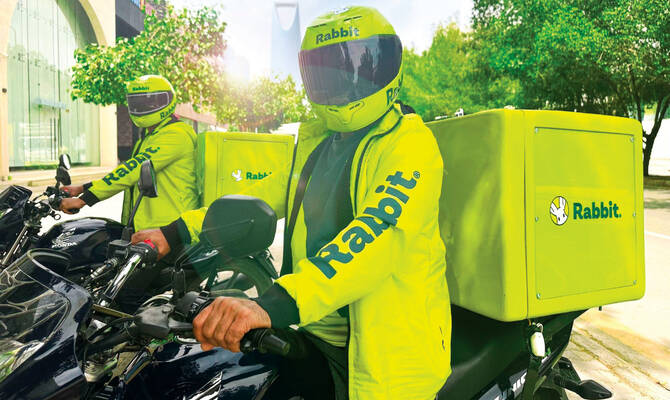

RIYADH: Early users of quick commerce company Rabbit in Riyadh are already showing promising signs of engagement, with weekly reorder rates comparable to those in the company’s more mature Egyptian market, Arab News has been told.
This strong early traction points to a positive product-market fit as the Cairo-based startup expands into Saudi Arabia.
Rabbit officially launched operations in the Kingdom in early 2024 and is aiming to replicate its hyper-growth strategy by tailoring its model to each city — starting with Riyadh.
“A more indicative, and exciting, insight is that we are seeing early users in Saudi Arabia already having a reorder rate of around one order a week,” said Ahmad Yousry, co-founder and CEO of Rabbit, in an interview with Arab News.
“This is in line with our much more established customer base in Egypt, which is a compelling sign for us,” he added.
Rabbit has already delivered more than 40 million items to 1.4 million users in Egypt, a market that has served as a foundational blueprint. However, the company is taking care not to simply copy and paste its strategies.
“Hence, we adopt a tailored approach, focused on building city-by-city and being highly nimble as a company, which has already proven key,” said Yousry.
Within six weeks of launching in Riyadh, Rabbit built a network of dark stores covering half of the city. Its goal is to expand across the remainder of the capital and into additional cities over the next 24 months. Dark stores — also known as micro-fulfillment centers or dark warehouses — are retail or distribution hubs designed exclusively to handle and process online shopping orders.
Known for its ultra-fast service, Rabbit is maintaining its performance standards in Saudi Arabia.
“Our goal is to deliver over 94 percent of our orders within the promised time frame,” Yousry said, referring to Rabbit’s 20-minute delivery commitment.
Rabbit aims to deliver 20 million items in Saudi Arabia by 2026, forecasting exponential — not linear — growth. While the company has not disclosed current delivery volumes or active user numbers in the Kingdom, Yousry emphasized the importance of retention over vanity metrics.
“We focus on methodically growing the number of households that depend on Rabbit on a weekly basis,” he said.

A more indicative, and exciting, insight is that we are seeing early users in Saudi Arabia already having a reorder rate of around one order a week.
Ahmad Yousry, co-founder and CEO of Rabbit
In Egypt, Rabbit recorded 2.5 times year-on-year growth in the first quarter of 2025, highlighting the scalability of its operational model.
Yousry cautioned against direct comparisons, saying: “The unit economics for both markets are quite different. We try not to base our growth strategy on comparative analytics, but rather on adapting the operational learnings from one market to another and building a sustainable business model around them.”
According to Yousry, increasing customer numbers and basket sizes are central to sustainable growth.
“There are two fundamental ways to grow the business in a sustainable and organic manner: acquire more customers and, or, increase the basket value per customer. We aim to focus on both of these elements,” he said.
A major element of Rabbit’s regional strategy is local sourcing. In Egypt, over 60 percent of products are sourced from local suppliers, and the company is pursuing a similar — or higher — ratio in Saudi Arabia.
“In Saudi Arabia, we are currently on track to have even more local brands on the platform,” Yousry said.
“Our partner-first focus, and our commitment to growing local brands and empowering local entrepreneurs, has significantly paid off in Egypt and we expect to see the same in Saudi Arabia.”
Beyond fulfillment, Rabbit is prioritizing customer experience, emphasizing both convenience and reliability.
“While speed is incredibly important, to be successful in the e-grocery market, you must also focus on the other key elements of the customer experience: convenience and reliability,” said Yousry.
“Our customers know they can count on us to deliver speed, convenience, and consistency.”
Technology, particularly artificial intelligence, plays a critical role in Rabbit’s operations. The company is applying AI to enhance inventory management, logistics, and user engagement.
“AI is a fundamental enabler of our operations and future growth in Saudi Arabia,” Yousry said.
FASTFACTS
• Within six weeks of launching in Riyadh, Rabbit built a network of dark stores covering half of the city. Its goal is to expand across the remainder of the capital and into additional cities over the next 24 months.
• Rabbit aims to deliver 20 million items in Saudi Arabia by 2026, forecasting exponential — not linear — growth.
• Rabbit has already delivered more than 40 million items to 1.4 million users in Egypt, a market that has served as a foundational blueprint.
“We are leveraging AI for sophisticated inventory management to predict demand accurately and minimize stockouts, ensuring product availability for our customers.”
Rabbit also uses machine learning to personalize the shopping experience within the app. “We are utilizing proprietary machine-learning solutions to provide tailored product recommendations and a more engaging shopping experience for our users in the Kingdom,” Yousry added.
The decision to launch regionally with Saudi Arabia was driven by the size and structure of its grocery sector.
“The food and grocery market is valued at $60 billion, yet the current online grocery transactions in Saudi Arabia are at a lower rate, sitting at 1.3 percent, than the likes of the UAE and the US,” said Yousry.
“Riyadh is transforming at lightning speed, providing us with the opportunity to meet the shift in customer behavior and demands.”
Understanding and adapting to local consumer behavior has been central to Rabbit’s entry into the market.
“Consumers in Saudi Arabia prioritize convenience, quality, and new technologies for a seamless shopping experience,” said Yousry.
He added that, unlike Egypt — where purchases tend to be daily and need-based — Saudi shopping habits are more occasion-driven.
“In Egypt, the pattern leans more toward daily or impulse-driven purchases, often tied to single packs for immediate needs or smaller households.”
Rabbit’s mission is closely aligned with Saudi Arabia’s Vision 2030, particularly in areas such as digital infrastructure development and support for small and medium enterprises.
“We are helping to accelerate the growth of the digital economy in a growing sector that is yet to reach its digitization potential,” said Yousry, adding: “We are building and leveraging state-of-the-art technology across our entire supply chain, aligning directly with the Kingdom’s vision for a diversified and digitally empowered future in two key sectors: logistics and retail.”
Supporting local entrepreneurs remains a central pillar of Rabbit’s regional operations.
“Our commitment to local sourcing and partnerships with SMEs provides a platform for these businesses to reach a wider customer base and scale their operations,” he said.
“We hire local and build locally. We pride ourselves on being a hyperlocal company. We are not bringing Rabbit to Saudi Arabia; we are instead building Rabbit Saudi Arabia by Saudi hands.”
Looking ahead, Rabbit sees Saudi Arabia not only as a key growth market but also as a launchpad for broader expansion.
“We are very excited for the future of Rabbit in the GCC region,” said Yousry.
“We are already profitable in our first market, Egypt, and we look forward to building on this as we expand,” he stated.
“We see Saudi Arabia as a champion market for the reasons already mentioned. We are focused on growing sustainably and expanding our footprint in the Kingdom, ultimately reaching profitability,” the CEO added.


