

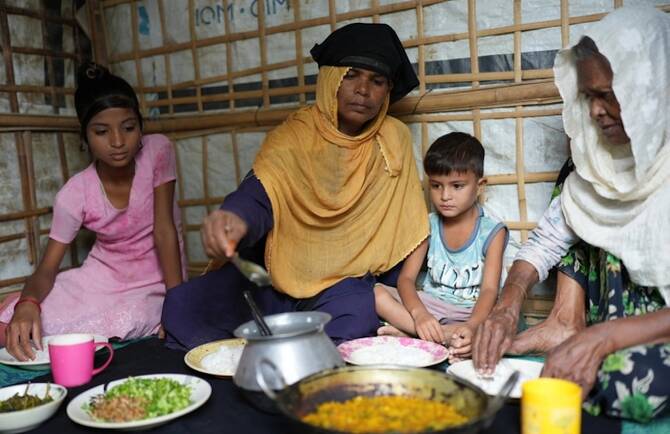

DHAKA: As she prepared for Eid Al-Adha celebrations on Saturday, Nikash Tara could not recall the last time she served a proper meal for her family.
In the cramped camps of Cox’s Bazar, a nutritious meal was a near-impossible treat available only during special occasions and solely dependent on charitable contributions.
Most days, Rohingya refugee mothers like Tara could only rely on food rations, which have been slashed in recent years due to insufficient funding.
“It was probably during Eid Al-Fitr when we last had a truly nutritious meal … We survive on the food rations, which are not enough now. Sometimes, I skip meals so that my children can eat,” Tara told Arab News.
“We get rice, lentils, and oil, but no vegetables, no milk. It’s hard to call it a ‘meal,’ let alone nutritious.”
Eid Al-Adha, known as the “Feast of Sacrifice” and one of the two most important holidays for Muslims, is the first time this year that the mother of three gets to serve meat for her family.
Eid Al-Adha commemorates the Prophet Ibrahim’s test of faith when he was commanded by God to sacrifice his son. To reflect his readiness to do so, Muslims around the world slaughter an animal, usually a goat, sheep or cow, and distribute the meat among relatives and the poor.
“On the occasion of Eid, we received a small portion of meat … I prepared a curry with potato and the meat I received. Although it’s not much in quantity, it made the children happy, as it is a chance to have a meal with beef for the first time this year,” Tara said.
“It hurts me as a mother. My heart breaks when my children get excited over a single good meal. It reminds me how little they get on normal days. Eid should be joyful, but I cry inside, knowing my children are being deprived every other day of the year. I feel helpless.”
Mizanur Rahman, refugee relief and repatriation commissioner in Cox’s Bazar, said this year the camps received 1,800 cattle and 350 goats for Eid sacrifice, donated by various Muslim and local nongovernmental organizations.
“In addition to that, different organizations and philanthropists promised to deliver 50,000 kg of fresh meat to be distributed on the day of Eid Al-Adha,” Rahman told Arab News.
The donations will help Bangladeshi authorities to “reach many of the Rohingya families … (and) offer them a feast on the occasion of Eid,” he added.
Bangladesh hosts about 1.3 million Rohingya Muslims, who, for decades, have fled neighboring Myanmar to escape persecution, especially during a military crackdown in 2017 that the UN has been referring to as a “textbook case” of ethnic cleansing.
The majority of them now live in Cox’s Bazar in eastern Bangladesh, which has become the world’s largest refugee settlement. Over the years, humanitarian conditions in the squalid camps have been deteriorating, with aid continuously declining since the COVID-19 pandemic. The Rohingya also have limited access to job opportunities and education.
With nobody able to earn a living, Mariam Khatun’s family was among those entirely dependent on food aid.
“With little food aid and in a life with no earning opportunity, for my children, a decent meal is something unimaginable,” Khatun told Arab News.
Though Eid was a joyful occasion, she said it was “painful that joy comes only once or twice a year.
“It breaks my heart when the children look at the meat and ask: ‘Will we eat this again tomorrow?’ I have no answer.”
Before fleeing her village in Myanmar, the 29-year-old mother of two used to prepare spicy beef curry, her children’s favorite, frying the meat until it was crispy.
“But here, I barely have them. We rely fully on the food rations, but the amount has been cut so much. It’s not enough for a full month,” she said.
“Maybe only on this Eid, we got a little meat. That’s the only time this year my children got something with some nutrition. We’re not living; we’re just trying not to starve.”


