WASHINGTON: The State Department is weighing giving $500 million to the new foundation providing aid to war-shattered Gaza, according to two knowledgeable sources and two former US officials, a move that would involve the US more deeply in a controversial aid effort that has been beset by violence and chaos.
The sources and former US officials, all of whom requested anonymity because of the sensitivity of the matter, said that money for Gaza Humanitarian Foundation (GHF) would come from the US Agency for International Development (USAID), which is being folded into the US State Department.
The plan has met resistance from some US officials concerned with the deadly shootings of Palestinians near aid distribution sites and the competence of the GHF, the two sources said.
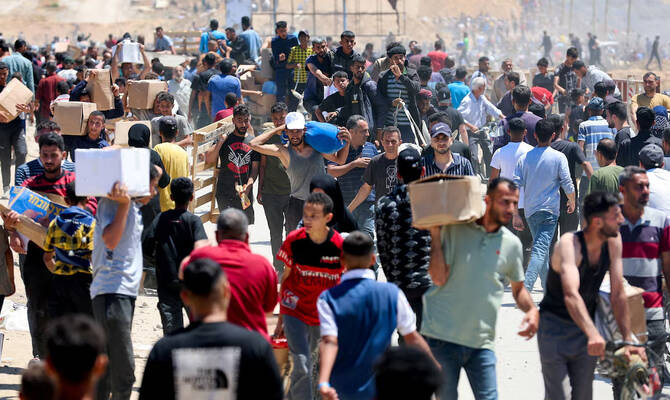
The GHF, which has been fiercely criticized by humanitarian organizations, including the United Nations, for an alleged lack of neutrality, began distributing aid last week amid warnings that most of Gaza’s 2.3 million population is at risk of famine after an 11-week Israeli aid blockade, which was lifted on May 19 when limited deliveries were allowed to resume.
The foundation has seen senior personnel quit and had to pause handouts twice this week after crowds overwhelmed its distribution hubs.
The State Department and GHF did not immediately respond to requests for comment.
Reuters has been unable to establish who is currently funding the GHF operations, which began in Gaza last week. The GHF uses private US security and logistics companies to transport aid into Gaza for distribution at so-called secure distribution sites.
On Thursday, Reuters reported that a Chicago-based private equity firm, McNally Capital, has an “economic interest” in the for-profit US contractor overseeing the logistics and security of GHF’s aid distribution hubs in the enclave.
While US President Donald Trump’s administration and Israel say they don’t finance the GHF operation, both have been pressing the United Nations and international aid groups to work with it.
The US and Israel argue that aid distributed by a long-established UN aid network was diverted to Hamas. Hamas has denied that.
USAID has been all but dismantled. Some 80 percent of its programs have been canceled and its staff face termination as part of President Donald Trump’s drive to align US foreign policy with his “America First” agenda.
One source with knowledge of the matter and one former senior official said the proposal to give the $500 million to GHF has been championed by acting deputy USAID Administrator Ken Jackson, who has helped oversee the agency’s dismemberment.
The source said that Israel requested the funds to underwrite GHF’s operations for 180 days.
The Israeli government did not immediately respond to a request for comment.
The two sources said that some US officials have concerns with the plan because of the overcrowding that has affected the aid distribution hubs run by GHF’s contractor, and violence nearby.
Those officials also want well-established non-governmental organizations experienced in running aid operations in Gaza and elsewhere to be involved in the operation if the State Department approves the funds for GHF, a position that Israel likely will oppose, the sources said.
Gaza hospital officials have said more than 80 people had been shot dead and hundreds wounded near GHF’s distribution points between June 1-3.
Since launching its operation, the GHF has opened three hubs, but over the past two days, only two of them have been functioning.
Witnesses blamed Israeli soldiers for the killings. The Israeli military said it fired warning shots on two days, while on Tuesday it said soldiers had fired at Palestinian “suspects” advancing toward their positions.


![]()

US mulls giving millions to controversial Gaza aid foundation, sources say
Short Url
https://arab.news/vtxyh
US mulls giving millions to controversial Gaza aid foundation, sources say
- The plan has met resistance from some US officials concerned with the deadly shootings of Palestinians near aid distribution sites and the competence of the GHF, the two sources said


Latest updates


Recommended


© 2026 SAUDI RESEARCH & PUBLISHING COMPANY, All Rights Reserved And subject to Terms of Use Agreement.