

The route to Makkah: Pilgrim’s journey from home to the holy city

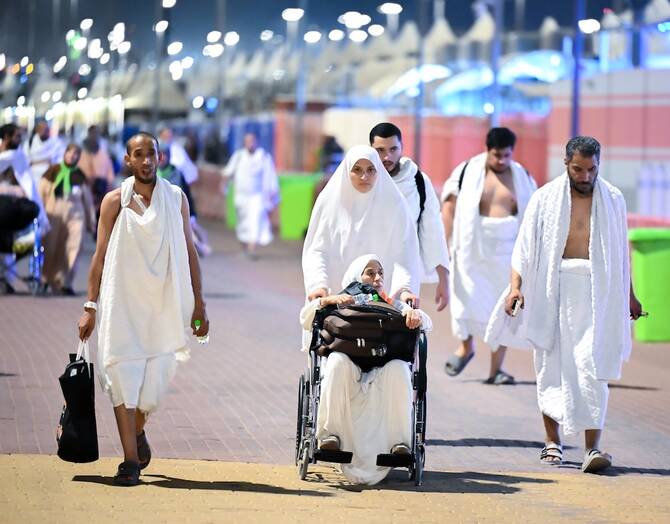
The route to the holy city begins with a deep, personal decision motivated by faith, hope for closeness to God. (AN photo/Basheer Saleh)
Short Url
Updated 06 June 2025
Follow

The route to Makkah: Pilgrim’s journey from home to the holy city

  • Hajj experience is pathway to lifelong transformation

RIYADH: Every year, millions of Muslims around the world take on a spiritual journey to perform the pilgrimage to Makkah. This religious obligation is only performed once in a lifetime for those who are able, and begins long before the pilgrim arrives in Makkah.

The route to the holy city begins with a deep, personal decision motivated by faith, hope for closeness to God, and the fulfilment of accomplishing one of the five pillars of Islam.

From the moment pilgrims form the intention to perform Hajj, a transformative process begins where they must secure their spot through Saudi officials in their countries.

Some countries request attending educational seminars before the Hajj to prepare them spiritually and physically for the trip.

“We have the administrative facilities that include Hajj registration, application, and all related administrative matters,” said Abdulrahman Mustafa Hamidh, a Syrian living in Turkyie, who is currently working as a religious guide for pilgrims.

“It’s simple. The process starts by applying through the Hajj offices located throughout the city, or by appointing someone for those who are far away in distance and unable to attend. They can appoint someone else, such as a brother, to do the registration process for them and pay a small registration fee,” he said.

Hamidh is currently studying for his PhD in religious studies and has been a frequent traveler to Makkah for Hajj since 2016.

After registration is completed, Hamidh explained the second step, which is the final part of the process. According to him, people take their passports to their guide or group leader to complete their registration applications for them.

“The entire process for pilgrims is very, very simple,” he said.

After this step, pilgrims wait for their applications to be accepted by Saudi officials and to receive their visa and the documents that they need for Hajj.

Once accepted, pilgrims receive the necessary tools such as Ihram, luggage, and all the belongings they will need for the journey.

“As for packing a travel bag, it’s also easy. Hajj pilgrims often receive large luggage from the organizing agency, which contains smaller bags and other Hajj supplies, such as Ihram, as well as Hajj garments for women,” Hamidh said.

When pilgrims complete the logistics, prepare their luggage and say their farewells to their families and loved ones, they leave their homes, carrying with them not only essential supplies but also hopes, prayers and hearts full of devotion.

However, while they arrive in Makkah and engage in this emotional and precious experience, others may face obstacles that hinder them from either completing the journey or arriving early.

One example is the journey of a pilgrim from Libya, Amir Qathafi, who was part of the last group of pilgrims from his country to depart for Makkah this year.

Unfortunately, before boarding, it took some time to go through security due to an issue with his passport. This resulted in the plane taking off, leaving him behind.

Surprisingly, a problem with the plane arose a few minutes after take-off, which required the pilot to return to the airport to solve the issue.

For a second time, Amir was refused permission to board the plane, and the flight took off again. Yet, miraculously, performing Hajj this year was destined for him, and the plane faced another technical issue a few minutes after the second departure.

This time, the pilgrim from Libya was allowed to board the plane to join the rest of his team on the route to Makkah.

Like Amir, millions of Muslims have genuine appreciation for this once-in-a-lifetime opportunity. The journey to Hajj is more than a physical experience. It is a deeply spiritual and emotional commitment that begins with intention and ends with lifelong transformation.


Threat to Kingdom’s security is ‘red line’ that will be ‘addressed and neutralized,’ Saudi envoy says

Updated 14 January 2026
Follow

Threat to Kingdom’s security is ‘red line’ that will be ‘addressed and neutralized,’ Saudi envoy says

  • Abdulaziz Alwasil tells UN Security Council the situation in southern Yemen is ‘a just cause with social and historic dimensions’ that can only be resolved through dialogue
  • Recent military activity in the south was unilateral, resulting in an escalation that harms the interests of Yemeni people and undermines efforts to address issues in the south, he said

NEW YORK CITY: Any attempt to threaten Saudi Arabia’s national security is a “red line” and will be met with decisive action, the Kingdom’s ambassador to the UN told the Security Council on Wednesday.

Speaking during a meeting of the council to discuss Yemen, Abdulaziz Alwasil said the situation in the south of the country is “a just cause with social and historic dimensions” that can only be resolved through dialogue.

“We stress that any attempt to threaten our national security is a red line, and we will not hesitate to take the necessary actions and steps to address it and neutralize it,” he added.

Alwasil reaffirmed Saudi Arabia’s support for Yemeni President Rashad Al-Alimi, the Presidential Leadership Council, and the Yemeni government in their efforts to achieve security, stability, development and peace while preserving national unity.

He said military activity by Southern Transitional Council forces in Hadramout and Al-Mahra on Dec. 2, 2025, was unilateral, did not have the approval of the Presidential Leadership Council, and was not carried out in coordination with the Coalition to Restore Legitimacy in Yemen.

It had resulted in an unjustified escalation that harmed the interests of the Yemeni people, undermined efforts to address the issues in the south, and ran counter to the coalition’s objectives, Alwasil added.

The Kingdom, working with its coalition partners, the Presidential Leadership Council and the Yemeni government, had moved to contain the situation by dispatching a military force to coordinate arrangements with the Southern Transitional Council in Aden, he said.

The aim was to ensure the return of the southern council’s forces to their previous positions outside of Hadramout and Al-Mahra, and the handover of camps to legitimate government forces and local authorities in line with agreed procedures, Alwasil added.

He expressed regret over the military operations that took place in Hadramout and Al-Mahra, close to Saudi Arabia’s southern border, which he said posed a direct threat to the Kingdom’s national security, as well as the security of Yemen and regional stability. Such steps were extremely dangerous, he added, and contradicted the principles on which the Coalition to Restore Legitimacy in Yemen had been founded.

Alwasil welcomed a prisoner and detainee exchange agreement signed in Muscat on Dec. 23, which he described as an important humanitarian measure to alleviate suffering and build confidence.

He praised Oman for hosting and sponsoring the consultations and supporting negotiations, and commended the efforts of UN’s special envoy for Yemen, Hans Grundberg, the International Committee of the Red Cross and all others that has played a part.

Regarding the political efforts to resolve the crisis, Alwasil said Saudi Arabia welcomed President Al-Alimi’s call for an inclusive conference in Riyadh to bring together all stakeholders to discuss just solutions to the situation in southern Yemen.

Preparations for the conference have begun, he added, in cooperation with the Yemeni government and southern representatives, reflecting the close ties between the two countries and their shared interests in stabilizing Yemen.

He urged all southern stakeholders to participate actively and constructively in the talks, to help find comprehensive and just solutions that meet the legitimate aspirations of the people of southern Yemen.

Alwasil called on all Yemeni forces and stakeholders to cooperate and intensify their efforts to reach a lasting political settlement that would ensure security and stability.

He described the southern issue as “a just cause with social and historic dimensions,” adding that “the only way to address it is through dialogue that leads to a comprehensive political solution” based on nationally and internationally agreed terms of reference.