

Pakistani PM to meet Saudi Crown Prince today to bolster bilateral ties, discuss regional security

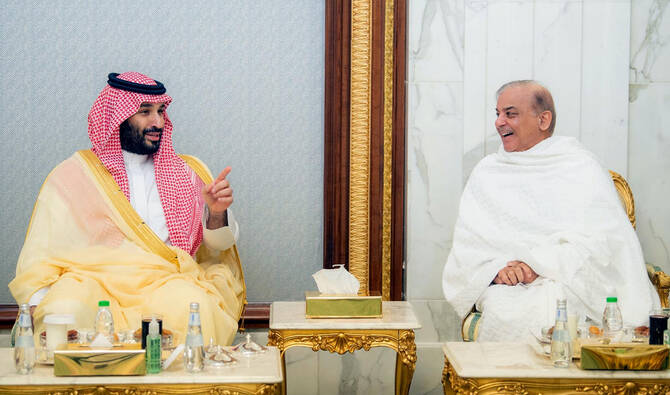
Saudi Crown Prince Mohammed bin Salman meets Pakistan's Prime Minister Shehbaz Sharif (right) in his palace on the eve of 29th Ramadan, during the holy month of Ramadan, in the holy city of Makkah, Saudi Arabia, on April 7, 2024. (Saudi Press Agency/File)
Short Url
Updated 06 June 2025
Follow

Pakistani PM to meet Saudi Crown Prince today to bolster bilateral ties, discuss regional security

  • During his stay on June 5 and 6, Sharif will celebrate Eid Al-Adha, hold bilateral meeting with Crown Prince Mohammed bin Salman
  • Discussions are expected to focus on enhancing cooperation in trade, investment and regional security, welfare of Muslim Ummah

ISLAMABAD: Pakistani Prime Minister Shehbaz Sharif is on a two-day visit to Saudi Arabia this week where he will meet Crown Prince Mohammed bin Salman today, Friday, and discuss trade and investment as well as regional security matters. 

The Pakistani prime minister will celebrate Eid Al-Adha in the Kingdom and hold a bilateral meeting with the Saudi Crown Prince that is expected to focus on enhancing cooperation in trade, investment and regional security.

Sharif reached Jeddah on Thursday evening and departed for Makkah to perform Umrah, the Prime Minister’s Office (PMO) said.

“The two leaders will discuss ways to further strengthen bilateral cooperation in various fields, including trade and investment, welfare of the Muslim Ummah, and regional peace and security,” PMO said about Sharif’s meeting with the Saudi Crown Prince later today, Friday. 

Sharif is also expected to express gratitude to the Saudi leadership for their role in de-escalating recent tensions between Pakistan and India. 

Last month, following the worst military confrontation between India and Pakistan in decades, Saudi Arabia, along with other Gulf nations, played a key role in mediating between the two nuclear-armed neighbors, helping to avert a potential war. 

The visit also comes amid deepening economic ties between Pakistan and Saudi Arabia. In recent months, the two countries have signed multiple agreements aimed at boosting bilateral trade and investment. Notably, Saudi Arabia has committed to a $5 billion investment package to support Pakistan’s economy, which has been grappling with a balance of payments crisis.

Last year, Saudi and Pakistani businessmen signed 34 memorandums of understanding worth $2.8 billion, covering sectors such as industry, technology, and agriculture. Additionally, Saudi Arabia’s Manara Minerals is in talks to acquire a 10-20 percent stake in Pakistan’s $9 billion Reko Diq copper and gold mining project, one of the largest of its kind globally.

Defense cooperation is also a key component of the bilateral relationship. The two nations have a history of military collaboration, with Saudi Arabia providing support to Pakistan during times of regional tension and Pakistan training Saudi forces. 

Pakistan has a 2.7 million-strong diaspora in Saudi Arabia, which accounts for the highest remittance inflow, a crucial lifeline for the country’s economy.


Pakistan depart for T20 World Cup while waiting for ICC reaction to India game boycott

Updated 02 February 2026
Follow

Pakistan depart for T20 World Cup while waiting for ICC reaction to India game boycott

  • Pakistan shook cricketing world when their government approved participation in World Cup, but asked team to boycott India match on Feb. 15
  • The ICC has said Pakistan’s ‘position of selective participation is difficult to reconcile with the fundamental premises of a global sporting event’

ISLAMABAD: Pakistan departed for the T20 World Cup in Sri Lanka on Monday and awaited any sanction from the International Cricket Council for refusing to play India in the tournament.

In video footage released by the Pakistan Cricket Board, the cricketers were dressed in their new World Cup kit as they boarded a bus from a hotel to the airport in Lahore.

India is co-hosting the World Cup but Pakistan will play all of its games in Sri Lanka — including any in the knockout stage — because of political tensions with India.

Pakistan shook the cricketing world when its government instructed the team on Sunday to compete in the World Cup but boycott the group game against India in Colombo on Feb. 15. The government did not give a reason on its X account.

The PCB has reportedly not given official notice to the ICC.

The ICC warned Pakistan there will be consequences.

The ICC said “the position of selective participation is difficult to reconcile with the fundamental premises of a global sporting event.” The ICC added Pakistan’s decision was “not in the interest of the global game or the welfare of fans worldwide, including millions in Pakistan.”

Pakistan and India have fought four wars and frequently clash on their border, so their cricket matchups often attract the highest audience and are therefore a significant source of income for broadcasters, sponsors, and the ICC.

They are regularly grouped at ICC tournaments because they have not played a bilateral cricket series for 14 years.

The T20 World Cup starts on Saturday when Pakistan is scheduled to open against the Netherlands.

Pakistan will play a final warmup game against Ireland on Wednesday in Colombo.

After Pakistan wrapped up a 3-0 Twenty20 series win over Australia on Sunday in Lahore, Pakistan captain Salman Ali Agha said he will follow the government’s instructions.

“It’s not our decision (to boycott the India game), we can’t do anything about it,” Agha said. “We will do whatever our government and the (PCB) chairman say.”

PCB chairman Mohsin Naqvi has criticized the ICC for “double standards” by refusing to shift Bangladesh’s games to Sri Lanka after the Bangladesh government didn’t allow its team to travel to India due to security concerns. The ICC axed Bangladesh and replaced it with Scotland for the tournament.

The strained political relations between India and Pakistan spilled onto the cricket field last year when India players refused to shake hands with Pakistan players during three Asia Cup games, including the final, in the United Arab Emirates. Later, India left without the trophy after it refused to accept it from Naqvi, who is the president of the Asian Cricket Council.