


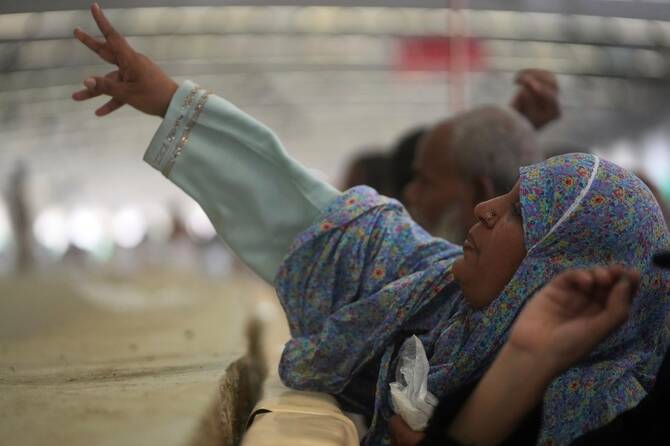


MINA, Saudi Arabia: Pilgrims were performing the last major ritual of the Hajj — the “stoning of the devil” — on Friday, as Muslims around the globe celebrated the beginning of the Eid Al-Adha holiday.
From before day break, the 1.6 million-plus pilgrims began throwing seven stones at each of three concrete walls symbolising the devil in the Mina valley, on the outskirts of the holy city of Makkah.
#فيديو_واس | مشعر منى يستقبل حجاج بيت الله الحرام لرمي جمرة العقبة.#واس_حج46 | #واس_عام pic.twitter.com/LwZh1pRrmi
— واس العام (@SPAregions) June 6, 2025
Droves of pilgrims had already set out from their accommodation in the sprawling tent city in Mina before dawn, taking advantage of the cool temperatures.
The ritual commemorates Abraham’s stoning of the devil at the three spots where it is said Satan tried to dissuade him from obeying God’s order to sacrifice his son.
***
GALLERY: Hajj Pilgrimage 2025: Muslims ‘stone the devil’
***
“Our experience in Mina was easy and simple. We entered and within five minutes we had completed the stoning of the devil at the ‘Jamarat’,” said 34-year-old Wael Ahmed Abdel Kader, from Egypt, after carrying out the ritual at dawn.
Howakita, a pilgrim from Guinea, said the prospect of celebrating Eid in Makkah filled her with joy.
“When I threw the stones I felt at ease. I was truly proud,” she said.
A day earlier, pilgrims converged on Mount Arafat, praying and reciting Qur’anic verses at the 70-meter (230-foot) rocky rise near Makkah, where the Prophet Muhammad is believed to have given his last sermon.
Many climbed the mount despite the searing heat, though numbers had thinned by midday following official warnings for pilgrims to stay inside between 10 a.m. and 4 p.m..
#فيديو_واس | مشاهد لحجاج بيت الله الحرام وهم يرمون جمرة العقبة.#واس_حج46 | #واس_عام pic.twitter.com/QaEAjRr2G4
— واس العام (@SPAregions) June 6, 2025
This year’s Hajj saw authorities implementing a range of heat mitigation efforts alongside a wide-ranging crackdown on illicit pilgrims — resulting in noticeably thinner crowds and a heavy security presence at holy sites in Makkah and surrounding areas.
The measures were aimed at preventing a repeat of last year’s Hajj that saw 1,301 people die in temperatures that hit 51.8 degrees Celsius (125 degrees Fahrenheit).
Saudi authorities said a majority of those deaths were among pilgrims who slipped into Makkah illegally and lacked access to accommodation and other services aimed to keep pilgrims safe and protected from the searing desert heat.
This Hajj season has recorded the lowest number of pilgrims in over three decades, barring the years of Covid restrictions from 2020-2022.
Last year, 1.8 million Muslims took part in the Hajj, according to official figures.
Hajj permits are allocated to countries on a quota basis and distributed to individuals by a lottery system.
But even for those who can secure them, the high costs spur many to attempt the Hajj without a permit, even though they risk arrest and deportation if caught.
The stoning ritual in the Mina valley was the scene of a fatal stampede in 2015, when 2,300 people were killed in one of the deadliest Hajj disasters.
Saudi Arabia earns billions of dollars a year from the Hajj, and the lesser pilgrimage known as umrah, undertaken at other times of the year.
The pilgrimages are also a source of prestige for the Saudi monarch, who is known as the Custodian of the Two Holy Mosques of Makkah and Medina.
The end of the Hajj coincides with the beginning of Eid Al-Adha — an annual feasting holiday marked by the slaughter of an animal — typically a goat, sheep, cow, bull or camel.


