

Residents of south Beirut suburbs flee Israeli warnings, strikes on Hezbollah factories

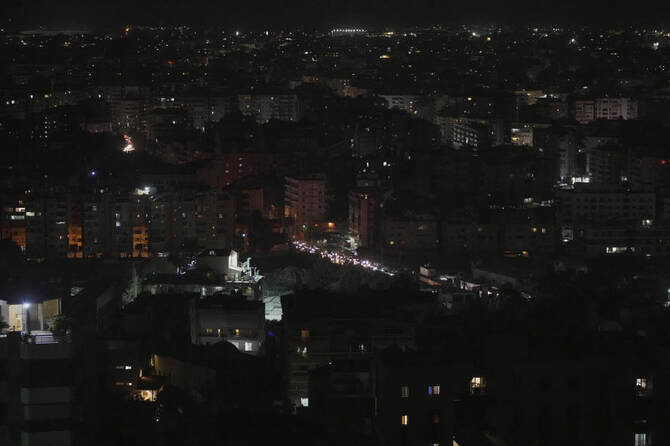
Residents evacuate after Israeli warnings of an impending attack on Dahiyeh, a southern suburb of Beirut, Lebanon, Thursday, June 5, 2025. (AP)
Short Url
Updated 06 June 2025
Follow

Residents of south Beirut suburbs flee Israeli warnings, strikes on Hezbollah factories

  • November ceasefire sought to end the fighting — which left Hezbollah severely weakened
  • Under the truce, Hezbollah fighters were to withdraw north of the Litani river

BEIRUT: Huge numbers of people fled Beirut’s southern suburbs on Thursday after the Israeli military issued an evacuation warning and said it was striking underground drone factories belonging to Hezbollah.

The streets around the area were seen jammed with traffic as residents tried to leave, with Lebanese media reporting Israeli warning strikes.

“You are located near facilities belonging to the terrorist organization Hezbollah,” said the warning from the Israeli army’s Arabic-language spokesman, Avichay Adraee.

“For your safety and the safety of your families, you are required to evacuate these buildings immediately and move away from them at a distance of no less than 300 meters.”

In a separate statement, the army said it would “soon carry out a strike on underground UAV (drone) production infrastructure sites that were deliberately established in the heart of (the) civilian population” in Beirut.

Israel and the Iranian-backed Hezbollah engaged in more than a year of hostilities that began with the outbreak of the Gaza war and culminated in an intense Israeli bombing campaign and ground incursion into southern Lebanon.

A November ceasefire sought to end the fighting — which left Hezbollah severely weakened — but Israel has continued to regularly carry out strikes in Lebanon’s south.

Strikes targeting Beirut’s southern suburbs, considered a Hezbollah stronghold, have been rare, however.

“Following Hezbollah’s extensive use of UAVs as a central component of its terrorist attacks on the state of Israel, the terrorist organization is operating to increase production of UAVs for the next war,” the army statement said, calling the activities “a blatant violation of the understandings between Israel and Lebanon.”

Under the truce, Hezbollah fighters were to withdraw north of the Litani river, about 30 kilometers from the border, and dismantle their military posts to the south.

Israel was to pull all its troops from Lebanon, but it has kept them in five positions it deems “strategic” along the frontier.

The Lebanese army has been deploying in the south and removing Hezbollah infrastructure there, with Prime Minister Nawaf Salam saying Thursday that it had dismantled “more than 500 military positions and arms depots” in the area.


Lebanon approves release of former minister accused of corruption

Updated 16 December 2025
Follow

Lebanon approves release of former minister accused of corruption

  • Salam is the only ex-minister to be arrested since the start of Lebanon’s economic crisis in 2019
  • The official added that the bail was paid, with procedures ongoing to secure his release from prison

BEIRUT: Lebanon’s judiciary approved the release on bail of former economy minister Amin Salam on Tuesday after six months of detention over corruption linked to contracts deemed suspicious, a judicial official said.
Salam, who served in the cabinet of former prime minister Najib Mikati from 2021 to 2025, is the only ex-minister to be arrested since the start of Lebanon’s economic crisis in 2019.
The official, who requested anonymity, told AFP Lebanon’s judiciary “agreed to release former economy minister Amin Salam on bail of nine billion Lebanese pounds, equivalent to $100,000” and a travel ban.
The official added that the bail was paid, with procedures ongoing to secure his release from prison.
In June, another judicial official said Salam had been arrested in connection with alleged “falsification, embezzlement and suspicious contracts.”
Salam’s adviser Fadi Tamim was sentenced in 2023 to one year in prison for blackmail and personal enrichment at the expense of insurance companies.
The former minister’s brother Karim Salam was also arrested earlier this year in a “case of illicit enrichment, forgery and extortion of insurance companies,” committed “under cover of the minister himself,” the official said in June.
Many in Lebanon attribute the economic crisis to mismanagement and corruption that has plagued state institutions for decades.
President Joseph Aoun and Prime Minister Nawaf Salam, who both took office this year, have vowed to make the fight against endemic corruption a priority, as part of the reforms demanded by international donors.
Both have vowed to uphold the independence of the judiciary and prevent interference in its work, in a country plagued by official impunity.
In September, former central bank governor Riad Salameh, who faces numerous accusations including embezzlement, money laundering and tax evasion, was released after being detained for over a year by paying a record bail of more than $14 million.