

Afghan women UN staff forced to work from home after threats

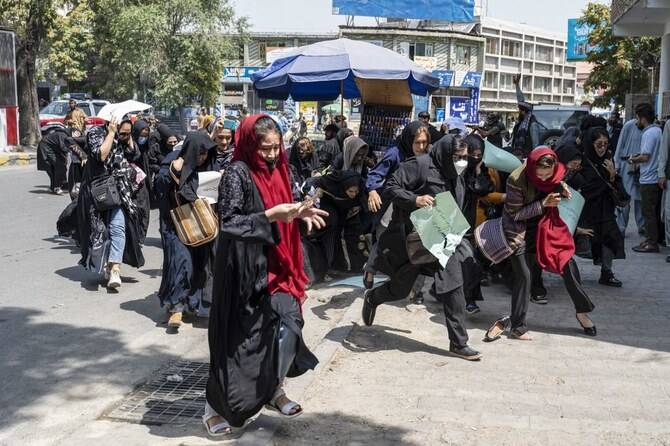
Afghan women working for the United Nations in Kabul have been threatened by unidentified men because of their jobs, the organisation and several women told AFP on Thursday. (AFP/File)
Short Url
Updated 05 June 2025
Follow

Afghan women UN staff forced to work from home after threats

  • UNAMA confirmed that UN staff had been threatened
  • “Several United Nations female national staff members in the Afghan capital Kabul have been subjected to threats,” it said

KABUL: Afghan women working for the United Nations in Kabul have been threatened by unidentified men because of their jobs, the organization and several women told AFP on Thursday.

Multiple women working for various UN agencies told AFP on condition of anonymity they had been threatened on the street and over the phone by men warning them to “stay home.”

UN staffer Huda — not her real name — said that for weeks she has been bombarded with messages abusing her for “working with foreigners.”

“The messages keep coming and they are always harassing us... saying, ‘Don’t let me see you again, or else’,” the young woman told AFP.

She said her office had advised her to work from home until further notice.

The United Nations Assistance Mission in Afghanistan (UNAMA) confirmed that UN staff had been threatened.

“Several United Nations female national staff members in the Afghan capital Kabul have been subjected to threats by unidentified individuals related to their work with the UN,” it said in a statement.

Considering the threats “extremely serious,” the UN has taken “interim” measures “to ensure the safety and security of staff members,” it added.

The Taliban government, accused by the UN of imposing a “gender apartheid” against women since returning to power in 2021, has denied any involvement.

Interior ministry spokesman Abdul Mateen Qani said such threats were a “crime” and that police would take action.

UNAMA said the authorities had opened an investigation.

Since seizing power in 2021, the Taliban authorities have severely restricted Afghan women from working and it is the only country in the world where women are banned from education beyond primary school.

The government in 2022 banned women from working for domestic and international NGOs, which was extended to include the UN’s offices in the country the following year.

The policy has some exceptions including for women working in health care and education, and has not been consistently enforced.

The UN has previously called the policy “deeply discriminatory.”

Selsela, in her 30s, said while returning from the office last week she was approached by unknown men who told her she should be “ashamed” and that she must “stay home.”

“They said, ‘We told you nicely this time, but next time you’ll have another thing coming’,” she told AFP.

“I was very scared,” she said, explaining how she struggles to work efficiently from home in a country where electricity and Internet are unreliable.

“The situation for women is getting worse every day.”

Another woman, Rahila, said she and two other women colleagues were stopped by men while traveling home in a UN vehicle and told not to go to the office anymore.

“They said, ‘Don’t you know that you are not allowed?’,” Rahila said, adding that she has also received threatening messages from unknown numbers.

“I am very worried, I need my job and my salary,” she said.

Three-quarters of Afghanistan’s population of some 45 million people struggle to meet their daily needs, according to the UN, with the country facing one of the world’s worst humanitarian crises.


African Union rejects ‘any recognition of Somaliland’ after Israel declaration

A man holds a flag of Somaliland in front of the Hargeisa War Memorial monument in Hargeisa on November 7, 2024. (AFP)
Updated 27 December 2025
Follow

African Union rejects ‘any recognition of Somaliland’ after Israel declaration

  • Egypt’s foreign ministry said its top diplomat had spoken with his counterparts from Turkiye, Somalia and Djibouti, who together condemned the move and emphasized “their full support for the unity, sovereignty and territorial integrity of Somalia”
  • Israel repeatedly hit targets in Yemen after the Gaza war broke out in October 2023, in response to Houthi attacks on Israel that the rebels said were in solidarity with Palestinians in the Gaza Strip

NAIROBI: The African Union on Friday said it “rejects any recognition of Somaliland” after Israel declared it viewed the breakaway Somali territory as a sovereign state.
In a statement issued by its head, Mahamoud Ali Youssouf, the AU called for African borders to be respected and said: “Any attempt to undermine the unity, sovereignty, and territorial integrity of Somalia... risks setting a dangerous precedent with far-reaching implications for peace and stability across the continent.”
The chief of the pan-African body, which counts Somalia as a member, said he “firmly rejects any initiative or action aimed at recognizing Somaliland as an independent entity” and stating that Somaliland “remains an integral part of the Federal Republic of Somalia.”

While, Somalia reacted angrily on Friday after Israel formally recognized its northern region of Somaliland as an “independent and sovereign state” — the first country to do so.
Somaliland, which declared independence from Somalia in 1991, has for decades pushed for international recognition, which has been the key priority for president Abdirahman Mohamed Abdullahi since he took office last year.
But a Somali foreign ministry statement warned that the decision was “deliberate attack” on its sovereignty that would undermine peace in the region. Several other countries also condemned Israel’s decision.
Israeli Prime Minister Benjamin Netanyahu’s office said he announced “the official recognition of the Republic of Somaliland as an independent and sovereign state,” making Israel the first country to do so.
“The declaration is in the spirit of the Abraham Accords,” Netanyahu’s office said, referring to several agreements between Israel and Arab countries brokered by US President Donald Trump during his first presidency to normalize ties with Israel.
It said Netanyahu had invited Abdullahi to visit.
Hailing Israel’s decision, Abdullahi said in a post on X that it marked the beginning of a “strategic partnership.”
“This is a historic moment as we warmly welcome” he said, affirming “Somaliland’s readiness to join the Abraham Accords,” he added.
In Hargeisa, the capital of Somaliland, crowds of people took to the streets to celebrate, many carrying the flag of the breakaway state, said sources.

- ‘Illegitimate actions’ -

Somalia’s foreign ministry said: “Illegitimate actions of this nature seriously undermine regional peace and stability, exacerbate political and security tensions, in the Horn of Africa, the Red Sea and Gulf of Aden, the Middle East and the wider region.”
Turkiye, a close ally of Somalia, also condemned the move.
“This initiative by Israel, which aligns with its expansionist policy... constitutes overt interference in Somalia’s domestic affairs,” it said in a foreign ministry statement.
Egypt’s foreign ministry said its top diplomat had spoken with his counterparts from Turkiye, Somalia and Djibouti, who together condemned the move and emphasized “their full support for the unity, sovereignty and territorial integrity of Somalia.”
In video showing Netanyahu speaking to Abdullahi by telephone, the Israeli leader said: “I want you to know that I am signing now as we speak Israel’s official recognition of the Somaliland,” adding that the new relationship would offer economic opportunities.
“I am very, very happy and I am very proud of this day and I want to wish you and the people of Somaliland the very, very best,” he said.
Netanyahu also said that he would communicate to Trump Abdullahi’s “willingness and desire to join the Abraham accords.”
A self-proclaimed republic, Somaliland enjoys a strategic position on the Gulf of Aden, has its own money, passports and army. But since its unilateral declaration of independence in 1991, it has grappled with decades of isolation.

- Strategic -

Analysts say matters of strategy were behind Israel’s drive to recognize Somaliland.
“Israel requires allies in the Red Sea region for many strategic reasons, among them the possibility of a future campaign against the Houthis,” said the Institute for National Security Studies in a paper last month, referring to Yemen’s Iran-backed rebels.
“Somaliland is an ideal candidate for such cooperation as it could offer Israel potential access to an operational area close to the conflict zone,” it said, adding there were also economic motives.
Israel repeatedly hit targets in Yemen after the Gaza war broke out in October 2023, in response to Houthi attacks on Israel that the rebels said were in solidarity with Palestinians in the Gaza Strip.
The Houthis have halted their attacks since a fragile truce began in Gaza in October.
Somaliland’s lack of international recognition has hampered access to foreign loans, aid and investment, and the territory remains deeply impoverished.
A deal between landlocked Ethiopia and Somaliland last year to lease a stretch of coastline for a port and military base enraged Somalia.
Israel has been trying to bolster relations with countries in the Middle East and Africa.
Historic agreements struck late in Trump’s first term in 2020 saw several countries including Muslim-majority United Arab Emirates and Morocco normalize relations with Israel, but wars that have stoked Arab anger, particularly in Gaza, have hampered recent efforts.