

Guardians of the sacred: SRCA and university volunteers unite to shield pilgrims

1 / 3
Beneath Makkah’s unrelenting sun, the Saudi Red Crescent Authority, or SRCA, and university volunteers have engineered a sanctuary of safety for Hajj 2025. (AN Photo/Abdulrahman Shalhoub)
2 / 3
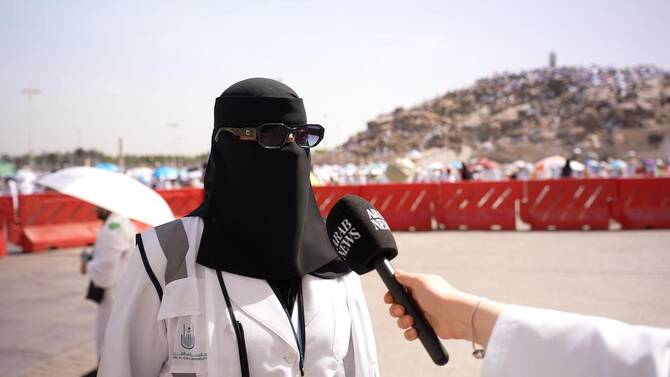
Rawabi Omar Al-Arabi, a fifth-year Umm Al-Qura University medical student leading the Systematic Hajj Program. (AN Photo/Abdulrahman Shalhoub)
3 / 3
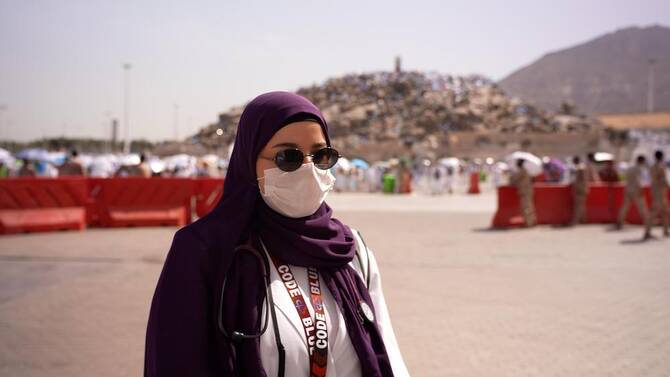
Jannah Halawani, a second-year medical student at Umm Al-Qura University heading the Media Committee. (AN Photo/Abdulrahman Shalhoub)
Short Url
Updated 05 June 2025
Follow

Guardians of the sacred: SRCA and university volunteers unite to shield pilgrims

  • The SRCA’s logistical symphony spans 578 ambulances, nine helicopter surveillance teams and 80 rapid-response vehicles

ARAFAT: Beneath Makkah’s unrelenting sun, the Saudi Red Crescent Authority, or SRCA, and university volunteers have engineered a sanctuary of safety for Hajj 2025.

From SRCA’s 7,517 paramedics to Umm Al-Qura University’s medical students, this human tapestry works in lockstep across Islam’s holiest sites.

The SRCA’s logistical symphony spans 578 ambulances, nine helicopter surveillance teams and 80 rapid-response vehicles threading through human currents.

Mobility support includes 500 electric scooters and 205 golf carts pre-positioned at ritual grounds, while 633 logistics specialists orchestrate medical supply chains.

Fourteen emergency clinics and 32 first-aid stations anchor operations, with nine ambulance buses drilled for mass casualties.

Volunteers confront predictable yet constant health threats. Kholood Abdulwasea, an SRCA volunteer who traveled from Madinah to serve in Makkah, reported: “The cases we face, mostly they were having heat exhaustion. Some of them had hypoglycemia.” She credited mitigation efforts: “It wasn’t much because of the water sprays and the efforts put into providing water.”

Medical students corroborated this clinical landscape. Rawabi Omar Al-Arabi, a fifth-year Umm Al-Qura University medical student leading the Systematic Hajj Program, cited heatstroke, dehydration and hypoglycemia as predominant issues.

Jannah Halawani, a second-year peer heading the Media Committee, expanded the list, as she told Arab News: “Heatstroke, low blood sugar, low blood pressure, plus fractures or wounds needing stitches.”

Coordinating 10,000 caregivers across shifting pilgrim tides presented particular hurdles. Al-Arabi highlighted accommodation logistics as her team’s steepest challenge: “Coordinating large volunteer groups across field hospitals while ensuring 24/7 oversight. That’s the toughest part.”

Transportation emerged as another pressure point. Halawani emphasized the complexity of reaching ritual sites such as Arafat and Mina, calling it a “massive time and coordination” effort.

Beyond statistics, the human spirit defined the mission. Abdulwasea called her contribution an enduring honor: “It was a good day and I’m honored to be part of this noble mission.”

For university volunteers, the experience resonated deeper. Al-Arabi described serving pilgrims as “life-changing,” stressing that sacrificing seven days with family was “worth every second” for the privilege of honoring Allah’s guests.

Halawani captured the sentiment: “An indescribable privilege. Being chosen by Allah to serve Hajj pilgrims honors both the location and the moment. If you get this chance? Grab it. It’s truly unmissable.”


National program identifies 165 native plants for afforestation efforts in Asir

Updated 29 December 2025
Follow

National program identifies 165 native plants for afforestation efforts in Asir

  • The survey is part of broader plans focused on restoring degraded land, using native vegetation 

JEDDAH: Saudi Arabia’s National Afforestation Program has identified more than 165 species of native plants suitable for afforestation in the Asir region, highlighting the ecological diversity of one of the Kingdom’s most environmentally varied areas, the Saudi Press Agency reported.

The findings form part of broader national efforts to expand vegetation cover, address land degradation, and support sustainability goals linked to the Saudi Green Initiative and Vision 2030.

According to the program, the identified species are distributed across a wide range of natural environments in Asir, including mountainous terrain, highlands, slopes, valleys, plains, rocky landscapes, and coastal areas stretching from the Red Sea to Tihama.

The species belong to numerous plant families, including Fabaceae, Anacardiaceae, Burseraceae, Capparaceae, Ebenaceae, Euphorbiaceae, Malvaceae, Myrtaceae, Oleaceae, and Primulaceae, among others.

Plants suitable for afforestation range from large and small trees to perennial and annual shrubs, herbs, succulents, bulbs, and climbing plants. 

Among the most notable species identified are the grey mangrove, mastic tree, mooring or ben tree, juniper, sycamore fig, wild olive, henna, wild jasmine, hawthorn, and arak.

The Saudi Arabian Botanical Society described the announcement as an important step in protecting plant diversity and strengthening the ecosystem conservation in the Kingdom. 

Munirah bin Hamad Al-Hazani, founder and president of the society, said that prioritizing native species is central to sustainable afforestation.

“Focusing on the cultivation of native plants adapted to diverse environments forms the cornerstone of sustainable afforestation projects, as it plays a pivotal role in enhancing vegetation cover, combating land degradation, and conserving natural and financial resources,” she told Arab News.

Al-Hazani added that long-term success depends on cooperation between government bodies and the nonprofit sector, alongside community involvement and environmental awareness programs.

The National Afforestation Program has increasingly emphasized community participation, working with government agencies, private companies, and nonprofit organizations to support planting initiatives and environmental education. Its approach includes promoting volunteerism and discouraging harmful environmental practices, while focusing on the use of native plants adapted to local conditions.

Parallel efforts are underway in other regions of the Kingdom to support vegetation restoration through research and infrastructure development. In Jouf, often referred to as the Kingdom’s food basket, the King Salman bin Abdulaziz Royal Reserve Development Authority has established a Central Nursery and a Wild Seeds Research and Production Station to address the growing demand for reliable sources of native seeds and seedlings.

The project was launched in 2023 under the directive of Prince Abdulaziz bin Saud bin Naif, the minister of interior and chairman of the authority’s board of directors. 

Since then, the facilities has become a key component of vegetation restoration efforts within the reserve.

The authority has focused on building operational capacity by recruiting and training specialists to manage cultivation and research activities. The research and production station includes 14 mother-seed production fields containing over 400,000 trees and shrubs. 

Planting began in late 2024, with more than 30 native plant species represented, selected for their role in the reserve’s natural ecosystem. 

The facility also includes two seed storage units with a combined capacity of 3,000 kilograms. Seeds are collected annually from multiple sites within the reserve and used for seedling production habitat rehabilitation.

The Central Nursery spans 6,000 square meters and includes 30 greenhouses spanning 1,500 square meters, as well as two shade houses used during summer months. A plant hardening facility, designed to prepare seedlings for natural environmental conditions, covers 10,000 square meters and is divided into seven sections. The nursery’s annual production capacity reaches 1.5 million seedlings, representing more than 15 native plant species. 

Together, these initiatives underscore the growing role of native plant research and propagation in Saudi Arabia’s afforestation strategy, particularly as the Kingdom works to balance environmental restoration with long-term sustainability goals.