

Pakistan says ‘no formal decision’ taken on abrogating bilateral agreements with India

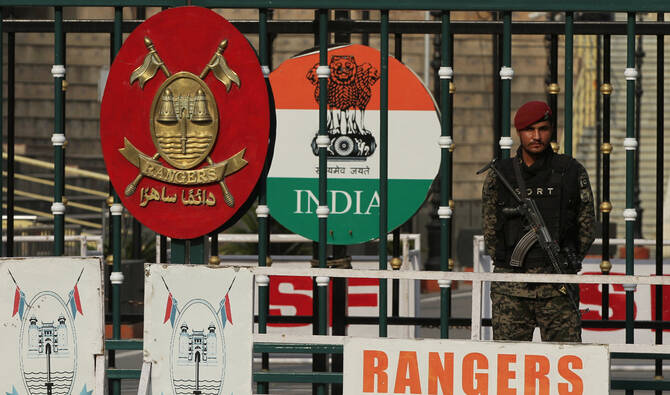
A Pakistan Ranger stands guard at the Pakistan-India joint check post at Wagah border, near Lahore, Pakistan on May 14, 2025. (REUTERS/File)
Short Url
Updated 05 June 2025
Follow

Pakistan says ‘no formal decision’ taken on abrogating bilateral agreements with India

  • Pakistan’s defense minister earlier said Simla Agreement with India “has no worth or value”
  • Pakistan, India agreed to resolve Kashmir dispute bilaterally in the 1972 Simla Agreement

ISLAMABAD: Pakistan has so far not made any decision to abrogate any bilateral agreement with India, a senior official of the country’s foreign office said on Thursday, hours after Defense Minister Khawaja Asif said the provisions of the Simla Agreement with Delhi were no longer applicable.

India and Pakistan signed the Simla Agreement in 1972 after the 1971 war between the two countries, which New Delhi won and led to the creation of Bangladesh. One of its main clauses was that India and Pakistan both agreed to bilaterally discuss and resolve the issue of the disputed Himalayan territory of Kashmir.

Another clause of the agreement was that both countries renamed the Ceasefire Line, the de facto border separating Pakistan-administered Kashmir from the one governed by India, to the “Line of Control” (LoC). Both India and Pakistan agreed not to change it unilaterally.

After India suspended a decades-old water-sharing treaty with Pakistan following an attack in Indian-administered Kashmir in April, Pakistan announced a raft of tit-for-tat measures against Delhi. Islamabad said it had the right to hold all bilateral agreements with India, including the Simla Agreement, in abeyance.

Speaking to Geo News, Asif said the “sanctity” of the agreement had ended due to India’s steps and that all of its provisions were no longer applicable. The defense minister said the bilateral agreement as a whole after India and Pakistan’s May military confrontation, “has no worth or value.”

“No formal decision on abrogation of any bilateral agreement with India has so far been made,” a senior official of Pakistan’s Ministry of Foreign Affairs (MoFA) told Arab News in response to questions.

Asif had reiterated Pakistan’s position that India’s move to hold the Indus Waters Treaty (IWT) in abeyance was illegal as the terms dictated that neither of the two parties could alter its status unilaterally.

Signed in 1960, the treaty allocates the six Indus Basin rivers between India and Pakistan, with the World Bank acting as its guarantor.

Pakistan has rights to the western rivers — Indus, Jhelum, and Chenab — for irrigation, drinking, and non-consumptive uses like hydropower. India controls the eastern rivers — Ravi, Beas, and Sutlej — for unrestricted use but must not significantly alter their flow.

India can use the western rivers for limited purposes such as power generation and irrigation, without storing or diverting large volumes

Asif said neither the World Bank nor any other institution had any “interference or patronage” in the Simla Agreement when it was signed in 1972.

“So then, the Control Line will once again shift to its original status of Ceasefire Line,” the minister said.

While the fragile ceasefire between India and Pakistan announced on May 10 by US President Donald Trump -persists, tensions remain high as delegations by both nuclear-armed neighbors head to world capitals and blame each other for the May conflict.

Kashmir has always remained the root cause of conflict between India and Pakistan. The two countries claim the region in full but administer only parts of it. They have fought two out of three wars since 1947 over the territory.

Delhi blames Islamabad for fomenting militancy in the part of Kashmir it administers. Pakistan denies the allegations and says it only extends diplomatic support to the people of Kashmir it says are living under “occupation.”


UN torture expert decries Pakistan ex-PM Khan’s detention

Updated 12 December 2025
Follow

UN torture expert decries Pakistan ex-PM Khan’s detention

  • Khan’s party alleges government is holding him in solitary confinement, barring prison visits
  • Pakistan’s government rejects allegations former premier is being denied basic rights in prison

GENEVA: Pakistan’s former prime minister Imran Khan is being held in conditions that could amount to torture and other inhuman or degrading treatment, the United Nations’ special rapporteur on torture warned Friday.

Alice Jill Edwards urged Pakistan to take immediate and effective action to address reports of the 73-year-old’s inhumane and undignified detention conditions.

“I call on Pakistani authorities to ensure that Khan’s conditions of detention fully comply with international norms and standards,” Edwards said in a statement.

“Since his transfer to Adiala Jail in Rawalpindi on September 26, 2023, Imran Khan has reportedly been held for excessive periods in solitary confinement, confined for 23 hours a day in his cell, and with highly restricted access to the outside world,” she said.

“His cell is reportedly under constant camera surveillance.”

Khan an all-rounder who captained Pakistan to victory in the 1992 Cricket World Cup, upended Pakistani politics by becoming the prime minister in 2018.

Edwards said prolonged or indefinite solitary confinement is prohibited under international human rights law and constitutes a form of psychological torture when it lasts longer than 15 days.

“Khan’s solitary confinement should be lifted without delay. Not only is it an unlawful measure, extended isolation can bring about very harmful consequences for his physical and mental health,” she said.

UN special rapporteurs are independent experts mandated by the Human Rights Council. They do not, therefore, speak for the United Nations itself.

Initially a strong backer of the country’s powerful military leadership, Khan was ousted in a no-confidence vote in 2022, and has since been jailed on a slew of corruption charges that he denies.

He has accused the military of orchestrating his downfall and pursuing his Tehreek-e-Insaf (PTI) party and its allies.

Khan’s supporters say he is being denied prison visits from lawyers and family after a fiery social media post this month accusing army leader Field Marshal Asim Munir of persecuting him.

According to information Edwards has received, visits from Khan’s lawyers and relatives are frequently interrupted or ended prematurely, while he is held in a small cell lacking natural light and adequate ventilation.

“Anyone deprived of liberty must be treated with humanity and dignity,” the UN expert said.

“Detention conditions must reflect the individual’s age and health situation, including appropriate sleeping arrangements, climatic protection, adequate space, lighting, heating, and ventilation.”

Edwards has raised Khan’s situation with the Pakistani government.