

Pentagon chief confident NATO will commit to Trump’s defense spending target

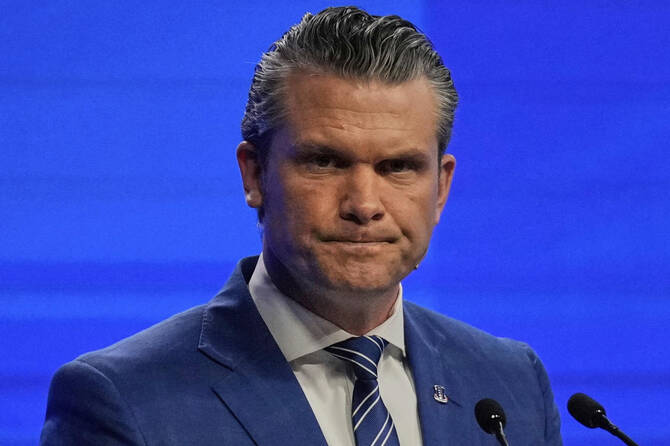
US Defense Secretary Pete Hegseth is confident that members of the NATO alliance will sign up to Donald Trump’s demand for a major boost in defense spending. (AP)
Short Url
Updated 05 June 2025
Follow

Pentagon chief confident NATO will commit to Trump’s defense spending target

  • Donald Trump has said NATO allies should boost investment in defense to 5 percent of GDP
  • Hiking defense expenditure is the price of ensuring a continued US commitment to the continent’s security

BRUSSELS: US Defense Secretary Pete Hegseth said on Thursday he was confident that members of the NATO alliance will sign up to Donald Trump’s demand for a major boost in defense spending, adding that it had to happen by a summit later in June.

The US president has said NATO allies should boost investment in defense to 5 percent of gross domestic product, up from the current target of 2 percent.

“To be an alliance, you got to be more than flags. You got to be formations. You got to be more than conferences. You need to be, keep combat ready capabilities,” Hegseth said as he arrived at a gathering of NATO defense ministers in Brussels.

“We’re here to continue the work that President Trump started, which is a commitment to 5 percent defense spending across this alliance, which we think will happen,” Hegseth said, adding: “It has to happen by the summit at The Hague later this month.”

Diplomats have said European allies understand that hiking defense expenditure is the price of ensuring a continued US commitment to the continent’s security and that keeping the US on board means allowing Trump to be able to declare a win on his 5 percent demand during the summit, scheduled for June 24-25.

“We have to go further and we have to go faster,” NATO Secretary-General Mark Rutte told reporters on Wednesday.

“A new defense investment plan will be at the heart of the NATO summit in The Hague,” he added.

In a bid to meet Trump’s 5 percent goal, Rutte has proposed alliance members boost defense spending to 3.5 percent of GDP and commit a further 1.5 percent to broader security-related spending, Reuters has reported.

Details of the new investment plan will likely continue to be negotiated until the eve of the NATO summit.

“We have to find a realistic compromise between what is necessary and what is possible really to spend,” German Defense Minister Boris Pistorius said on Wednesday.

Countries remain divided over the timeline for a new pledge.

Rutte has proposed reaching the 5 percent by 2032 – a date that some eastern European states consider too distant but which some others see as too early and unrealistic given current spending and industrial production levels.

A 2032 target is “definitely too late,” Lithuanian Defense Minister Dovile Sakaliene said on Wednesday, arguing for a target of 2030 at the latest.

There is also an ongoing debate over how to define “defense-related” spending, which might include spending on cybersecurity and certain types of infrastructure.

“The aim is to find a definition that is precise enough to cover only real security-related investments, and at the same time broad enough to allow for national specifics,” said one NATO diplomat.


Trump says Zelensky ‘isn’t ready’ yet to accept US-authored proposal to end Russia-Ukraine war

Updated 08 December 2025
Follow

Trump says Zelensky ‘isn’t ready’ yet to accept US-authored proposal to end Russia-Ukraine war

  • Trump said he was “disappointed” and suggested that the Ukrainian leader is holding up the talks from moving forward
  • He also claimed Russia is “fine with it” even though Putin last week had said that aspects of Trump’s proposal were unworkable

KYIV, Ukraine: President Donald Trump on Sunday claimed Ukrainian President Volodymyr Zelensky “isn’t ready” to sign off on a US-authored peace proposal aimed at ending the Russia-Ukraine war.
Trump was critical of Zelensky after US and Ukrainian negotiators completed three days of talks on Saturday aimed at trying to narrow differences on the US administration’s proposal. But in an exchange with reporters on Sunday night, Trump suggested that the Ukrainian leader is holding up the talks from moving forward.
“I’m a little bit disappointed that President Zelensky hasn’t yet read the proposal, that was as of a few hours ago. His people love it, but he hasn’t,” Trump claimed in an exchange with reporters before taking part in the Kennedy Center Honors. The president added, “Russia is, I believe, fine with it, but I’m not sure that Zelensky’s fine with it. His people love it it. But he isn’t ready.”
To be certain, Russian President Vladimir Putin hasn’t publicly expressed approval for the White House plan. In fact, Putin last week had said that aspects of Trump’s proposal were unworkable, even though the original draft heavily favored Moscow.
Trump has had a hot-and-cold relationship with Zelensky since riding into a second White House term insisting that the war was a waste of US taxpayer money. Trump has also repeatedly urged the Ukrainians to cede land to Russia to bring an end to a now nearly four-year conflict he says has cost far too many lives.
Zelensky said Saturday he had a “substantive phone call” with the American officials engaged in the talks with a Ukrainian delegation in Florida. He said he had been given an update over the phone by US and Ukrainian officials at the talks.
“Ukraine is determined to keep working in good faith with the American side to genuinely achieve peace,” Zelensky wrote on social media.
Trump’s criticism of Zelensky came as Russia on Sunday welcomed the Trump administration’s new national security strategy in comments by the Kremlin spokesman published by Russia’s Tass news agency.

Dmitry Peskov said the updated strategic document, which spells out the administration’s core foreign policy interests, was largely in line with Moscow’s vision.
“There are statements there against confrontation and in favor of dialogue and building good relations,” he said, adding that Russia hopes this would lead to “further constructive cooperation with Washington on the Ukrainian settlement.”
The document released Friday by the White House said the US wants to improve its relationship with Russia after years of Moscow being treated as a global pariah and that ending the war is a core US interest to “reestablish strategic stability with Russia.”
Speaking on Saturday at the Reagan National Defense Forum, Trump’s outgoing Ukraine envoy, Keith Kellogg, said efforts to end the war were in “the last 10 meters.”
He said a deal depended on the two outstanding issues of “terrain, primarily the Donbas,” and the Zaporizhzhia Nuclear Power Plant.
Russia controls most of Donbas, its name for the Donetsk and neighboring Luhansk regions, which, along with two southern regions, it illegally annexed three years ago. The Zaporizhzhia Nuclear Power Plant is in an area that has been under Russian control since early in Moscow’s invasion of Ukraine and is not in service. It needs reliable power to cool its six shutdown reactors and spent fuel, to avoid any catastrophic nuclear incidents.
Kellogg, who is due to leave his post in January, was not present at the talks in Florida.
Separately, officials said the leaders of the United Kingdom, France and Germany would participate in a meeting with Zelensky in London on Monday.
As the three days of talks wrapped up, Russian missile, drone and shelling attacks overnight and Sunday killed at least four people in Ukraine.
A man was killed in a drone attack on Ukraine’s northern Chernihiv region Saturday night, local officials said, while a combined missile and drone attack on infrastructure in the central city of Kremenchuk caused power and water outages. Kremenchuk is home to one of Ukraine’s biggest oil refineries and is an industrial hub.
Kyiv and its Western allies say Russia is trying to cripple the Ukrainian power grid and deny civilians access to heat, light and running water for a fourth consecutive winter, in what Ukrainian officials call “weaponizing” the cold.
Three people were killed and 10 others wounded Sunday in shelling by Russian troops in Ukraine’s Kharkiv region, according to the regional prosecutor’s office.