


Following our in-depth coverage of this year’s Saudi and Qatar entries, here are three more must-see pavilions at this year’s biennale.
Bahrain

“Heatwave” presents a meaningful and practical response to the climate crisis.
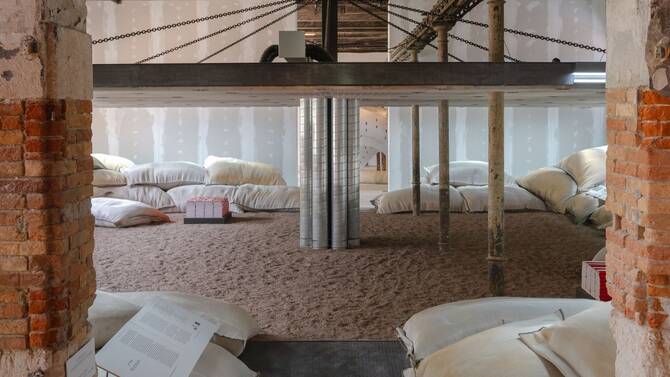
At first glance, Bahrain’s pavilion isn’t much to look at. A modest modular structure consisting of a raised platform, a suspended ceiling, and a central column, it lacks the artistic clout of other pavilions. And yet, this passive cooling installation designed for public spaces was awarded the Golden Lion for best national participation.
“Heatwave” presents a meaningful and practical response to the climate crisis. By reimagining traditional Bahraini cooling systems, such as wind towers and shaded courtyards, it provides an innovative response to rising temperatures. The pavilion’s design integrates a geothermal well that draws in cool air from below the surface, paired with a solar chimney that releases warm air upwards. Together, these elements form what the designers describe as a “thermo-hygrometric axis,” a system that maintains a mild, regulated indoor climate.
In the exhibition space, where excavation for a geothermal well was not feasible, the system relies on mechanical ventilation, drawing air through a canal-facing window and guiding it through a network of ducts and nozzles to create a controlled microclimate. Importantly, it is designed to be scalable and adaptable to a wide range of environments.
Commissioned by Shaikh Khalifa bin Ahmed Al-Khalifa, president of the Bahrain Authority for Culture and Antiquities, and curated by architect Andrea Faraguna, the pavilion functions as a full-scale, inhabitable prototype. Aimed primarily at meeting the challenges faced by construction workers in the Gulf, the pavilion’s design was developed in collaboration with structural engineer Mario Monotti and thermomechanical expert Alexander Puzrin.
Britain

British Pavilion - Detail from PART's 'Objects of Repair.' (Courtesy of the British Council)
“I call this pavilion a reverse case because it also makes a statement against British colonial rule,” says Yara Sharif, one of the co-founders of the Palestine Regeneration Team (PART). “After all, they were the ones who initiated the exploitation of Palestinian resources. So having a platform within the British Pavilion is, in itself, a statement — a reverse case that says, ‘We are also here to occupy you.’ It’s also a way to challenge the mental occupation; the idea of portraying Palestinians as passive subjects.”
PART’s “Objects of Repair” is a small but vitally important component within the British pavilion’s “Geology of Britannic Repair,” a UK-Kenya collaboration that seeks to expose and rework the entangled legacies of architecture and colonization. In a series of installations, the exhibition proposes earth-bound solutions that resist extractive practices and respond to climate, social, and political upheaval. The British Pavilion received a special mention for national participation.
At the core of PART’s installation, created by Sharif, Nasser Golzari, and Murray Fraser, lies the Travelling Lab, a project inspired by Gazans’ reappropriation of rubble to create new architectural ‘skins.’
“The whole idea behind the Travelling Lab is that it continues to develop and evolve as it moves,” explains Sharif, who is also a co-founder of Architects for Gaza. “We call it a way to cultivate hope, but also to create a matrix of possibilities that may suggest new scenarios and aesthetics to challenge the ones we’re familiar with. The aim of the pavilion is not to create a beautiful object; it’s to provoke a collision, spark discussion, and to draw attention to a context that is continually being rendered invisible.”
Uzbekistan

“A Matter of Radiance,” the Uzbekistan pavilion’s exhibition. (Supplied)
One of the first things you see when entering the Uzbekistan National Pavilion is a heliostat – a mirror system designed to track the sun and reflect its light onto a fixed point. Beyond it lie a control room table, a monumental glass chandelier created by Irena Lipene, and a giant solar screen. All belong to — or are reconstructions of those found at — the Sun Institute of Material Science in Tashkent, one of the city’s Soviet-era modernist structures.
The landmark building, originally known as the Sun Heliocomplex, is the inspiration behind “A Matter of Radiance,” the pavilion’s exhibition. Curated by GRACE studio’s Ekaterina Golovatyuk and Giacomo Cantoni, the exhibition explores the scientific and cultural relevance of the Heliocomplex. In particular, its potential as an international scientific hub.
“This was a catalyst building for its time,” says Gayane Umerova, chairperson of the Uzbekistan Art and Culture Development Foundation, who commissioned the exhibition. “The architecture was profound. The designers were given remarkable freedom, and I think it’s important for us to not only celebrate it, but also preserve it.”
Opened near Tashkent in 1987, the Heliocomplex is one of only two major solar furnaces in the world designed to study how materials behave under extreme temperatures. It is also one of 24 key modernist sites spread across the capital, 21 of which have been granted national heritage status.
“It’s important for us to show that this is not just a monolith,” says Umerova of the Heliocomplex, which is currently being used for civilian scientific research. “It’s an art object, in a way, but it’s a living structure.”


