

What We Are Buying Today: Snowhite Arabia beauty products

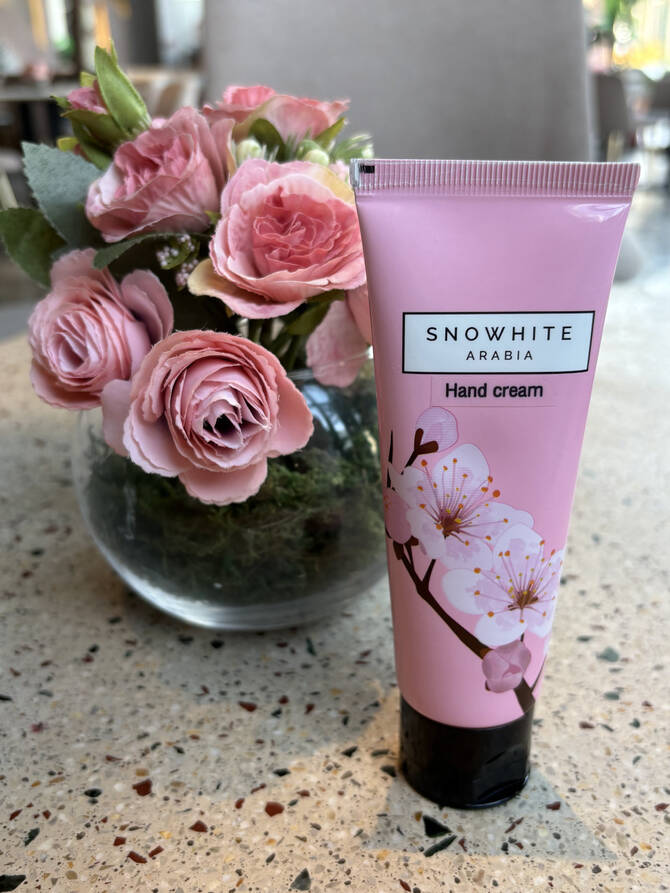
The Snowhite hand cream is moisturizing and fragrant. (AN photo)
Short Url
Updated 16 January 2026
Follow

What We Are Buying Today: Snowhite Arabia beauty products

The Saudi beauty market is saturated with shelves lined with creams, serums and promises. If you have entered a local pharmacy recently, you likely already noticed Snowhite Arabia’s products — the distinct pink packaging is hard to miss.

Consider this your sign to try it.

Founded in 2014 by Heba Al-Madani as a home-based workshop, Snowhite Arabia has since evolved into a substantial operation, manufactured at Al-Madani’s factory for Snowhite Est., proudly labeled with the “Saudi Made” stamp.

I started with the hand cream, which the package recommends using twice a day while avoiding direct sun exposure. The formula includes avocado oil, aloe vera juice and mango butter, among other ingredients.

The Snowhite hand cream is moisturizing and fragrant, but without a greasy or overly perfumed aftermath. After a few uses, my dry-prone hands felt noticeably smoother.

I also like how it is vibrantly-colored so I can easily fish it out of my tote bag to reapply when I am out and about.

For the home, I tried the Moroccan soap in the bath. Its dark color, slimy texture and pungent smell were slightly alarming at first. Once worked with a bit of water, it foamed easily, and I learned quickly that a little goes a long way. I now like it.

Snowhite Arabia also offers hair masks and other products, though these are the only ones I have tried so far. I am looking forward to trying the broccoli shampoo next.

For now, the hand cream stands out as the most practical winter companion and my current local favorite.

Follow them @snowhitesa_ on Instagram.


Mini op-ed: We need a ‘potluck’ culture of reading

Updated 10 March 2026
Follow

Mini op-ed: We need a ‘potluck’ culture of reading

DUBAI: The number of times we hear, “My kids don’t read,” “I don’t have the time,” or “Do people even read anymore?” is alarming.

With newspapers declared dead and YouTube summaries or ChatGPT reviews becoming the main course of words, I often wonder: have those asking these questions considered the role they play?

Each of us — school representatives, librarians, parents, educators, children, and even occasional readers — must ask whether we are helping create a culture where reaching for a book feels as natural as reaching for a smartphone.

Even the smallest effort counts. I think of a reading culture as a potluck where everyone brings something small, and together it becomes a wholesome meal. If you do not know where to begin, look around.

Purva Grover is an author, poet, playwright, stage director, TEDx speaker, and creative entrepreneur. (Supplied)

The UAE is rich in public libraries including in Sharjah and Dubai, such as the Mohammed Bin Rashid Library, which is proof that access is not the issue. 

Meanwhile, Saudi Arabia is embedding reading into its national identity under Vision 2030 through digital libraries, major book fairs, and daily school reading.

Not a reader? Events such as the Emirates Airline Festival of Literature or the Sharjah International Book Fair offer easy entry points for conversation, community and curiosity.

They are built on cultural blocks that subtly encourage even non-readers into reading spaces. You could even start a reading club. I run one in Dubai called The Reading Village and have seen its quiet magic.

Culture is built by saying yes. And no to pirated PDFs on WhatsApp, as well as unchecked screen habits.

Tiny habits can help build an environment where reading becomes as much a part of our lives as scrolling on Netflix to decide what to binge-watch next.

Purva Grover is an author, poet, playwright, stage director, TEDx speaker, and creative entrepreneur. She is the founder of The Reading Village, a Dubai-based community.