
RIYADH: As the world marks World Environment Day, a global celebration of nature and a call to protect our planet, attention turns to an ecological transformation taking place in northwestern Saudi Arabia.
NEOM, the Kingdom’s futuristic megacity project, is rapidly becoming a haven for biodiversity — and at the heart of this effort is a renewed commitment to falcon conservation.
Under the banner of the Hadad Program, NEOM is working in partnership with the Saudi Falcons Club and other national entities to reintroduce native falcon species to the Arabian Peninsula, rebuild local ecosystems, and revive an ancient cultural tradition.

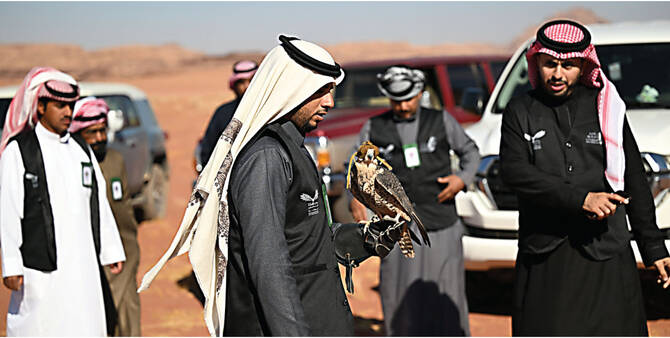
Under the Hadad program, NEOM, the Saudi Falcons Club have successfully released eight pairs of the very rare barbary falcon in NEOM's Nature Reserce. (Supplied)
The work being done in NEOM is about more than saving birds; it is about restoring balance to a landscape often misunderstood as barren and bringing nature back to the center of modern development.
Since 1973, June 5 has been observed as World Environment Day. Led by the UN Environment Programme, it serves as a platform to raise awareness and prompt action on pressing environmental issues from climate change and pollution to biodiversity loss.
Announced in 2017 as part of Saudi Arabia’s Vision 2030 reform agenda, NEOM is a $500 billion mega-project designed to reshape the future of urban living, sustainability and technology.
FASTFACT
• World Environment Day, held on June 5 since 1973, raises awareness on global issues like climate change and biodiversity loss.
Encompassing 26,500 square kilometers of mountains, desert, and coastline along the Red Sea, NEOM’s planners aim to build a zero-emission, high-tech region powered entirely by renewable energy.
Yet beyond the cities of the future lies a growing commitment to the past — particularly in preserving and restoring the Kingdom’s natural heritage.

This photo taken on April 19, 2024 shows Tarek Qaddumi (R), executive director of the Saudi Arabia mega-project NEOM, giving a briefing on NEOM sites at a visual culture exhibition in Hong Kong. (AFP/File)
“People tend to assume that this part of the world is an empty desert, but NEOM is stunning for its habitat diversity,” Paul Marshall, head of nature conservation at NEOM, told Arab News.
Indeed, NEOM’s terrain is anything but barren, from mountain peaks reaching 2,600 meters above sea level to oceanic depths plummeting 1.5 kilometers. In between are red sand deserts, canyons and caves, and spectacular shores with crystal-clear waters and coral reefs.
This biologically rich region is home to creatures great and small: from hyrax, ibex and oryx to hedgehogs, gazelles and a wide variety of birds and insects.
“From those plants we have insects and mammals. Then, we have the large mammals, of course,” Marshall said.

Paul Marshall, head of nature conservation at NEOM. (Supplied)
Before human encroachment, the region was even home to apex predators such as cheetahs, lynx and leopards. Now, through conservation, NEOM is seeking to recreate conditions that allow such species to return.
“For all of our biodiversity, it is still a fundamentally arid ecosystem,” he said. “The species here have adapted to survive with very low rainfall and because of that, they are able to thrive despite the conditions.”
The Hadad Program supports NEOM’s rewilding strategy by reintroducing native falcon species, most notably the lanner and barbary falcons. “This is a really exciting program,” Marshall said. “It is one of many programs we are doing to restore the full ecosystem in the NEOM area.”

NEOM and the Saudi Falcons Club signed a strategic partnership to enhance falcon habitats within NEOM's Nature Reserve during the Hadad Annual Meeting in November 2024. (SPA/File)
Despite the climatic conditions, several types of plants were able to grow and uniquely adapt to different parts of NEOM’s ecosystem.
“From those plants we have insects and mammals. Then, we have the large mammals, of course,” he said.
He added: “This is a really exciting program. It is one of many programs we are doing to restore the full ecosystem in the NEOM area.”
Falcons used to be widespread throughout the whole of the Arabian Peninsula. But, through a combination of hunting and capturing for sports, in many places, Marshall said, that these animals are hard to find. Today, efforts are underway to bring them back.

Under a partnership between NEOM and the Saudi Falcons, authorities hope to see native falcon species throughout the whole of the Arabian Peninsula. (NEOM photo)
With the rich habitat and the efforts to safeguard the falcons, they are creating an environment where the species can be released with the best chances of survival.
They successfully released eight pairs of barbary falcons, which are a very rare type; very few of them are left in the wild.
“We are committed to caring for falcons as a cultural and historical heritage and supporting all related activities through a set of regulations and organizational frameworks adopted by the club,” Talal Abdulaziz AlShammisi, CEO of the Saudi Falcons Club, told Arab News.
“This includes promoting and preserving falconry heritage, organizing falcon auctions, collaborating with universities, colleges, research centers and health institutions to conduct falcon-related studies and scientific research.”

Talal Abdulaziz AlShammisi, CEO of the Saudi Falcons Club
Falconry is not just a pastime in Saudi Arabia; it is a centuries-old tradition deeply woven into the fabric of national identity.
“Falconry has been practiced by our ancestors across the deserts of the Kingdom for centuries and today the country is home to thousands of falcons and passionate falconers,” said AlShammisi.
“Local species such as the lanner falcon and the barbary falcon are native to the Saudi environment and hold significant ecological value as essential components of environmental balance.”
The barbary falcon, once on the brink of extinction in parts of the Arabian Peninsula, is now making a comeback. Thanks to the Hadad Program’s careful release, rehabilitation and monitoring strategies, the birds are beginning to reclaim their place in Saudi skies.
The initiative’s success is underpinned by a network of partnerships.
FASTFACT
26,500
Area (square kilometers) of NEOM spanning mountains, desert and Red Sea coastline.
NEOM is working with the Saudi National Center for Wildlife, the Saudi Falcon Club and the Special Forces for Environmental Security to monitor these falcons, to protect them and give them not only the best chances of survival but appearing and breeding.
Soon, the first new generation of barbary falcons is expected to hatch in NEOM.
While falcons are among the stars of NEOM’s rewilding efforts, the program goes much further. More than 1,100 animals once absent from the region — including oryx, ibex, mountain gazelles and sand gazelles — have been reintroduced to help restore a natural ecological balance.

More than 1,100 animals once absent from the region — including oryx, ibex, mountain gazelles and sand gazelles — have been reintroduced by Saudi Arabia's National Center for Wildlife to help restore a natural ecological balance. (SPA photos)
The reintroduction of different species of animals is not only a victory for biodiversity but also a chance to restore natural food chains and ecological interactions that sustained this environment for millennia.
With plans to extend across 95 percent of megacity project’s total land area, the NEOM Nature Reserve represents one of the most ambitious conservation zones in the world.
Through projects such as the Saudi Green Initiative and the Middle East Green Initiative, the Kingdom aims to plant billions of trees, reduce emissions, and protect vast swaths of land and sea.
As World Environment Day shines a spotlight on the urgent need to protect and restore our natural world, NEOM stands as a compelling example of how large-scale development and ecological stewardship can go hand in hand.