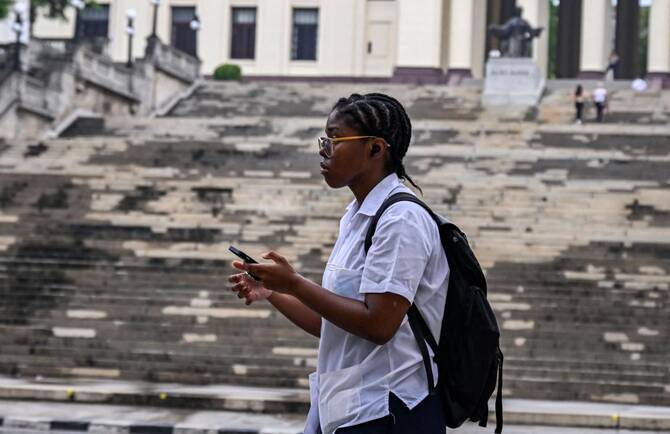
HAVANA: Cuban students called for a boycott of classes Wednesday over new mobile Internet tariffs that include steep fees for those who exceed their monthly data limits.
Cubans say the tariff hikes implemented by state telecoms company Etecsa on May 30 will leave them with only a few gigabytes of data per month as purchasing additional data will be prohibitively expensive.
Students have been particularly angered by the new pricing system, under which top-ups must be paid in hard-to-come-by-dollars or at a steep increment in Cuban pesos.
While acknowledging “progress” in negotiations with Etecsa, student union president Jose Almedia told AFP: “We want more.”
On Tuesday evening, student leaders at the University of Havana’s mathematics and informatics faculty called for a boycott of classes in order to try to force Etecsa to annul the tariff hikes.
Fellow leaders of the union chapter in the philosophy, history and sociology faculty backed the boycott, as did some students from the arts department.
It was not immediately clear how many students heeded the call for the protest.
But an arts student who attended classes on Wednesday told AFP there were “practically no students” in the faculty.
New pricing structure
Etecsa gave no forewarning of its new pricing structure, which it said was necessary to fund investment in infrastructure.
Rafael Gomez, an 18-year-old student at the University of Havana, said the new tariffs left mobile users with the bare minimum in terms of data.
“We were used to a certain system,” where customers can top up their credit as often as they like, he told AFP.
Now, they are limited to 6GB of data, which Gomez noted “is nothing and if you want to buy more, it costs over 3,000 pesos ($25), which you cannot afford on a regular Cuban salary,” Gomez said.
The average monthly salary on the communist island is 5,700 pesos, or $47.
Faced with the outcry from students, President Miguel Diaz-Canel said Sunday that the government was looking at “options” for “the most vulnerable sectors, including our dear students.”
After talks with student bodies Etecsa on Monday announced that students would be allowed two monthly top-ups at 360 pesos ($3), compared with one for the rest of the population.
Further top-ups have to be paid in dollars or at the eye-watering price of over 3,000 pesos.
The concessions failed to assuage the anger of many students.
Brian Gamez, a history student, told AFP he favored “peaceful protests” but was afraid that a mobilization could lead to vandalism.
The Cuban government has been wary of stoking popular discontent since July 2021 when thousands of people took to the streets in a rare show of defiance to demonstrate over shortages of fuel, food, medicine and electricity.
One person was killed and dozens injured in the protests, which Havana accused Washington of orchestrating.


![]()

Cuban students call boycott over mobile tariff hikes
Short Url
https://arab.news/nqr36
Cuban students call boycott over mobile tariff hikes
- Student leaders at the University of Havana’s mathematics and informatics faculty called for a boycott of classes in order to try to force state telecoms company to annul the tariff hikes
- The average monthly salary on the communist island is 5,700 pesos, or $47. Topping up data would cost the individual 3,000 pesos, or $25


Latest updates


© 2026 SAUDI RESEARCH & PUBLISHING COMPANY, All Rights Reserved And subject to Terms of Use Agreement.