

Sweden tries militant over Jordanian pilot burned to death by Daesh

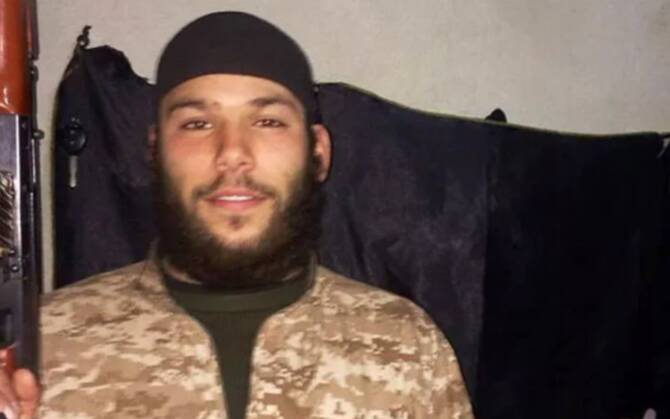
Convicted Swedish militant Osama Krayem went on trial in Stockholm on Wednesday accused of war crimes for his role in the 2014 killing of a Jordanian pilot who was burned alive in Syria. (Social Media)
Short Url
Updated 04 June 2025
Follow

Sweden tries militant over Jordanian pilot burned to death by Daesh

  • “Osama Krayem has, together and in agreement with other perpetrators belonging to Daesh, killed Maaz Al-Kassasbeh,” prosecutor Reena Devgun told the court
  • In the 22-minute video of the killing, the victim is seen walking past several masked Daesh fighters, including Krayem, according to prosecutors

STOCKHOLM: A convicted Swedish militant went on trial in Stockholm on Wednesday accused of war crimes for his role in the 2014 killing of a Jordanian pilot who was burned alive in Syria.

The case is considered unique as the other militants involved in the brutal killing, which sparked international outrage at the time, are presumed dead, Swedish prosecutor Henrik Olin told AFP.

Osama Krayem, a 32-year-old Swede, is already serving long prison sentences for his role in the Paris and Brussels attacks in 2015 and 2016.

He now faces charges of “serious war crimes and terrorist crimes” for his alleged participation in the killing of the Jordanian pilot.

On December 24, 2014, an aircraft belonging to the Royal Jordanian Air Force crashed in Syria.

The pilot was captured the same day by fighters from the Daesh group near the central city of Raqqa and he was burned alive in a cage sometime before February 3, 2015, when a video of the gruesome killing was published, according to the prosecution.

The slickly-produced propaganda video was one of the first such videos released by Daesh.

The killing shocked Jordan, which was participating in the US-led coalition’s strikes against Daesh positions in Syria.

“Osama Krayem has, together and in agreement with other perpetrators belonging to Daesh, killed Maaz Al-Kassasbeh,” prosecutor Reena Devgun told the court on Wednesday.

“Osama Krayem, in uniform and armed, guarded and led the victim Maaz Al-Kassasbeh to a metal cage, where the latter was then locked up. One of the co-perpetrators then set fire to Maaz Al-Kassasbeh, who had no possibility to defend himself or call for help,” Devgun said.

Krayem, wearing a dark blue shirt and with a thick beard and long, loose dark hair, had his back to the handful of journalists and spectators who followed Wednesday’s proceedings behind a glass wall in the high security courtroom in Stockholm’s district court.

He appeared calm as the prosecution laid out the charges, which could result in a life sentence if Krayem is convicted.

In the 22-minute video of the killing, the victim is seen walking past several masked Daesh fighters, including Krayem, according to prosecutors.

The pilot is then seen being locked in the cage and praying as he is set on fire.

Prosecutors have been unable to determine the exact date of the murder but the investigation has identified the location.

The pilot’s father, Safi Al-Kassasbeh, told AFP on Wednesday the family hoped Krayem would “receive the harshest penalty according to the magnitude of the crime.”

“This is what we expect from a respected and fair law,” he said.

It was thanks to a scar on the suspect’s eyebrow, visible in the video and spotted by Belgian police, that Krayem was identified and the investigation was opened, Devgun said when the charges were announced last week.

Other evidence in the case includes conversations on social media, including one where Krayem asks a person if he has seen a new video “where a man gets fried,” according to the investigation, a copy of which has been viewed by AFP.

“I’m in the video,” Krayem said, pointing out the moment when the camera zooms in on his face.

The other person replies: “Hahaha, yes, I saw the eyebrow.”

The defendant’s lawyer, Petra Eklund, told AFP before the start of the trial that her client admitted to being present at the scene but disputed the prosecution’s version.

“He denies the acts for which he is prosecuted,” she said.

“He acknowledges having been present at that place during the event, but claims not to have acted in the manner described by the prosecutors in the account of the facts,” she added.

Krayem, who is from Malmo in southern Sweden, joined the Daesh group in Syria in 2014 before returning to Europe in September 2015.

He was arrested in Belgium in April 2016.

In June 2022, he was sentenced to 30 years in prison in France for helping plan the November 2015 Paris attacks in which 130 people were killed.

The following year, he was given a life sentence in Belgium for participating in the March 2016 bombings at Brussels’ main airport and on the metro system, in which 32 people were killed.

Krayem has been temporarily handed over to Sweden for the Stockholm trial, which is scheduled to last until June 26.


Moscow made an offer to France regarding a French citizen imprisoned in Russia, says Kremlin

Updated 5 sec ago
Follow

Moscow made an offer to France regarding a French citizen imprisoned in Russia, says Kremlin

  • Laurent Vinatier, an adviser for Swiss-based adviser Center for Humanitarian Dialogue, Vinatier was arrested in Moscow in June 2024
  • He is accused of failing to register as a “foreign agent” while collecting information about Russia’s “military and military-technical activities” 

The Kremlin on Thursday said it was in contact with the French authorities over the fate of a French political scholar serving a three-year sentence in Russia and reportedly facing new charges of espionage.
Kremlin spokesman Dmitry Peskov told reporters that Russia has made “an offer to the French” regarding Laurent Vinatier, arrested in Moscow last year and convicted of collecting military information, and that “the ball is now in France’s court.” He refused to provide details, citing the sensitivity of the matter.
French President Emmanuel Macron is following Vinatier’s situation closely, his office said in a statement. French Foreign Ministry spokesperson Pascal Confavreux said Thursday that all government services are fully mobilized to pay provide consular support to Vinatier and push for his liberation as soon as possible.
Peskov’s remarks come after journalist Jérôme Garro of the French TF1 TV channel asked President Vladimir Putin during his annual news conference on Dec. 19 whether Vinatier’s family could hope for a presidential pardon or his release in a prisoner exchange. Putin said he knew “nothing” about the case, but promised to look into it.
Vinatier was arrested in Moscow in June 2024. Russian authorities accused him of failing to register as a “foreign agent” while collecting information about Russia’s “military and military-technical activities” that could be used to the detriment of national security. The charges carry a maximum penalty of five years in prison.
The arrest came as tensions flared between Moscow and Paris following French President Emmanuel Macron’s comments about the possibility of deploying French troops in Ukraine.
Vinatier’s lawyers asked the court to sentence him to a fine, but the judge in October 2024 handed him a three-year prison term — a sentence described as “extremely severe” by France’s Foreign Ministry, which called for the scholar’s immediate release.
Detentions on charges of spying and collecting sensitive data have become increasingly frequent in Russia and its heavily politicized legal system since Moscow invaded Ukraine in February 2022.
In addition to criticizing his sentence, the French Foreign Ministry urged the abolition of Russia’s laws on foreign agents, which subject those carrying the label to additional government scrutiny and numerous restrictions. Violations can result in criminal prosecution. The ministry said the legislation “contributes to a systematic violation of fundamental freedoms in Russia, like the freedom of association, the freedom of opinion and the freedom of expression.”
Vinatier is an adviser for the Center for Humanitarian Dialogue, a Switzerland-based nongovernmental organization, which said in June 2024 that it was doing “everything possible to assist” him.
While asking the judge for clemency ahead of the verdict, Vinatier pointed to his two children and his elderly parents he has to take care of.
The charges against Vinatier relate to a law that requires anyone collecting information on military issues to register with authorities as a foreign agent.
Human rights activists have criticized the law and other recent legislation as part of a Kremlin crackdown on independent media and political activists intended to stifle criticism of the war in Ukraine.
In August 2025, Russian state news agency Tass reported that Vinatier was also charged with espionage, citing court records but giving no details. Those convicted of espionage in Russia face between 10 and 20 years in prison.
Russia in recent years has arrested a number of foreigners — mainly US citizens — on various criminal charges and then released them in prisoner swaps with the United States and other Western nations. The largest exchange since the Cold War took place in August 2024, when Moscow freed journalists Evan Gershkovich and Alsu Kurmasheva, fellow American Paul Whelan, and Russian dissidents in a multinational deal that set two dozen people free.