Pakistan’s Punjab issues solar panel installation guidelines following accidents 

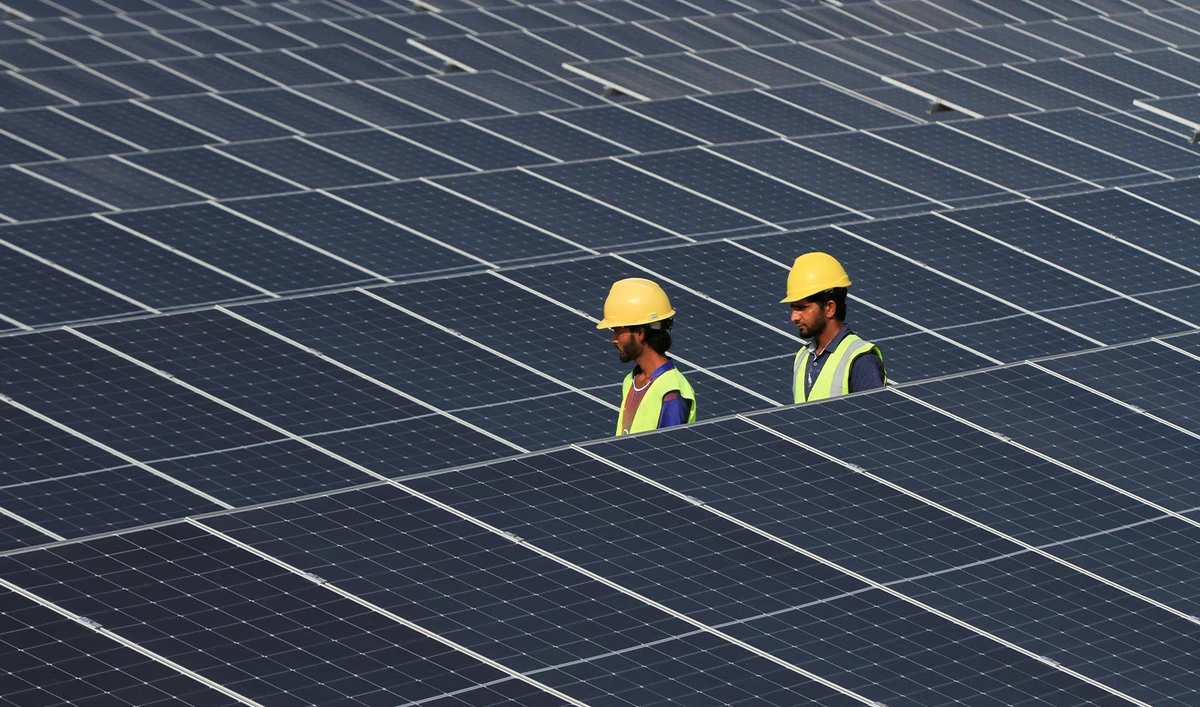
Technicians walk between solar panels at the Interloop industrial park, in Faisalabad, Pakistan, on April 8, 2025. (REUTERS/File)
Short Url
Updated 04 June 2025
Follow

Pakistan’s Punjab issues solar panel installation guidelines following accidents 

  • Over 70% of 124 accidents reported across Punjab during May 24 thunderstorms were related to solar panels, says disaster management authority
  • Guidelines include installation of solar panels by those certified by federal government, using wind-rated mounting systems that withstand pressure 

ISLAMABAD: The disaster management authority in Pakistan’s most populous Punjab province on Wednesday issued new guidelines for the installation of solar systems, citing that over 70 percent of accidents related to solar panels were reported during a thunderstorm last month. 

Thunderstorms killed at least 21 people and injured more than 100 others in Punjab late last month as moist currents penetrated upper parts of Pakistan, according to national and provincial disaster management authorities.

Earlier this week, the Punjab Disaster Management Authority (PDMA) issued a fresh alert for rain and strong, dusty winds across the province from June 2 to June 5. 

“During the thunderstorm on May 24, there were 124 small and large accidents in Punjab,” PDMA spokesperson Mazhar Hussain told Arab News. 

“When this was analyzed, it was revealed that over 70 percent of the accidents have been caused by solar panels or related structures,” he added. 

PDMA Director General Irfan Ali Kathia said new guidelines and a regulatory framework were prepared by stakeholders, including the province’s energy department and the local government department.

“These instructions are aligned with the national framework provided by the Alternative Energy Development Board (AEDB), and include essential safety protocols, installation standards and the responsibilities of certified installers,” Kathia explained. 

According to the guidelines seen by Arab News, the PDMA has directed users to procure the services of AEDB-certified installers to ensure a professional solar system design and so that the panels are properly mounted, sealed and structurally reinforced.

Along with other technical details, the PDMA stresses people to use wind-rated mounting systems attached to mountings by stainless steel nut bolts. The authority directs that these bolts be fastened using stainless steel spring washers. 

It also says people should consider windstorm-safe anchors or extra brackets in the province’s regions prone to storms. 

“The mountings itself should be properly secured with base/floor to ensure it can withstand windstorms and other climatic vagaries,” the document stated.

Kathia said only professionals approved by the AEDB will be authorized to install solar energy systems. He said this move was aimed at ensuring technical standards were maintained and risks associated with faulty or unregulated installations were reduced.

“In addition, all structures across Punjab that may be vulnerable to future damage are being surveyed by the respective deputy commissioners,” the PDMA official said.

He added strict compliance would be ensured in close coordination with district administrations to avoid such accidents in the future. 

Khalil Ahmed, owner of a solar installation company in Punjab’s provincial capital Lahore, supported the PDMA’s decision.

Ahmed said people often hire non-professional installers to save a small amount of money, putting both their systems and safety at risk.

“Ensuring that only AEDB-certified professionals handle solar installations is not just a matter of compliance, it’s a matter of public safety,” he told Arab News.

Proper mounting, structural reinforcement, and weatherproofing are essential to prevent accidents and protect both lives and property, he added.
T20 World Cup: ICC deputy chief in Lahore for talks after Pakistan boycotts India match

Updated 08 February 2026
Follow

T20 World Cup: ICC deputy chief in Lahore for talks after Pakistan boycotts India match

  • Islamabad’s boycott over Bangladesh’s exclusion has threatened the tournament’s most lucrative game
  • Bangladesh Cricket Board chief has also arrived in Pakistan and is expected to participate in meetings

ISLAMABAD: International Cricket Council (ICC) Deputy Chairman Imran Khwaja arrived in Lahore on Sunday for talks with Pakistan Cricket Board (PCB) officials, the PCB said, as the sport’s governing body strives to save a high-stakes T20 World Cup clash between arch-rivals Pakistan and India.

The development follows Islamabad’s decision to boycott the Feb. 15 Pakistan-India match in Colombo, a move to protest the ICC’s exclusion of Bangladesh from the ongoing T20 World Cup.

The controversy over Pakistan’s participation erupted after the ICC replaced Bangladesh with Scotland, following Bangladesh’s decision to not play matches in India owing to security fears.

The ICC has since requested the Pakistan Cricket Board to reconsider the decision to boycott their match against India in Colombo or they will have to forfeit the marquee game of the tournament.

“ICC Deputy Chairman Imran Khwaja arrived in Lahore,” the PCB said on Sunday, adding that he was received at the airport by the PCB chairman’s adviser, Aamir Mir.

Prior to Khwaja’s arrival in Lahore, where the PCB is headquartered, Pakistan welcomed Bangladesh Cricket Board (BCB) President Aminul Islam, who was received by PCB CEO Salman Naseer.

The two visiting officials are scheduled to meet PCB Chairman Mohsin Naqvi.

“Bangladesh Cricket Board President Aminul Islam will also take part in other meetings,” the PCB said in a statement, hinting that he will be part of the meeting with ICC’s Khwaja.

The dispute stems from the ICC’s decision to replace Bangladesh with Scotland last month after Bangladesh refused to play tournament matches in India. Dhaka’s decision followed the removal of Mustafizur Rahman from the Indian Premier League (IPL). He was bought for $1 million by the IPL’s Kolkata Knight Riders, but on Jan. 3 the Board of Control for Cricket in India (BCCI) ordered Kolkata to release Mustafizur without a public explanation but amid regional tensions.

Pakistan have boycotted the 27th match of the tournament against India, due to take place at R. Premadasa Stadium in Colombo. An India-Pakistan fixture is the sport’s most lucrative asset, generating a massive share of global broadcasting and sponsorship revenue.

The PCB has remained defiant amid reports of potential sanctions. On Saturday, the board rejected claims by Indian media that it had initiated a dialogue with the ICC to find a way out of the standoff.

“I categorically reject the claim by Indian sports journalist Vikrant Gupta that PCB approached the ICC,” PCB’s Mir said in a statement. “As usual, sections of Indian media are busy circulating fiction. A little patience and time will clearly show who actually went knocking and who didn’t.”

The standoff highlights the growing friction within the sport’s governance.

Pakistan has accused India’s cricket board of influencing the ICC’s decisions.

Defense Minister Khawaja Asif this week called for the formation of a new cricket governing body, saying the ICC, currently chaired by Jay Shah, son of India’s Home Minister Amit Shah, was being held “hostage” to “Indian political interests.”

India generates the largest share of cricket’s commercial revenue and hence enjoys considerable influence over the sport. Critics argue that this financial contribution translates into decisive leverage within the ICC.

A large part of that revenue comes from the Indian Premier League (IPL), the sport’s most lucrative T20 cricket competition, which is run by the Board of Control for Cricket in India (BCCI). Between 2024 and 2027, the IPL is projected to earn $1.15 billion, nearly 39 percent of the ICC’s total annual revenue, according to international media reports.

While the Pakistani government cleared the team to participate in the rest of the tournament, Prime Minister Shehbaz Sharif maintained that the boycott of the India game was necessary to protest the “unjust” treatment of Bangladesh.