


Pilgrims receive gifts reflecting Saudi culture

1 / 5
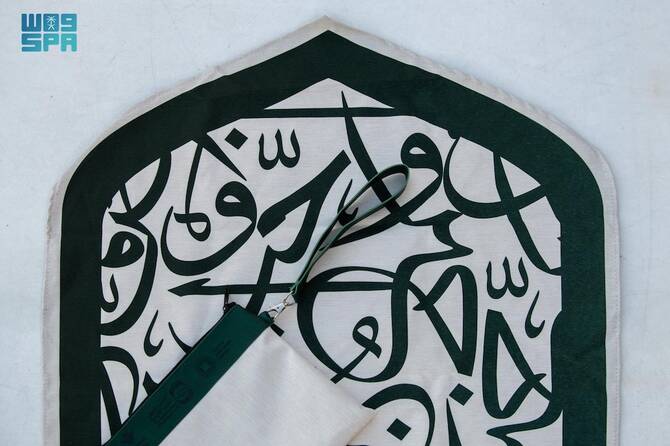
Pilgrims received prayer rugs adorned by Arabic calligraphy and medallions featuring traditional inscriptions reflecting Saudi cultural values. (SPA)
2 / 5
Pilgrims received prayer rugs adorned by Arabic calligraphy and medallions featuring traditional inscriptions reflecting Saudi cultural values. (SPA)
3 / 5
Pilgrims received prayer rugs adorned by Arabic calligraphy and medallions featuring traditional inscriptions reflecting Saudi cultural values. (SPA)
4 / 5
Pilgrims received prayer rugs adorned by Arabic calligraphy and medallions featuring traditional inscriptions reflecting Saudi cultural values. (SPA)
5 / 5
Pilgrims received prayer rugs adorned by Arabic calligraphy and medallions featuring traditional inscriptions reflecting Saudi cultural values. (SPA)
Short Url
Updated 04 June 2025
Follow

Pilgrims receive gifts reflecting Saudi culture

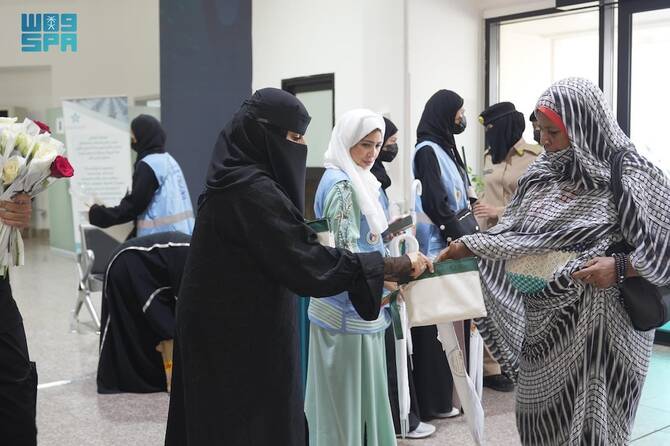
MAKKAH: The Royal Institute of Traditional Arts, known as Wrth, has welcomed pilgrims arriving in Saudi Arabia via land, sea, and air with gifts inspired by traditional Saudi arts.

This initiative, in collaboration with the Pilgrim Awareness Center and Saudia airline, aims to enrich pilgrims’ experience culturally and intellectually, according to the Saudi Press Agency.

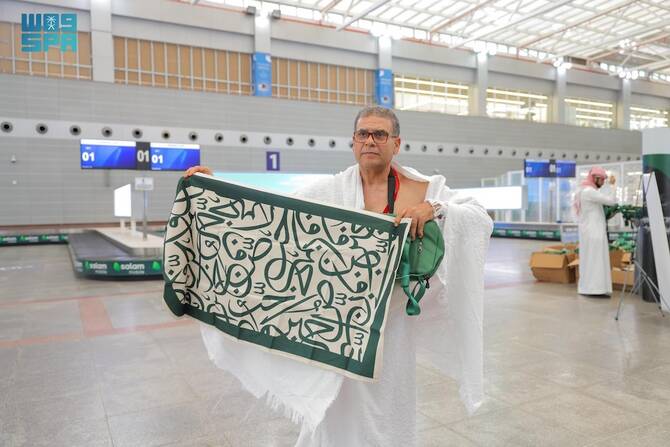
Pilgrims received prayer rugs adorned by Arabic calligraphy and medallions featuring traditional inscriptions reflecting Saudi cultural values.

Accompanying the gifts were informational cards about Hajj rituals, provided by the Pilgrim Awareness Center.

Gifts were distributed at key entry points, including King Abdulaziz International Airport, Jeddah Islamic Port, and the Hajj dispatching control center on Hijrah Road.

Wrth’s participation aligns with its mission to raise awareness of traditional arts and offer a unique pilgrim experience during the Kingdom’s Year of Handicrafts.

The initiative highlights national identity and strengthens the global presence of traditional Saudi arts, the SPA reported.

The royal institute recently completed a billboard project along Hijrah Road between Makkah and Madinah, in collaboration with the Roads General Authority.

The billboards feature designs inspired by traditional motifs and crafts such as weaving, reflecting the national identity. These showcase the beauty of local arts and regional patterns and aim to enrich pilgrims’ cultural experience and promote heritage tourism.


Red Sea Global unveils scientific model for regenerative tourism worldwide

Updated 26 February 2026
Follow

Red Sea Global unveils scientific model for regenerative tourism worldwide

  • The report details the model’s rollout at “The Red Sea” and “AMAALA” destinations, backed by studies covering 8 marine habitats

TABUK: Red Sea Global (RSG) has unveiled a science-based model aimed at achieving a 30 percent net positive conservation benefit across its tourism destinations by 2040. 

The framework is now available for global adoption, according to a statement released by RSG.

Owned by Saudi Arabia’s Public Investment Fund (PIF), Red Sea Global is the multi-project developer behind ambitious regenerative tourism destinations like “The Red Sea” and “AMAALA.” 

As a cornerstone of the Kingdom’s Vision 2030, the company aims to diversify the national economy while setting new global benchmarks for sustainable, nature-positive development.

CEO John Pagano stated that openly sharing this detailed approach will help elevate the global tourism sector and secure a healthier environment for future generations.
 

Map showing the boundaries of the Red Sea Zone. (Graphic from the RSG report)

The cornerstone of this initiative is the proprietary SIIG Model, a four-step framework:
• Survey: Establish biodiversity baselines and monitor long-term changes.
• Identify: Assess risks to priority habitats and species.
• Intervene: Execute evidence-based actions, such as regulating fishing and enhancing natural habitats.
• Gain: Measure and verify biodiversity improvements.

The report details the model’s rollout at “The Red Sea” and “AMAALA” destinations, backed by extensive 2022–2023 environmental baseline studies covering eight marine habitats and priority species groups during 2022 and 2023. 

A major intervention is the 5,015-square-kilometer Fishery Management Area in Al-Wajh Lagoon. The plan reserves 38 percent of the area for priority conservation—protecting 62 percent of local coral reefs—while allocating 61 percent for sustainable fishing.

According to scientific modeling, eliminating fishing in high-protection zones could increase reef fish populations by 113 percent, sharks and rays by 72 percent, and marine mammals by 24 percent. These measures are expected to boost coral resilience, support ecosystem recovery, and protect vulnerable species like sea turtles and seabirds.
Ihab Kindi, RSG’s Red Sea Destination Executive Director, called the data-driven model a practical roadmap for large-scale marine recovery. The complete methodology is available in the new report, “The SIIG Model: A Roadmap Toward Achieving Measurable Conservation Gains.”