

Pakistan textile union warns of capital flight to UAE, urges industrial policies to retain investment

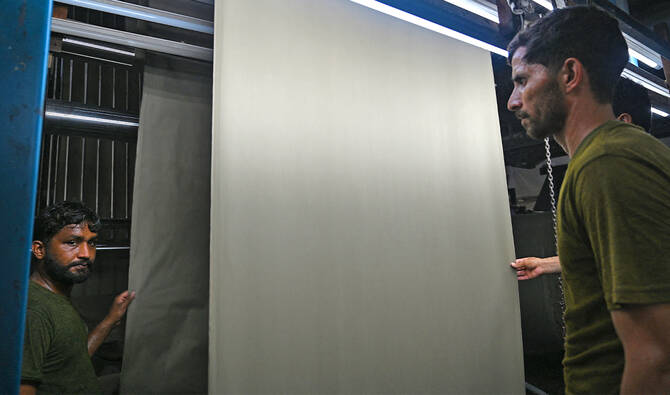
In this picture taken on July 20, 2023, workers monitor fabric as they work on a machine at the Kohinoor Textile Mills in Lahore. (AFP/File)
Short Url
Updated 04 June 2025
Follow

Pakistan textile union warns of capital flight to UAE, urges industrial policies to retain investment

  • APTMA chief urges government to remove yarn and fabric from the Export Facilitation Scheme in next budget
  • He says lack of favorable policies driving capital flight as textile exports fall over 13 percent between FY22 and FY24

KARACHI: Pakistan is facing the flight of capital, with local industrialists shifting their factories to investor-friendly Middle Eastern countries like the United Arab Emirates due to the lack of favorable industrialization policies at home, Kamran Arshad, chairman of the All Pakistan Textile Mills Association (APTMA), said on Tuesday.

APTMA represents more than 200 textile millers, which employ the country’s largest industrial workforce of more than 40 million people and account for half of the nation’s total exports. Its top official made the remark during an interview with Arab News just a week ahead of the country’s federal budget that is scheduled to be announced on June 10.

“Pakistani investors are now the second or third largest investors in places like Dubai,” he said during the conversation.

“Yes, there has been a flight of capital,” he continued, adding “had there been curbs and checks and balances on the flight of capital and favorable industrialization policies, the capital would have remained within Pakistan and it would have gone into agriculture and industry.”

Pakistan’s government is trying to turn around the country’s debt-ridden economy by curtailing imports and increasing exports with the help of the International Monetary Fund’s (IMF) loan program.

The government has emphasized its commitment to creating a more business-friendly environment in recent years, identifying textiles as a central driver in achieving a $60 billion export target by 2029 under its newly unveiled five-year economic framework.

Overall, the country’s exports rose six percent to $27 billion this year through April, but its textile exports declined more than 13 percent between FY22 and FY24 after hitting a record $19.3 billion in FY22.

Arshad maintained this was mainly due to the Export Facilitation Scheme (EFS) introduced last year that did not work well for the sector.

Originally envisaged to streamline and incentivize exports by allowing exporters duty- and tax-free access to inputs used in the production of export goods, the scheme benefited importers over local input producers by putting yarn and all varieties of fabric on the EFS.

By removing the sales tax exemption from domestically produced inputs like cottonseed and yarn while keeping imported equivalents tax-free, the scheme made local sourcing less competitive for Pakistani manufacturers.

“We fully expect that the government would be considerate and they would honor our request, our demand to remove yarn and fabric of all sorts from the EFS scheme and to create a level playing field,” the APTMA chief said.

Separately, at a news conference, he said that while hundreds of local industries had already closed, others were running at partial capacity.

“More than 120 spinning mills and over 800 ginning factories stand closed at the moment,” he said.

NO BUYER FOR US COTTON

Arshad said the government may not find buyers for the additional cotton it is expected to import from the US if the heavily taxed spinning and ginning factories continue to shut down at the current pace.

Pakistan and the US last week began negotiating their “reciprocal” trade tariffs, with Islamabad aiming to bridge its $3 billion trade surplus with Washington by buying more cotton and soybean to avoid the imposition of 29 percent tariffs on its exports to the US.

“Washington has indicated availability of up to 1.5 million bales for export to Pakistan,” the APTMA chairman told reporters at a press briefing.

In the ongoing trade talks, he said one of the offers the Americans were expected to make was the doubling or tripling of cotton exports to Pakistan, which uses cotton as a raw material for its textile industry that fetched $16.7 billion in exports last year.

The US is the biggest buyer of Pakistan’s exports, mostly textiles, which were valued at $5.44 billion last year through June, according to State Bank of Pakistan data.

US Charge d’Affaires Natalie A. Baker last month met Pakistan’s commerce minister, Jam Kamal Khan, and cited enhanced cooperation in the cotton sector as a key area for mutual growth, given Pakistan’s textile industry’s demand for high-quality cotton and the US ability to meet that demand.

“Who will buy this US cotton,” said Arshad, “while more than 120 spinning mills and 800 ginning factories have already shut down across the country.”

He noted the industry was already dealing with the carryover stocks of as much as 800,000 cotton bales from last year while the next crop was about to land.

Spinning mills consume most of Pakistan’s cotton output, which is falling and halved this year to 7.1 million bales after reaching a record 15 million bales in FY15, according to Pakistan Central Cotton Committee data.

Pakistan’s annual cotton consumption is about 15 million bales, but a poor crop made it the biggest importer of US raw cotton in FY23, when the dollar-strapped country had to spend billions on importing more than 4 million cotton bales, each weighing 170 kilograms.

Arshad said for Pakistan to absorb an increased amount of US cotton, a viable and operational spinning industry was essential.

“Without restoring competitiveness for domestic spinners, additional cotton imports will not materialize,” he added.

Pakistan’s finance adviser Khurram Schehzad declined to comment on issues related to the textile sector “before budget,” while finance ministry spokesperson Qamar Sarwar Abbasi did not respond to questions.


Pakistan’s interior minister accuses Imran Khan’s party of politicizing health issues

Updated 59 min 26 sec ago
Follow

Pakistan’s interior minister accuses Imran Khan’s party of politicizing health issues

  • Interior Minister Mohsin Naqvi rejects reports of Imran Khan losing 85 percent vision in his affected eye
  • Health concerns for Khan’s eye ailment have triggered protests and road closures in Khyber Pakhtunkhwa

ISLAMABAD: Pakistan Interior Minister Mohsin Naqvi on Tuesday accused former prime minister Imran Khan’s party of politicizing his health issues for mileage, reiterating that the government had granted him adequate medical treatment in prison. 

Naqvi’s response came hours after Khan’s Pakistan Tehreek-e-Insaf (PTI) party rejected a government-issued medical report on his eye condition, demanding authorities allow family members and his personal physician to examine him in prison. 

Health concerns emerged last week after a court-appointed lawyer, Barrister Salman Safdar, visited Khan at Rawalpindi’s Adiala Jail and reported that the former premier had suffered “severe vision loss” in his right eye due to central retinal vein occlusion (CRVO), leaving him with about 15 percent sight in the affected eye.

Jail authorities said a team of doctors from multiple hospitals examined Khan on Sunday and submitted findings to a court. A two-page medical document circulated on social media stated that unaided vision in Khan’s right eye was 6/24 and 6/9 in the left, improving to 6/9 (partial) and 6/6 respectively with glasses. While Naqvi has confirmed a medical report has been released, he did not discuss its findings. 

Speaking to reporters in Lahore during a press conference, the interior minister accused the PTI of creating a “propaganda” that Khan had lost 85 percent vision in his affected eye. 

“It is our obligation to tell people this much that whatever cells in your [PTI] party that are doing this, beware of them,” he said. “They are enemies of the people and are trying to do their politics under the guise of some other objectives.”

Naqvi said contrary to what the PTI was doing, the government did not want to politicize Khan’s eye ailment, adding that the welfare of every prisoner was its responsibility. 

“After all this thing I have come to the conclusion about some people [in PTI] that they care more about their politics than his [Khan’s] health,” he said. 

Sharing details of the checkup, Naqvi said he invited PTI Chairman Gohar Ali Khan to reach Rawalpindi’s Adiala jail, where Khan is imprisoned, to witness the former premier’s medical examination on Sunday. However, the minister said Gohar refused, citing party consultations.

He said Gohar, along with the opposition leaders in the Senate and National Assembly— Allama Raja Nasir Abbas and Mehmood Khan Achakzai--and their preferred doctors were invited to the Pakistan Institute of Medical Sciences (PIMS) for a briefing on Khan’s checkup. 

Naqvi said Gohar, Abbas and Achakzai, along with the doctors, expressed satisfaction over Khan’s examination. However, he alleged Khan’s sister Aleema Khanum told party members that if they accepted the government’s version, “the issue would die down.”

“You also got the medical report yesterday,” Naqvi told reporters. “And in it, all things are clear.”

Khan’s health concern has sparked protests by supporters, including demonstrations and road closures in the northwestern Khyber Pakhtunkhwa province where his party governs, and a sit-in outside parliament in Islamabad.

FORMER CAPTAINS RALLY FOR KHAN 

Separately, 14 former international cricket captains appealed to the government to grant Khan immediate medical treatment for his eye ailment, calling for “humane and dignified detention conditions” for the former Pakistan captain. 

The statement was issued on behalf of former captains Michael Atherton, Allan Border, Michael Brearley, Greg Chappell, Ian Chappell, Belinda Clark, Sunil Gavaskar, David Gower, Kim Hughes, Nasser Hussain, Clive Lloyd, Kapil Dev, Steve Waugh and John Wright. 

“As fellow cricketers who understand the values of fair play, honor, and respect that transcend the boundary rope, we believe that a person of Imran Khan’s stature deserves to be treated with the dignity and basic human consideration befitting a former national leader and a global sporting icon,” the statement read. 

The statement also called for “fair and transparent access” to legal processes for Khan without undue delay or hindrances.

Khan, a former cricket star who served as prime minister from 2018 to 2022 before being removed in a parliamentary vote of no confidence, has been in jail since August 2023 in multiple cases he says are politically motivated. The government denies the allegations.

Khan’s family members are expected to hold a press conference in the evening today outside Adiala jail on his health condition.
