

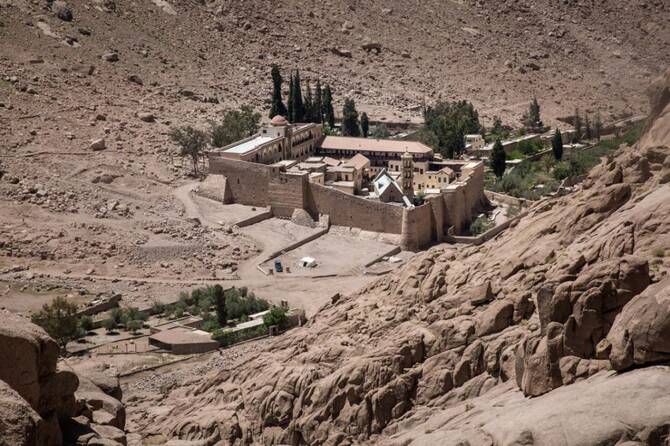

CAIRO: Nestled in the Sinai mountains, the ancient St Catherine's Monastery has been the centre of recent tensions after an Egyptian court ruled last week that it sat on state-owned land.
Dating back to the sixth century BC, the UNESCO World Heritage Site is the world's oldest continuously inhabited monastery, attracting hundreds of pilgrims and tourists every year.
Following warnings from the authorities and Orthodox Church in Greece that the ruling threatens the monastery's status, a government delegation is travelling from Athens to Cairo on Wednesday to discuss the situation.
The monastery was founded by Byzantine Emperor Justinian in the sixth century at the biblical site of the burning bush at the foot of Mount Sinai, where Moses was believed to have received the 10 commandments, according to the world's three major monotheistic religions.
It was named for Saint Catherine of Alexandria, whose remains are housed in the church, along with rare iconography and manuscripts.
It is headed by the Archbishop of Mount Sinai and Raithu, under the ecclesiastical jurisdiction of the Greek Orthodox Patriarchate of Jerusalem.
According to UNESCO, "the entire area is of immense spiritual significance" to Christianity, Islam and Judaism.
The organisation says the monastery is "the property of the Greek Orthodox Church and belongs to the Archdiocese of Sinai".
Last Wednesday, an Egyptian appeals court ruled that the monastery "is entitled to use" the land and the archaeological religious sites dotting the area, all of which "the state owns as public property".
The ruling, only a brief of which has been published by Egyptian media, has drawn criticism from the Orthodox patriarchates in Athens, Jerusalem and Istanbul.
Archbishop Ieronymos, head of the Greek Orthodox church in Athens, warned the monastery's property could now be "seized and confiscated".
Egypt has defended the court ruling, saying it "consolidates" the site's sacred status.
President Abdel Fattah al-Sisi said Egypt was "fully committed to preserving the unique and sacred religious status of Saint Catherine's monastery", in a phone call with Greek Prime Minister Kyriakos Mitsotakis.
Mitsotakis meanwhile emphasised the importance of "preserving the pilgrimage and Greek Orthodox character of the monastery".
The delegation from Athens is expected to lay out its position on Wednesday.
According to Greece's state news agency, that position "is supported by a UNESCO document, which proves that Egypt had acknowledged in writing since 2002 that the ownership of the land and buildings belongs to the Greek Orthodox Church and the Archdiocese of Sinai".
Construction began in March 2021 in the Saint Catherine area, which includes the eponymous town and a nature reserve, for a government megaproject known as the 'Great Transfiguration' of Saint Catherine.
The project aims to bring upwards of a million tourists a year to the serene mountain village.
Its many construction projects include an events hall, hundreds of hotel rooms and a new residential area housing hundreds of units.
Observers say the project has harmed the reserve's ecosystem and threatened both the monastery and the local community.
According to a report by World Heritage Watch, the project has "destroyed the integrity of this historical and biblical landscape".
UNESCO in 2023 requested that Egypt "halt the implementation of any further development projects", conduct an impact evaluation and develop a conservation plan.
The government, which is campaigning for former tourism and antiquities minister Khaled al-Enany to head UNESCO from October, said in January that 90 percent of the project was complete.
The peaks and valleys around Saint Catherine attract large groups of hikers, peaking at 2,000 visitors to Mount Sinai in a single day last December, local authorities reported.
The area, 1.5 kilometres (one mile) above sea level, is particularly popular with both Egyptians and foreign tourists seeking a reprieve from overcrowded Red Sea resorts elsewhere in Sinai.
The area is home to the Jabaliya tribe, whose name derives from the Arabic word for "mountain".
Said to be the descendants of the Roman soldiers who came to guard the monastery in its early days, they maintain a close connection to Saint Catherine, with many working as tour guides today.
For decades, they have been calling for better infrastructure, including reliable water supply, emergency services and telecommunications coverage to improve their work and daily life.
According to World Heritage Watch, they are currently outnumbered by the thousands of labourers building the megaproject.


