

Azerbaijan’s quiet diplomacy between Turkiye and Israel

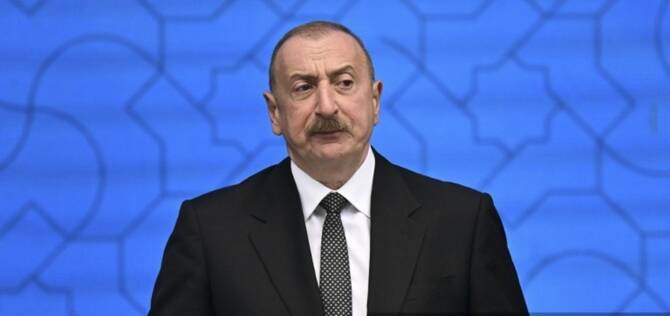
Azerbaijani President Ilham Aliyev delivers a speech during the event held within Azerbaijan Independence Day in Lachin, Azerbaijan. (AFP)
Short Url
Updated 03 June 2025
Follow

Azerbaijan’s quiet diplomacy between Turkiye and Israel

BAKU: With growing influence after its recapture of Nagorno-Karabakh from Armenian separatists in 2023, Azerbaijan is using its close ties with Israel and Turkiye to defuse tensions between the regional foes in Syria.
Azerbaijan’s top foreign policy adviser Hikmet Hajjiyev confirmed Baku has hosted more than three rounds of talks between Turkiye and Israel, who are both operating in Syria to reduce what they see as security threats.
“Azerbaijan is making diplomatic efforts for an agreement,” Hajjiyev told Turkish journalists in Baku on a visit organized by the Istanbul-based Global Journalism Council.
“Both Turkiye and Israel trust us.”
The overthrow of Syrian strongman Bashar Assad by Islamist-led HTS rebels, with Turkiye’s blessing, sparked security concerns in Israel.
It has since staged hundreds of strikes deep inside Syria, the latest on Friday, to allegedly stop advanced weapons falling into the hands of Syria’s new authorities whom it sees as jihadists.
Israel has accused Ankara of seeking to turn Syria into a Turkish protectorate, raising fears of a confrontation.
As a close ally and strategic partner of Turkiye, Azerbaijan has consistently aligned itself with Ankara’s positions on key international matters, including the Syrian issue.
But it also enjoys good relations with Israel — which is very reliant on Azerbaijani oil, and is a major arms supplier to Baku.
And now Baku, which has established contacts with Syria’s new rulers, is pushing quiet diplomacy by facilitating technical talks between Turkiye and Israel.
“We are successful if the two parties agree on a common model that respects each other’s concerns,” Farid Shafiyev, chairman of the Baku-based Center for Analysis of International Relations, told AFP.
“Syria, and especially its northern territories, is the Turkish security concern because of the presence of terrorist groups,” notably Kurdish fighters, he said.
Turkiye wants to control northern Syria but also to “have a stronger presence” around the Palmyra and T4 air bases to ensure security around Damascus, he added.

Ties between Turkiye and Israel have been shattered by Israel’s war against Hamas in Gaza, with Ankara insisting the talks were only technical.
“As long as the war in Gaza continues, Turkiye will not normalize ties with Israel,” a senior Turkish official told AFP on condition of anonymity.
Turkiye has suspended trade with Israel over the war in Gaza.
But some Turkish opposition figures have criticized Ankara, claiming trade has continued, notably oil shipments via the Baku-Tbilisi-Ceyhan pipeline which brings Azerbaijani oil to the southern port of Ceyhan from where it is shipped to Israel.
Turkiye’s energy ministry has dismissed the claims as “completely unfounded.”
Azerbaijan’s Hajjiyev said Baku had won valuable support from Israel during the Karabakh conflict, but seemed reluctant to comment on the issue of oil.
“We bought weapons from Israel during the war, we paid for them (and) Israel gave us diplomatic support,” he said.
“Azeri oil is coming to Ceyhan, but once that oil is loaded onto ships that sail on the open seas, you cannot control the final destination,” he said.
“These are the rules of the world oil market.”

In facilitating Turkiye-Israel dialogue on Syria, Azerbaijan is playing a “strategic role,” said Zaur Mammadov, chairman of Baku Political Scientists Club.
“(It) reflects Azerbaijan’s growing influence as a mediator... among regional actors,” he said.
Azerbaijan fought two wars with arch-foe Armenia for control of the disputed Karabakh region — one in the 1990s and another in 2020 — before it managed to seize the entire area in a 24-hour offensive in September 2023.
Baku is now trying to normalize ties with Yerevan — which, if successful, would be a major breakthrough in a region where major actors including Russia and Turkiye all jostle for influence.
Turkish analyst Serkan Demirtas said Azerbaijan had stepped in to head off a potential clash between Turkiye and Israel over their opposing security concerns in post-Assad Syria.
“A confrontation between its two best allies in the region is a situation Azerbaijan does not want at all,” he said.
“Incoming news shows that progress has been made. This indicates the growing influence of hydrocarbon-rich Azerbaijan in the region after the Karabakh war.”
fo/hmw/giv


China foreign minister blasts Middle East war, urges US to manage ties

Updated 4 sec ago
Follow

China foreign minister blasts Middle East war, urges US to manage ties

  • Wang Yi: ‘A strong fist does not mean strong reason. The world cannot return to the law of the jungle’
BEIJING: China’s top diplomat condemned on Sunday the war in the Middle East and urged the United States to iron out its differences with Beijing.
Foreign Minister Wang Yi told a press conference in the Chinese capital that the war, which was sparked by US and Israeli strikes on Iran, “should never have happened.”
“A strong fist does not mean strong reason. The world cannot return to the law of the jungle,” he told reporters.
He was speaking during China’s annual political gathering, which began this week, known as the “Two Sessions.”
The parallel meetings of China’s parliament and political consultative body are closely watched for clues as to the priorities of top leaders, in the face of a precarious geopolitical landscape
Wang addressed a range of issues, including a trade war with the United States, regional tensions in the South China Sea, as well as wars in the Middle East and Ukraine.
“This year is indeed a big year for Sino-US relations,” Wang said.
‘Manage differences’
Ties between China and the United States have been strained since US President Donald Trump returned to the White House last year, followed by a trade war that saw the two countries impose tit-for-tat tariffs on each other’s products.
“We observe certain country erecting tariff barriers and pursuing decoupling and supply chain disruption,” Wang said on Sunday.
“These actions are akin to trying to extinguish a fire with fuel. Ultimately, they will backfire and harm itself.”
While China and the United States “cannot change each other,” he said, “we can change the way we interact with each other.”
Wang urged both sides to “create a suitable environment, manage existing differences, and eliminate unnecessary interference.”
But a wide range of disagreements remain.
Beijing has blasted US and Israeli military strikes on Iran, with which it has diplomatic and trade ties.
It has in particular condemned the killing of the country’s supreme leader Ayatollah Ali Khamenei.
Wang also maintained that China’s relations with Moscow, which have been criticized by Western countries for sustaining the war in Ukraine, remained “steadfast and unshakeable.”
China ‘gym’
China has sought to profit off Trump’s volatile foreign policies, positioning itself as a reliable alternative to once traditional US allies.
Leaders from France, Canada, Finland and the United Kingdom, among others, have flocked to Beijing, recoiling from Trump’s bid to seize Greenland and tariff threats against fellow NATO members.
Wang welcomed the visits on Sunday, saying “we have noticed that more and more insightful Europeans agree that China is not a competitor, but a global partner.”
“We welcome our European friends to step out of the ‘small attic’ of protectionism and come to the ‘gym’ of the Chinese market, where they can strengthen their muscles and enhance their competitiveness,” he said.
In the spirit of warming relations, China has doled out visa-free travel agreements to around 50 countries including France, Germany, and the United Kingdom.
Beijing has also agreed to reduced tariffs with Ottawa and London in their exports to China.
Wang also addressed relations between China and Japan, which have been locked in a spat after comments by Prime Minister Sanae Takaichi in November that Tokyo could intervene militarily in any attack on self-ruled Taiwan.
Takaichi’s comments enraged Beijing, which views Taiwan as its territory and has not ruled out taking by force.
Wang emphasized on Sunday that Beijing “will never allow anyone or any force to separate Taiwan … from China once again.”
He warned Japan against “repeating the same disastrous mistakes,” adding that China “will never allow anyone to stand up for colonialism,” in an apparent reference to Tokyo’s actions during World War II.
The issue of Taiwan, he insisted, is “at the heart of China’s core interests” and “a red line that must not be crossed or trampled on.”