

Drama therapy workshop in Jeddah explores healing power of expression

1 / 2
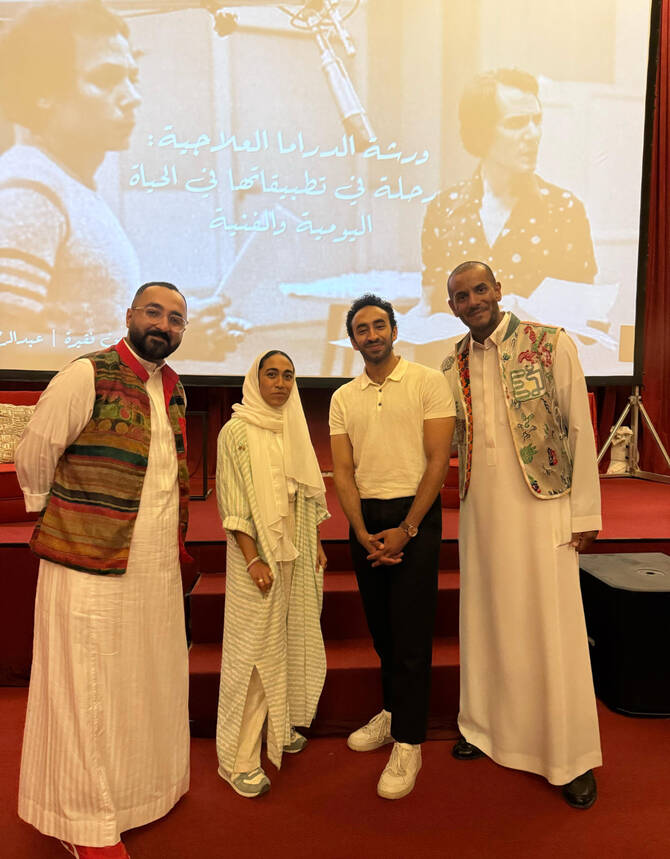
Psychologist Lujain Faqerah and actor Abdul Al-Shareef, center, with attendees at the drama therapy workshop in Jeddah. (Supplied)
2 / 2
Psychologist Lujain Faqerah and actor Abdul Al-Shareef. (Supplied)
Short Url
Updated 02 June 2025
Follow

Drama therapy workshop in Jeddah explores healing power of expression

  • Faqerah told Arab News: “Drama is integrated naturally in our daily responses and situations

JEDDAH: A drama therapy workshop was recently organized under the theme: “In drama we find the power to express, and in expression we find the power to heal,” at Cinema Al-Balad in Jeddah.

Led by Lujain Faqerah, senior psychologist and creative arts supervisor, in collaboration with actor and screenwriter Abdul Al-Shareef, the workshop explored the use of drama therapy in daily life and creative work.

Participants, including therapists, creatives, and others, learned how drama can support emotional awareness, healing, and connection.

The workshop showed how drama-based therapeutic techniques can help people access unconscious behaviors, foster self-expression, and improve creative practices such as screenwriting and acting.

Faqerah told Arab News: “Drama is integrated naturally in our daily responses and situations. In a therapeutic setting, it helps us observe these interactions and reflect on a deeper level of our unconscious body gestures and movements that might reveal a lot about our personalities.”

She made it clear that drama therapy is not about performing but about expressing what lies beneath — emotions, memories, or internal conflicts.

Faqerah said: “The word drama has a negative connotation to the extent that people reject it before trying. Drama therapy does not depend on acting skills or previous experience, but more on your self-expression and the challenges you experience.”

Her discovery of drama therapy was transformative. “It surprised me with the appearance of a hidden part of me that is more bold and confident. When this part emerged and I saw the benefits myself, I started incorporating it in my profession.”

Al-Shareef brought a creative perspective as an actor and screenwriter new to drama therapy but interested in its techniques.

“As an actor and a writer, I found this experiment with drama supervision and therapy fascinating. It’s a tool that I am willing to explore and learn more about to enhance my life and practice,” he said.

“Some people may think drama therapy is exclusively for artists, but it’s not. The techniques can be integrated into everyday routines, varying from person to person depending on their challenges.”


UNESCO honors Al-Bisht Al-Hasawi as thousands flock to Al-Ahsa festival

Updated 06 February 2026
Follow

UNESCO honors Al-Bisht Al-Hasawi as thousands flock to Al-Ahsa festival

RIYADH: The third edition of Al-Bisht Al-Hasawi Festival is drawing thousands of local and international visitors to Ibrahim Palace in Al-Hofuf.

Running until Feb. 7 at the historic palace, the event features a bisht exhibition, a rare bisht gallery, a handicrafts zone and workshops led by skilled artisans.

The festival showcases a convergence of cultures, with international pavilions highlighting the global appeal of this authentic Saudi heritage. 

The bisht’s allure has drawn international visitors eager to explore Al-Ahsa’s rich history and traditional crafts.

Tourists enthusiastically don the traditional robe, admiring its royal designs. Many participate in workshops with master artisans, learning the intricate art of Zari embroidery.

Organized by the Heritage Commission, this year’s festival celebrates the inscription of the bisht on UNESCO’s Representative List of the Intangible Cultural Heritage of Humanity, the Saudi Press Agency reported.

The event showcases Al-Ahsa’s centuries-old tradition of hand-weaving and gold embroidery, a craft passed down through generations of local families.

Visitors can explore interactive displays, participate in live workshops, and witness the meticulous process of tailoring this iconic symbol of prestige.

With UNESCO’s participation and representatives from six countries, the festival has evolved into a global platform for cultural dialogue, cementing the bisht’s status as a world-class cultural treasure.

At the heart of the festival is the story of the “Golden Threads” (Al-Zari), intricate gold-plated silver threads that define the bisht’s character and prestige.

Visitors can discover them in the Golden Threads VIP Area, where they can watch master artisans demonstrate the full bisht-making process at the Host’s Majlis, offering insight into Al-Ahsa’s centuries-old craftsmanship.