

Pakistan’s Air Sial launches inaugural flight to UAE

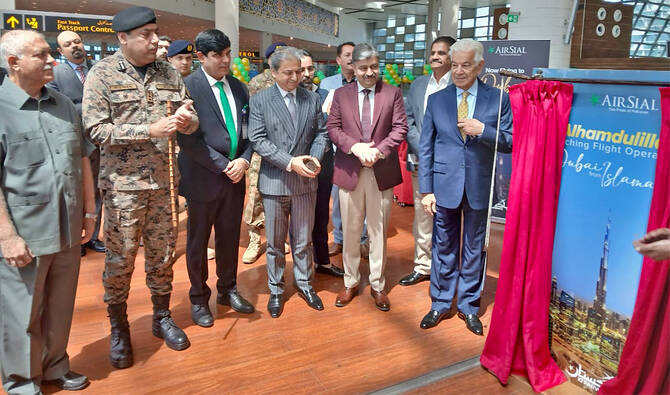
Pakistan's Defence Minister Khawaja Asif (right) and other officials of Air Sial inaugurat its first flight to UAE in Islamabad, Pakistan, on June 2, 2025. (Air Sial)
Short Url
Updated 02 June 2025
Follow

Pakistan’s Air Sial launches inaugural flight to UAE

  • Flight took off from Islamabad around 11:34am with 137 passengers aboard
  • The Pakistani airline already operates flights to cities in Saudi Arabia and Oman

ISLAMABAD: Air Sial, a Pakistani private airline, has launched its first flight to the United Arab Emirates, it said on Monday, in a significant development for the Pakistani aviation industry.

Inaugurated in 2020 by the Sialkot Chambers of Commerce and Industry, the airline initially aimed to improve air travel to and from Pakistan’s Sialkot city, a major industrial hub in the eastern Punjab province.
Over the years, Air Sial has expanded its operations not just countrywide, but to countries in the Gulf region and uses a fleet of modern Airbus A320 aircraft.

“Pakistan Airports Authority successfully facilitated and supervised the launch of Air Sial’s inaugural international flight (PF784) from Islamabad International Airport to Dubai,” Air Sial said on Monday, adding the flight departed around 11:34am with 137 passengers aboard.

Air Sial’s domestic network includes major cities like Karachi, Lahore, Islamabad, Sialkot, Quetta and Multan.

The airline entered the international market in March 2023 with the launch of its inaugural flight to Jeddah, Saudi Arabia. It also flies to Riyadh, Madinah and Dammam.

Air Sial extended its international reach the same year in June by launching direct flights from Pakistan to Oman.

Late last month, the state-run Pakistan International Airlines (PIA) also resumed direct flights between Dubai and Pakistan’s mountainous Skardu district in a bid to boost tourism.


Pakistan Airports Authority reports ‘historic’ twin-engine aircraft landing in Lahore

Updated 13 December 2025
Follow

Pakistan Airports Authority reports ‘historic’ twin-engine aircraft landing in Lahore

  • Twin-engine aircraft are usually larger, heavier and require better airport infrastructure, navigation systems to land
  • Pakistan Airports Authority says landing reflects its commitment to enhance aviation sector, strengthen infrastructure

ISLAMABAD: The Pakistan Airports Authority (PAA) announced on Saturday that the New General Aviation Aerodrome achieved a significant milestone when it handled the landing of a twin-engine aircraft. 

A twin-engine aircraft has two engines that provide it redundancy and increased performance compared to single-engine counterparts. These aircraft range from small twin-engine propeller planes to large commercial jetliners. The presence of multiple engines enhances safety by allowing the aircraft to continue flying in the event of an engine failure.

However, twin-engine aircraft are usually larger, heavier and more complex than single-engine planes. They require advanced airport infrastructure such as better runways, navigation systems and air traffic coordination. 

“The New General Aviation Aerodrome, Lahore achieved another significant operational milestone today with the successful landing of a twin-engine aircraft, following the recent arrival of a single-engine aircraft,” the PAA said in a statement. 

It said the flight was also boarded by Air Vice Marshal Zeeshan Saeed, the director general of the PAA. The move reflected “strong institutional confidence” in the aerodrome’s safety standards, operational capability, and overall readiness, it added. 

“The landing was conducted with exceptional precision and professionalism, demonstrating the aerodrome’s robust operational framework, technical preparedness, and effective airside coordination in accordance with contemporary aviation requirements,” the PAA said. 

It said the landing represented a “major advancement” in Pakistan’s general aviation sector and underscores the PAA’s commitment to enhancing regional aviation capacity, strengthening infrastructure and promoting excellence in aviation development.