

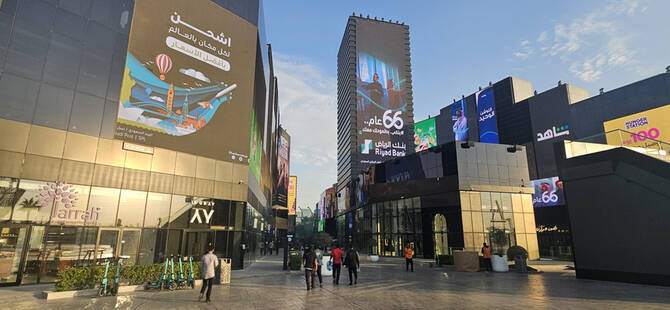

RIYADH: Saudi Arabia’s capital is spearheading the Kingdom’s retail transformation, with mall rents up by 4 percent in a year and 2.2 million sq. meters of shop space to be developed by 2030.
According to Knight Frank’s Spring 2025 Saudi Arabia Retail Market Overview, Riyadh accounts for the largest share of the 4.9 million sq. meters of retail developments planned across the Kingdom’s five largest cities by 2030.
These areas include Jeddah, Dammam Metropolitan Area, Khobar, and Dhahran.
The need for more retail space is evidenced by the average mall rent in the Saudi capital rising to SR2,848 ($765) per sq. meter by the end of March, according to the report, with occupancy rates up five percent to reach 92 percent in the first quarter of 2025.
The findings come as Saudi Arabia steps up efforts to become a global hub for tourism and business by the end of the decade, with the Real Estate General Authority projecting the property market to reach $101.62 billion by 2029, driven by an anticipated compound annual growth rate of 8 percent from 2024.
According to Knight Frank, Riyadh’s retail transformation is being accelerated by a combination of population growth, both domestic and expatriate, along with rising disposable incomes.
“Developers are prioritizing experiential formats, with over half of upcoming projects incorporating entertainment zones, dining experiences, and cinemas. These trends align with Vision 2030’s objective to create vibrant, leisure-centric urban spaces,” the report said.
In Jeddah, the retail market expanded with approximately 225,000 sq. meters of new space delivered in 2024, including Phase 1 of Souq 7 and Al Bahr Mall. The city’s total retail stock reached 2.9 million sq. meters. Rents in regional and super-regional malls rose two percent to SR2,513 per sq. meter, while occupancy declined slightly to 86 percent.
Jeddah is also set to see the launch of the Jawharat Mall by Cenomi Centers, a dedicated luxury retail district spanning 87,000 sq. meters, expected to be completed by the end of 2025. Another significant development, the Cove by Ezdihar, will deliver 70,000 sq. meters along Jeddah’s waterfront.
In the Dammam Metropolitan Area, retail performance remained stable. Rents in regional and super-regional malls rose slightly to SR2,285 per sq. meter, with community centers seeing a 1.25 percent increase. Occupancy rates held steady at around 90 percent.
New supply additions of 31,000 sq. meters in 2024 brought total retail stock to 1.4 million sq. meters.
Regional malls typically range from 30,000 sq. meters to 90,000 sq. meters and offer a broad mix of retail stores and services, often anchored by one or two department stores.
Super-regional malls exceed 90,000 sq. meters and include a wider variety of retail, dining, and entertainment options, serving a larger trade area and drawing visitors from across an entire metropolitan region.
Consumer spending in Saudi Arabia grew by 7 percent year-on-year to reach SR1.41 trillion in 2024, fueled by a surge in point-of-sale and e-commerce transactions, according to Knight Frank.
Of this, point-of-sale transactions reached SR668 billion, marking a 9 percent annual increase, while e-commerce grew by 26 percent to SR197.4 billion, reflecting the Kingdom’s accelerating shift toward digital consumption
Flagship destinations such as Riyadh Park and Al Nakheel Mall have continued to benefit from strong tenant demand and rising foot traffic, driven by integrated entertainment offerings, including cinemas and family attractions.
Riyadh’s total retail supply stood at 4 million sq. meters during the first quarter, bolstered by the launch of key projects like Solitaire Riyadh, a 65,000 sq. meter development blending upscale retail with leisure experiences.
An additional 540,000 sq. meters of retail space is expected to be added in 2025, bringing the total to 5.2 million sq. meters in 2026.
The report highlights that more than half of the upcoming projects are integrating entertainment zones, dining venues, and cinemas, aligning with Vision 2030’s goals of creating vibrant, leisure-centric urban environments.
Luxury retail is also gaining momentum, with international brands expanding their footprint to meet the growing demand for premium shopping.
Omnichannel strategies are becoming critical as digital payments and e-commerce continue to reshape consumer behavior.
The food and beverage sector emerged as a key contributor to retail activity, with restaurants and cafes accounting for 29.7 percent of all point-of-sale transactions in 2024.
This translates to SR198.6 billion, according to data from the Saudi Central Bank.
Projects such as Qiddiya, The Avenues Riyadh, and Jawharat Riyadh are expected to further redefine the urban retail landscape, offering lifestyle-oriented spaces that support the Kingdom’s broader economic diversification and quality-of-life goals.


