

Islamabad mulls new regulator to oversee digital finance and crypto ecosystem

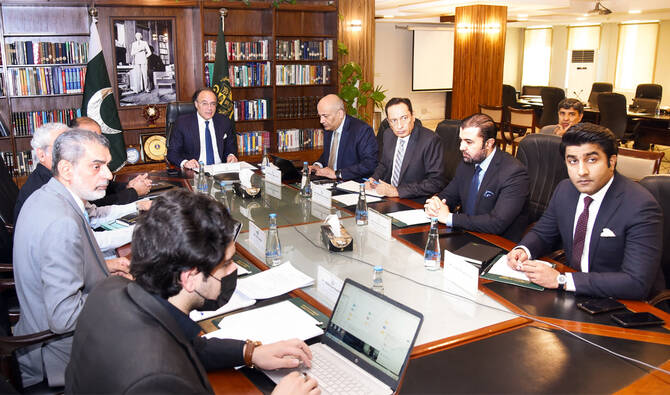
Federal Minister for Finance and Revenue Muhammad Aurangzeb (center) chairs a meeting of the Pakistan Crypto Council to discuss the draft regulatory framework for digital and virtual assets, in Islamabad on June 2, 2025. (Ministry of Finance, Pakistan)
Short Url
Updated 02 June 2025
Follow

Islamabad mulls new regulator to oversee digital finance and crypto ecosystem

  • The development comes months after Islamabad set up a crypto council to formulate legal framework for cryptocurrency trading
  • In April, Pakistan introduced its first-ever policy framework on how cryptocurrencies and the firms dealing in it will operate

KARACHI: Pakistan is mulling a new virtual asset regulator to oversee digital finance and cryptocurrency ecosystem in the country, it emerged on Monday, following a meeting of the Pakistan Crypto Council (PCC).

Pakistan set up the PCC in March to create a legal framework for cryptocurrency trading in a bid to lure international investment. In April, Pakistan introduced its first-ever policy framework to set rules for how digital money like cryptocurrencies and the companies that deal in it should operate in Pakistan. The policy has been formulated to align with compliance and financial integrity guidelines of the global Financial Action Task Force (FATF).

Last month, the government also approved setting up the Pakistan Virtual Assets Regulatory Authority (PVARA), a specialized regulatory body to oversee blockchain-based financial infrastructure.

On Monday, Finance Minister Muhammad Aurangzeb presided over a PCC meeting on the draft regulatory framework for digital and virtual assets in Pakistan, aiming to align with international standards and evolving technological trends.

“Participants also discussed various options around the establishment of an autonomous regulatory authority to oversee and regulate the digital finance and crypto ecosystem in the country,” the Pakistani finance ministry said after the meeting.

“It was agreed to constitute a technical committee comprising representatives from SBP (State Bank of Pakistan), SECP (Securities and Exchange Commission of Pakistan), Law Division, and IT & Telecom Division. The committee will review the draft laws and propose a robust framework and governance structure to be reviewed by the Pakistan Crypto Council in its next meeting.”

During the meeting, the ministry said, the PCC members provided valuable input to ensure a secure, transparent, and innovation-friendly regulatory environment, with the goal of promoting responsible blockchain adoption, safeguarding investors and advancing financial inclusion.

Finance Minister Aurangzeb, who is also the PCC chairman, appreciated the contributions of all stakeholders and reaffirmed the government’s commitment to building a future-ready financial infrastructure that supports innovation while maintaining financial stability and regulatory compliance.

Late last month, Pakistan announced the allocation of 2,000 megawatts (MW) of electricity in the first phase of a national initiative to power bitcoin mining and artificial intelligence data centers. The allocation is the first phase of a broader, multi-stage digital infrastructure roll-out.

Bilal Bin Saqib, the CEO of the Pakistan Crypto Council, last week unveiled the country’s first government-led strategic bitcoin reserve at the Bitcoin 2025 conference in Las Vegas.

However, the central bank said it had not declared virtual assets illegal but had in 2018 advised regulated entities to avoid dealing in virtual currency “due to the absence of any legal and regulatory framework.”

“This was done to protect its regulated entities and their customers from the risks emanating due to the absence of legal and regulatory framework for VAs in the country,” the central bank said in a statement last week.

“The SBP and Finance Division are currently engaged with the Pakistan Crypto Council established by the Federal Government for, among others, developing an appropriate legal and regulatory framework for VAs in Pakistan. We understand that the legal and regulatory framework would provide the requisite clarity and legal coverage about the VAs ensuring consumer and investor protection.”


US approves sale of $686 million tech upgrade, equipment for Pakistan’s F-16 fighter jets

Updated 4 sec ago
Follow

US approves sale of $686 million tech upgrade, equipment for Pakistan’s F-16 fighter jets

  • US Defense Security Coope­ration Age­ncy informs Congress sale will allow Pakistan to partner with US in counterterror efforts, won’t alter regional military balance
  • Non-Major Defense Equipment includes aircraft hardware and software modifications, precision navigation, cryptographic devices, and spare and repair parts

ISLAMABAD: The United States has approved the sale of advanced technology support and equipment for Pakistan’s F-16 fighter jets valued at $686 million, according to a letter sent by the US Defense Security Coope­ration Age­ncy (DSCA) to the American Congress, saying the move would allow Islamabad to partner with Washington in ongoing counterterrorism efforts. 

As per a copy of the document dated Dec. 8 seen by Arab News, the letter stated that Islamabad has requested to buy 92 Link-16 systems communication/data-sharing networks and six Mk–82 inert 500-lb general purpose bomb bodies. The letter also said that the sale includes non-Major Defense Equipment items such as aircraft hardware and software modifications, precision navigation, cryptographic devices, other weapons integration, test and support equipment such as spare and repair parts. 

“The estimated total cost is $686 million,” the DSCA’s letter to Congress reads. “This proposed sale will support the foreign policy and national security objectives of the United States by allowing Pakistan to retain interoperability with US and partner forces in ongoing counterterrorism efforts and in preparation for future contingency operations.”

Pakistan and the US have been key allies in battling militants in the region, with Islamabad counted among Washington’s closes non-NATO allies during the “War on Terror” campaign. The proposed sale takes place as Washington, under US President Donald Trump, warms up to Pakistan after his recent meetings with Prime Minister Shehbaz Sharif and Chief of Defense Forces Field Marshal Syed Asim Munir. 

The DSCA letter said the sale will maintain Pakistan’s capability to meet current and future threats by updating and refurbishing its Block–52 and Mid Life Upgrade F–16 fleet. 

“These updates will provide more seamless integration and interoperability between the Pakistan Air Force and the US Air Force in combat operations, exercises, and training, and refurbishment will extend the aircraft life through 2040 while addressing critical flight safety concerns,” the letter added. 

It further said Pakistan has shown a commitment to maintaining its military forces and “will have no difficulty” absorbing these articles into its armed forces. 

“The proposed sale of this equipment and support will not alter the basic military balance in the region,” the letter said. 

The principal contractor for the deal will be Lockheed Martin Company, the DSCA said, adding that the implementation of the sale will not require the assignment of any additional US government or contractor representatives to Pakistan. 

“All defense articles and services listed in this transmittal have been authorized for release and export to the Government of Pakistan,” the letter concluded. 

The development takes place as Pakistan undertakes efforts to expand its fleet of fighter jets, defense exports and deepen military-industrial partnerships with other countries. Islamabad claimed last month that a “friendly country” signed a memorandum of understanding to procure Pakistan’s JF-17 fighter aircraft during the Dubai Airshow 2025. 

The JF-17 Thunder, a multi-role fighter that Pakistan jointly developed with China, has become the backbone of the Pakistan Air Force (PAF) over the past decade. It is designed to replace aging legacy aircraft. 

The South Asian country has been eager to assert its regional dominance, especially when it comes to air warfare, after its four-day military confrontation with India in May. 

Pakistan claimed it shot down seven Indian fighter jets during the May altercation between the two forces. Indian officials have acknowledged their planes were shot down but have refused to share the exact number, rejecting Pakistan’s claim it had shot down seven.