

At least 34 dead in India’s northeast after heavy floods

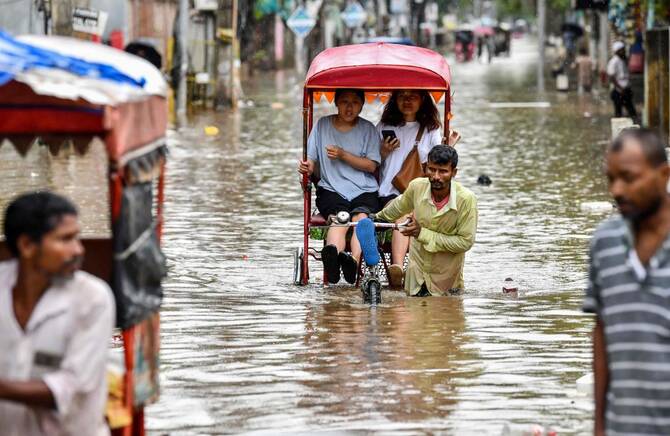
Women commute in cycle rickshaws through a flooded street after heavy rains in Guwahati, in India's Assam state on May 31, 2025. (AFP)
Short Url
Updated 02 June 2025
Follow

At least 34 dead in India’s northeast after heavy floods

  • More than a thousand tourists trapped in the Himalayan state of Sikkim were being evacuated
  • Authorities have warned of further landslides and flash floods

BHUBANESWAR/DHAKA: At least 34 people have died in India’s northeastern region after heavy floods caused landslides over the last four days, authorities and media said on Monday, and the weather department predicted more heavy rain.

More than a thousand tourists trapped in the Himalayan state of Sikkim were being evacuated on Monday, a government statement said, and army rescue teams were pressed into service in Meghalaya state to rescue more than 500 people stranded in flooded areas.

Torrential rains in northeast India resulted in a deadly landslide that crushed and killed three soldiers with six more missing, the Indian army said Monday.

In neighboring Bangladesh, at least four members of a family were killed in a landslide in the northeastern district of Sylhet, while hundreds of shelters have been opened across the hilly districts of Rangamati, Bandarban, and Khagrachhari on Sunday.

Authorities have warned of further landslides and flash floods, urging residents in vulnerable areas to remain alert.

India’s northeast and Bangladesh are prone to torrential rains that set off deadly landslides and flash floods, affecting millions of people every year.

Roads and houses in Assam’s Silchar city were flooded, visuals from news agency ANI showed, and fallen trees littered the roads.

“We are facing a lot of challenges. I have a child, their bed is submerged in water. What will we do in such a situation? We keep ourselves awake throughout the night,” Sonu Devi, a resident of Silchar, told ANI.


Afghanistan says working with Tajikistan to investigate deadly border clash

Updated 9 sec ago
Follow

Afghanistan says working with Tajikistan to investigate deadly border clash

  • Tajikistan shares a mountainous border of about 1,350 kilometers (839 miles) with Afghanistan and has had tense relations with Kabul’s Taliban authorities, who returned to power in 2021

KABUL: Afghanistan’s Taliban authorities said Saturday they were working with neighboring Tajikistan to investigate a border clash earlier this week that killed five people, including two Tajik guards.
Tajikistan announced on Thursday that three members of a “terrorist” group had crossed into the Central Asian country “illegally” at Khatlon province, which borders Afghanistan.
Tajik security forces killed the trio, but two border guards also died in the clash, the Tajik national security committee said.
Afghan Foreign Minister Amir Khan Muttaqi said on Saturday that “we have started serious investigations into” the recent “incidents” on Tajik soil.
“I spoke to the foreign minister of Tajikistan and we are working together to prevent such incidents,” he told an event in Kabul.
“We are worried that some malicious circles want to destroy the relations between two neighboring countries,” the minister added, without elaborating.
Tajikistan shares a mountainous border of about 1,350 kilometers (839 miles) with Afghanistan and has had tense relations with Kabul’s Taliban authorities, who returned to power in 2021.
Unlike other Central Asian leaders, Tajik President Emomali Rakhmon, who has been in power since 1992, has criticized the Taliban and urged them to respect the rights of ethnic Tajiks in Afghanistan.
At least five Chinese nationals were killed and several wounded in two separate attacks along the border with Afghanistan in late November and early December, according to Tajik authorities.
According to a UN report in December, the jihadist group Jamaat Ansarullah “has fighters spread across different regions of Afghanistan” with a primary goal “to destabilize the situation in Tajikistan.”
Dushanbe is also concerned about the presence in Afghanistan of members of the terrorist organization Daesh in Khorasan.