

Violent Pakistan storms trigger floods, landslides killing 10

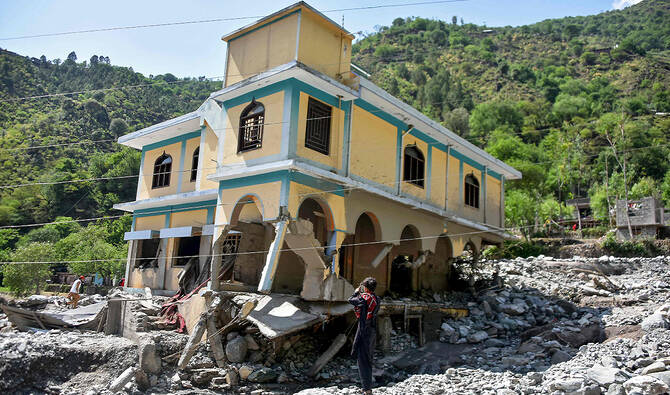
A man takes pictures of a damaged mosque, a day after flash floods in Balgran village near Muzaffarabad, capital of Pakistan-administered Kashmir on May 28, 2025. (AFP)
Short Url
Updated 29 May 2025
Follow

Violent Pakistan storms trigger floods, landslides killing 10

  • Strong winds, thunderstorms trigger flash floods, destroy homes in central and northern parts of Pakistan
  • Storms on Saturday killed at least 14 people and injured more than 100 more across the country

Muzaffarabad, Pakistan: At least 10 people were killed and 43 injured as strong winds and thunderstorms triggered flash floods and destroyed homes in central and northern parts of Pakistan, officials said Wednesday.

Four women and a man died in Pakistan-administered Kashmir and three in northwestern Khyber Pakhtunkhwa, the State Disaster Management Authority said, while other officials said two died in Punjab.

“One person is still missing,” Haroon Rasheed, a senior government official in Pakistan-administered Kashmir, told AFP, adding that 12 houses and a mosque were destroyed in one village.
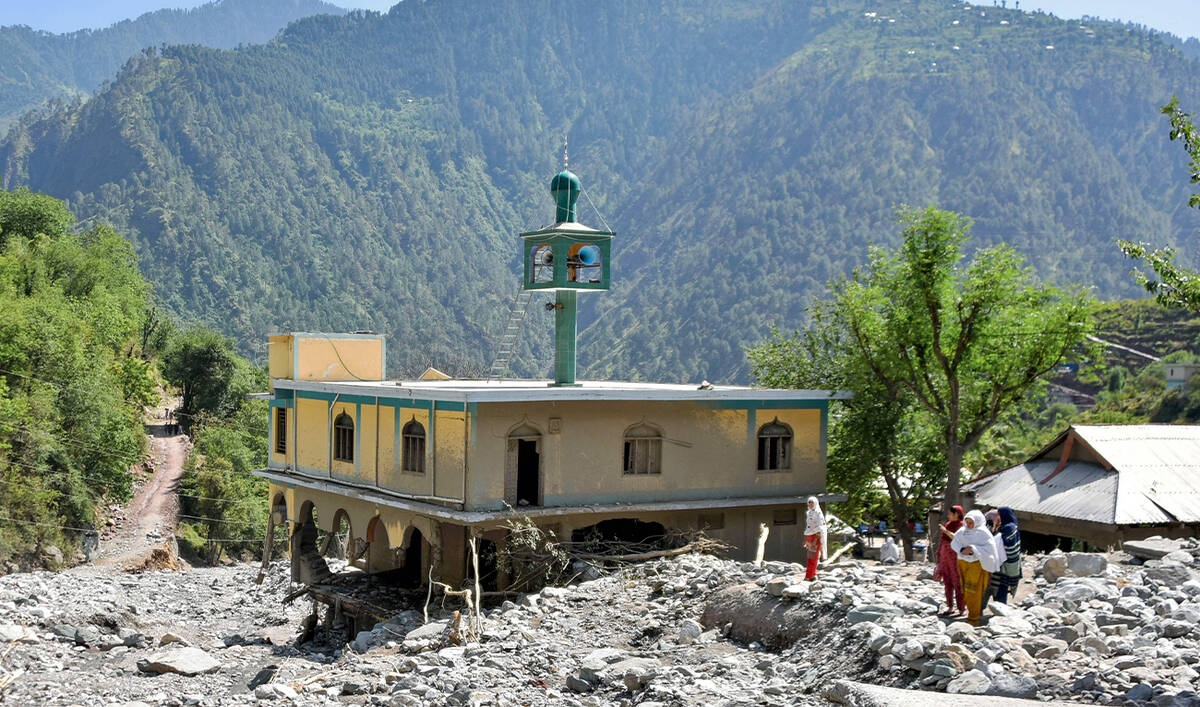


Women walk past a damaged mosque, a day after flash floods in Balgran village near Muzaffarabad, capital of Pakistan-administered Kashmir on May 28, 2025. (AFP)

Storms on Saturday killed at least 14 people and injured over 100 more across the country, which is grappling with increasingly frequent extreme weather events blamed on climate change.

Stormy weather is expected to continue in northern and central parts of the country until Saturday, according to the National Disaster Management Authority.

Soaring temperatures in April and May are becoming more common in Pakistan, which usually sees summer begin in early June.

Temperatures reached near-record levels in April — as high as 46.5 Celsius (116 Fahrenheit) in parts of Punjab.

Schools in Punjab and southwestern Balochistan provinces have closed early for summer vacations because of the heat.


Pakistan, ADB sign $730 loan agreements to boost SOE reforms, energy infrastructure

Updated 25 December 2025
Follow

Pakistan, ADB sign $730 loan agreements to boost SOE reforms, energy infrastructure

  • Both sign $330 million Power Transmission Strengthening Project and $400 million SOE Transformation Program loan agreements
  • Economic Affairs Division official says Transmission Project will secure Pakistan’s energy future by strengthening national grid’s backbone

KARACHI: Pakistan and the Asian Development Bank (ADB) on Thursday signed two loan agreements totaling $730 million to boost reforms in state-owned enterprises (SOEs) and energy infrastructure in the country, the bank said.

The first of the two agreements pertains to the SOE Transformation Program worth $400 million while the second loan, worth $330 million, is for a Power Transmission Strengthening Project, the lender said. 

The agreements were signed by ADB Country Director for Pakistan Emma Fan and Pakistan’s Secretary of Economic Affairs Division Humair Karim. 

“The agreements demonstrate ADB’s enduring commitment to supporting sustainable and inclusive economic growth in Pakistan,” the ADB said. 

Pakistan’s SOEs have incurred losses worth billions of dollars over the years due to financial mismanagement and corruption. These entities, including the country’s national airline Pakistan International Airlines, which was sold to a private group this week, have relied on subsequent government bailouts over the years to operate.

The ADB approved the $400 million loan for SOE reforms on Dec. 12. It said the program seeks to improve governance and optimize the performance of Pakistan’s commercial SOEs. 

Karim highlighted that the Power Transmission Strengthening Project will enable reliable evacuation of 2,300 MW from Pakistan’s upcoming hydropower projects, relieve overloading of existing transmission lines and enhance resilience under contingency conditions, the Press Information Department (PID) said. 

“The Secretary emphasized that both initiatives are transformative in nature as the Transmission Project will secure Pakistan’s energy future by strengthening the backbone of the national grid whereas the SOE Program will enhance transparency, efficiency and sustainability of state-owned enterprises nationwide,” the PID said. 

The ADB has supported reforms by Pakistan to strengthen its public finance and social protection systems. It has also undertaken programs in the country to help with post-flood reconstruction, improve food security and social and human capital. 

To date, ADB says it has committed 764 public sector loans, grants and technical assistance totaling $43.4 billion to Pakistan.