

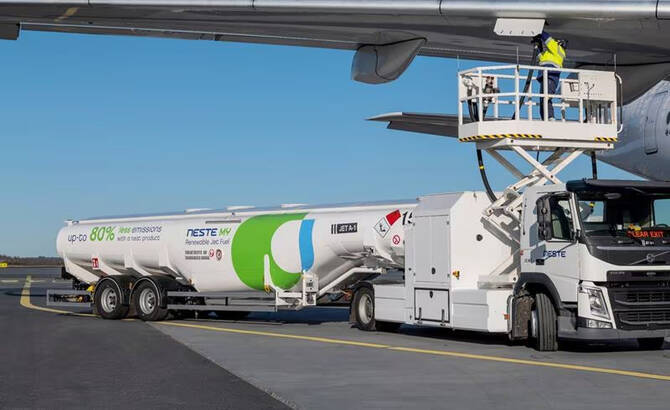
Global production of sustainable aviation fuel to reach 2m tonnes in 2025: IATA

The use of SAF has been increasingly prominent in recent years, as most countries have set stipulated targets to achieve net zero as part of their energy transition efforts. Reuters
Short Url
Updated 02 June 2025
Follow

Global production of sustainable aviation fuel to reach 2m tonnes in 2025: IATA

  • Ensuring success of Carbon Offsetting and Reduction Scheme for International Aviation is crucial, says IATA head
  • Sufficient government measures needed to meet decarbonization efforts, Willie Walsh added

NEW DELHI: Global sustainable aviation fuel production is expected to double to reach 2 million tonnes in 2025 compared to the previous year, according to the International Air Transport Association. 

In a press statement issued during IATA’s Annual General Meeting, Director General Willie Walsh noted that the projected 2 million tonnes of SAF will account for just 0.7 percent of total fuel consumption this year.

The use of SAF has been increasingly prominent in recent years, as most countries have set stipulated targets to achieve net zero as part of their energy transition efforts. 

“While it is encouraging that SAF production is expected to double to 2 million tonnes in 2025, that is just 0.7 percent of aviation’s total fuel needs,” said Walsh. 

He added: “And even that relatively small amount will add $4.4 billion globally to the fuel bill. The pace of progress in ramping up production and gaining efficiencies to reduce costs must accelerate.” 

The IATA official further stated that sufficient government measures, including the implementation of effective policies, are needed to meet decarbonization efforts. 

He added that ensuring the success of the Carbon Offsetting and Reduction Scheme for International Aviation is crucial to offsetting carbon emissions in the aviation sector. 

Under CORSIA, an initiative launched by the International Civil Aviation Organization, airplane operators must purchase and cancel “emissions units” to offset the increase in CO2 emissions. 

“Advancing SAF production requires an increase in renewable energy production from which SAF is derived. Secondly, it also requires policies to ensure SAF is allocated an appropriate portion of renewable energy production,” said IATA in the statement. 

In a separate statement, IATA said that $1.3 billion in airline funds are blocked from repatriation by governments as of the end of April.

The industry body, however, noted that this figure also represents a 25 percent improvement compared to the $1.7 billion reported for October. 

The aviation body also urged governments to remove all barriers preventing airlines from the timely repatriation of their revenues from ticket sales and other activities in accordance with international agreements and treaty obligations.

“Ensuring the timely repatriation of revenues is vital for airlines to cover dollar-denominated expenses and maintain their operations. Delays and denials violate bilateral agreements and increase exchange rate risks,” said Walsh. 

He added: “Economies and jobs rely on international connectivity. Governments must realize that it is a challenge for airlines to maintain connectivity when revenue repatriation is denied or delayed.” 


Closing Bell: Saudi stocks slip as Tadawul falls 1% amid broad market weakness

Updated 30 December 2025
Follow

Closing Bell: Saudi stocks slip as Tadawul falls 1% amid broad market weakness

RIYADH: Saudi stocks fell sharply on Tuesday, with the Tadawul All Share Index closing down 108.14 points, or 1.03 percent, at 10,381.51.

The broader decline was reflected across major indices. The MSCI Tadawul 30 Index slipped 0.78 percent to 1,378.00, while Nomu, the parallel market index, fell 1 percent to 23,040.79.

Market breadth was strongly negative on the main board, with 237 stocks falling compared to just 24 gainers. Trading activity remained robust, with 164.7 million shares changing hands and a total traded value of SR3.19 billion ($850.6 million).

Among the gainers, SEDCO Capital REIT Fund led, rising 2.73 percent to SR6.77, followed by Chubb Arabia Cooperative Insurance Co., which gained 2.69 percent to SR20.20.

National Medical Care Co. added 1.72 percent to close at SR141.60, while Alyamamah Steel Industries Co. and Thimar Advertising, Public Relations and Marketing Co. advanced 1.57 percent and 1.13 percent, respectively.

Losses were led by Al Masar Al Shamil Education Co., which tumbled 8.36 percent to SR24.65. Raoom Trading Co.fell 6.75 percent to SR64.20, while Alkhaleej Training and Education Co. dropped 6.60 percent to SR18.12 and Naqi Water Co. declined 5.51 percent to SR54.00. Gulf General Cooperative Insurance Co. closed 5.44 percent lower at SR3.65.

On the announcement front, Chubb Arabia Cooperative Insurance Co. signed a multiyear insurance agreement with Saudi Electricity Co. to provide various coverages, expected to positively impact its financial results over the 2025–2026 period. The deal will run for three years and two months and is within the company’s normal course of business.

Meanwhile, Bupa Arabia for Cooperative Insurance Co. announced a one-year health insurance contract with Saudi National Bank, valued at SR330.2 million, covering the bank’s employees and their families from January 2026. Despite the sizable contract, Bupa Arabia shares fell 0.8 percent to close at SR137, weighed down by the broader market weakness.

In contrast, United Cooperative Assurance Co. revealed an extension of its engineering insurance agreement with Saudi Binladin Group for the Grand Mosque expansion in Makkah. The contract value exceeds 20 percent of the company’s gross written premiums based on its latest audited financials and is expected to support results through 2026. However, the stock came under selling pressure, ending the session down 4.51 percent at SR3.39.