India sees tenfold rise in COVID-19 cases

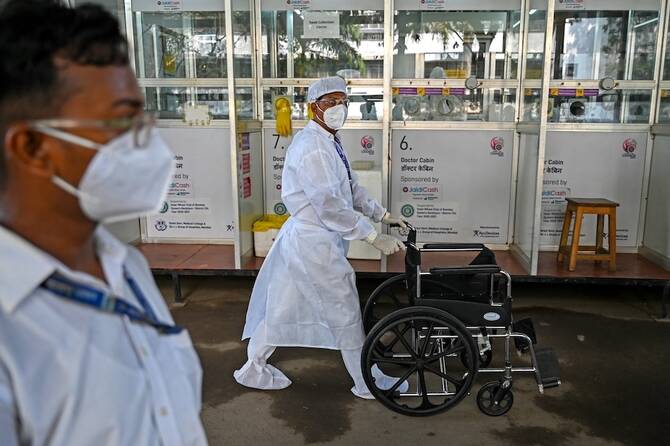
A health worker takes part in a mock drill to check preparations at COVID-19 facilities at a hospital in Mumbai on April 10, 2023. (AFP file photo)
Short Url
Updated 01 June 2025
Follow

India sees tenfold rise in COVID-19 cases

  • India’s official caseload increased to 3,395 on Sunday from 257 on May 22
  • No spike in hospitalization rate, pulmonologist says, as symptoms remain mild

NEW DELHI: India has reported a sharp increase in COVID-19 cases over the past 10 days, official data showed on Sunday, with new, more transmissible virus variants believed to be driving the surge.

A new wave of infections emerged in parts of Asia last month, especially Hong Kong, Singapore, China and Thailand.

The new spread of the coronavirus that a few years ago brought the world to a standstill has been linked to JN.1, a highly transmissible variant of the omicron strain of COVID-19. It emerged in late 2023 and spread globally through early 2024, becoming one of the dominant variants in many countries.

India’s current caseload is 3,395 as of Sunday, according to Ministry of Health data – up significantly from the previous official count of 257 on May 22.

The ministry confirmed last week it had detected across the country two subvariants of JN.1 – LF.7 and NB.1.8.1 – which spread faster but are believed to be mild.

“(The) majority of those are mild cases, just like seasonal flu, and we are not seeing any significant admission or emergency visits due to COVID-19. Right now, the situation is under control. Any flu that starts spreading spreads fast like wildfire,” Dr. Nikhil Modi, pulmonology and respiratory medicine specialist at Indraprastha Apollo Hospital in New Delhi, told Arab News.

While in the last 24 hours, four deaths have been recorded – in Delhi, Kerala, Karnataka, and Uttar Pradesh – the “patients were already suffering from critical illnesses,” Modi said.

“Severe disease is not being reported anywhere significantly.”

India was one of the worst-hit countries during the COVID-19 pandemic in 2021. At its peak, health authorities recorded over 400,000 new cases per day.

Hospitals across many states were overwhelmed with patients and faced severe shortages of oxygen supplies, hospital beds, ventilators, and critical medicines.

The World Health Organization estimates that 4.7 million deaths in India were directly and indirectly related to COVID-19.

“The way we have seen COVID-19 in 2021, panic is bound to come but things, for the time being, are under control. We are not seeing admissions significantly rising due to COVID, so we should be able to manage. Advisories and preparedness in all hospitals have started, so if the situation changes, we are ready for it,” Modi said.

“Right now, we don’t have to panic about it.”


Inside Chernobyl, Ukraine scrambles to repair radiation shield

Updated 2 sec ago
Follow

Inside Chernobyl, Ukraine scrambles to repair radiation shield

CHERNOBYL NUCLEAR POWER PLANT: Inside an abandoned control room at Ukraine’s Chernobyl nuclear power plant, a worker in an orange hardhat gazed at a grey wall of seemingly endless dials, screens and gauges that were supposed to prevent disaster.
The 1986 meltdown at the site was the world’s worst ever nuclear incident. Since Russia invaded in 2022, Kyiv fears another disaster could be just a matter of time.
In February, a Russian drone hit and left a large hole in the New Safe Confinement (NSC), the outer of two radiation shells covering the remnants of the nuclear power plant.
It functions as a modern high-tech replacement for an inner steel-and-concrete structure — known as the Sarcophagus, a defensive layer built hastily after the 1986 incident.
Ten months later, repair work is still ongoing, and it could take another three to four years before the outer dome regains its primary safety functions, plant director Sergiy Tarakanov told AFP in an interview from Kyiv.
“It does not perform the function of retaining radioactive substances inside,” Tarakanov said, echoing concerns raised by the International Atomic Energy Agency.
The strike had also left it unclear if the shell would last the 100 years it was designed to.
The gaping crater in the structure, which AFP journalists saw this summer, has been covered over with a protective screen, but 300 smaller holes made by firefighters when battling the blaze still need to be filled in.
Scaffolding engulfs the inside of the giant multi-billion-dollar structure, rising all the way up to the 100-meter-high ceiling.
Charred debris from the drone strike that hit the NSC still lay on the floor of the plant, AFP journalists saw on a visit to the site in December.

- ‘Main threat’ -

Russia’s army captured the plant on the first day of its 2022 invasion, before withdrawing a few weeks later.
Ukraine has repeatedly accused Moscow of targeting Chernobyl and its other nuclear power plants, saying Moscow’s strikes risk triggering a potentially catastrophic disaster.
Ukraine regularly reduces power at its nuclear plants following Russian strikes on its energy grid.
In October, a Russian strike on a substation near Chernobyl cut power flowing to the confinement structure.
Tarakanov told AFP that radiation levels at the site had remained “stable and within normal limits.”
Inside a modern control room, engineer Ivan Tykhonenko was keeping track of 19 sensors and detection units, constantly monitoring the state of the site.
Part of the 190 tons of uranium that were on site in 1986 “melted, sank down into the reactor unit, the sub-reactor room, and still exists,” he told AFP.
Worries over the fate of the site — and what could happen — run high.
Another Russian hit — or even a powerful nearby strike — could see the inner radiation shell collapse, director Tarakanov told AFP.
“If a missile or drone hits it directly, or even falls somewhere nearby ... it will cause a mini-earthquake in the area,” he said.
“No one can guarantee that the shelter facility will remain standing after that. That is the main threat,” he added.