

Norway warns Israel’s actions in Gaza risk setting dangerous global precedent

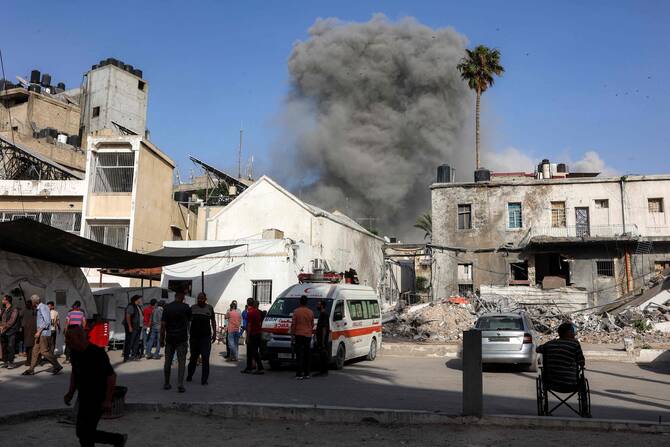
This picture taken from the grounds of the Ahli Arab Hospital, also known as the Maamadani (Baptist) Hospital, shows a cloud of smoke erupting following Israeli bombardment on a building in the Daraj neighbourhood of Gaza City on May 31, 2025. (AFP)
Short Url
Updated 31 May 2025
Follow

Norway warns Israel’s actions in Gaza risk setting dangerous global precedent

  • Norway’s international development minister Asmund Aukrust said Gaza crisis was eroding principles that protect civilians everywhere

LONDON: Israel’s conduct in Gaza is undermining international law and fueling a wider global threat, Norway’s international development minister has said, warning that the use of tactics such as blocking aid and targeting humanitarian groups could become a grim new norm in future conflicts.

“For the last one and a half years we have seen very low respect for international law in the war in Gaza and in recent months it is worse than ever before,” Asmund Aukrust said.

“So for the Norwegian government it is very important to protest against this, to condemn this very clear violation,” he added.

Aukrust said that the crisis was not only deepening suffering in Gaza but eroding principles that protect civilians everywhere, The Guardian newspaper reported on Saturday.

“We are very concerned that there will be a new international standard where food is used as a weapon, where the UN is denied entrance to the war and conflict zone, and other NGOs are denied entrance,” he said.

“And Israel is building up something they call Gaza Humanitarian Foundation (GHF), which is to militarise humanitarian aid.”

The GHF, supported by Israel and the US, began food distribution in Gaza this week. Israeli forces said that they fired “warning shots” at a center during chaotic scenes, while local health authorities reported one civilian killed and dozens injured.

A UN-led review earlier this month found all 2.1 million residents of Gaza at critical risk of famine, with 500,000 already in catastrophic conditions.

“We are afraid and very concerned that this might be a new standard in international law and this will make the world a lot more dangerous to all of us,” Aukrust said.

Asked whether Israel’s actions amounted to genocide, Aukrust said that was a matter for international courts, not politicians.

“Genocide is the worst crime a country can do and the worst crime that politicians can do and this should not be polarized,” he said.

He insisted that dialogue must remain open, even with groups such as Hamas, and stressed Norway’s long-term commitment to Gaza’s recovery.

“We have no limitation of who we are talking to. I would say the opposite. We would be happy to, and we want to, talk with those who are responsible, whether it is Israel, Hamas or others,” he said.

“Dialogue is the most important word when it comes to peacemaking and we want to have an open line with all countries, all groups that might have an influence here,” he added.

Norway, which recognized the Palestinian state in May, has long played a mediating role in the region, including hosting the 1993 Oslo Accords. Aukrust said that recognition was meant “to send out a message of hope.”

The country’s sovereign wealth fund, which is the world’s largest, has already blacklisted 11 companies for aiding Israel’s occupation, though Aukrust stressed decisions on investments are made by the bank, not politicians.

“The bank decides where they want to invest. What the politicians do is to decide the rules,” he said. The rules, he added, were “very clear” that the fund should not invest in anything that contributed to a violation of international law.

The Norwegian parliament is expected to vote next week against a proposal to block the fund from investing in firms operating in the occupied Palestinian territories.

Aukrust urged people across Europe to keep up pressure and stay engaged, adding: “As long as the war is going on, from the Norwegian government side we will all the time look into what more can we do. What new initiative can we take. How can we send an even clearer message to those who are responsible for this.”


Lebanon approves financial gap draft law despite opposition from Hezbollah and Lebanese Forces

Lebanon's Prime Minister Nawaf Salam speaking during a press conference after a cabinet session in Beirut on December 26, 2025.
Updated 8 sec ago
Follow

Lebanon approves financial gap draft law despite opposition from Hezbollah and Lebanese Forces

  • Legislation aims to address the fate of billions of dollars in deposits that have been inaccessible to Lebanese citizens during the country’s financial meltdown

BEIRUT: Lebanon’s Cabinet on Friday approved a controversial draft law to regulate financial recovery and return frozen bank deposits to citizens. The move is seen as a key step in long-delayed economic reforms demanded by the International Monetary Fund.

The decision, which passed with 13 ministers voting in favor and nine against, came after marathon discussions over the so-called “financial gap” or deposit recovery bill, stalled for years since the banking crisis erupted in 2019. The ministers of culture and foreign affairs were absent from the session.

The legislation aims to address the fate of billions of dollars in deposits that have been inaccessible to Lebanese citizens during the country’s financial meltdown.

The vote was opposed by three ministers from the Lebanese Forces Party, three ministers from Hezbollah and the Amal Movement, as well as the minister of youth and sports, Nora Bayrakdarian, the minister of communications, Charles Al-Hajj, and the minister of justice, Adel Nassar.

Finance Minister Yassin Jaber broke ranks with his Hezbollah and Amal allies, voting in favor of the bill. He described his decision as being in line with “Lebanon’s supreme financial interest and its obligations to the IMF and the international community.”

The draft law triggered fierce backlash from depositors who reject any suggestion they shoulder responsibility for the financial collapse. It has also drawn strong criticism from the Association of Banks and parliamentary blocs, fueling fears the law will face intense political wrangling in Parliament ahead of elections scheduled in six months.

Prime Minister Nawaf Salam confirmed the Cabinet had approved the bill and referred it to Parliament for debate and amendments before final ratification. Addressing public concerns, he emphasized that the law includes provisions for forensic auditing and accountability.

“Depositors with accounts under $100,000 will be repaid in full with interest and without any deductions,” Salam said. “Large depositors will also receive their first $100,000 in full, and the remainder will be issued as negotiable bonds backed by the assets of the Central Bank, valued at around $50 billion.”

He said further that bondholders will receive an initial 2 percent payout after the first tranche of repayments is completed.

The law also includes a clause requiring criminal accountability. “Anyone who smuggled funds abroad or benefited from unjustified profits will be fined 30 percent,” Salam said.

He emphasized that Lebanon’s gold reserves will remain untouched. “A clear provision reaffirms the 1986 law barring the sale or mortgaging of gold without parliamentary approval,” he said, dismissing speculation about using the reserves to cover financial losses.

Salam admitted that the law was not perfect but called it “a fair step toward restoring rights.”

“The banking sector’s credibility has been severely damaged. This law aims to revive it by valuing assets, recapitalizing banks, and ending Lebanon’s dangerous reliance on a cash economy,” he said. “Each day of delay further erodes people’s rights.”

While the Association of Banks did not release an immediate response after the vote, it previously argued during discussions that the law would destroy remaining deposits. Bank representatives said lenders would struggle to secure more than $20 billion to cover the initial repayment tier and accused the state of absolving itself of responsibility while effectively granting amnesty for decades of financial mismanagement and corruption.

The law’s fate now rests with Parliament, where political competition ahead of the 2025 elections could complicate or delay its passage.

Lebanon’s banking sector has been at the heart of the country’s economic collapse, with informal capital controls locking depositors out of their savings and trust in state institutions plunging. International donors, including the IMF, have made reforms to the sector a key condition for any financial assistance.