

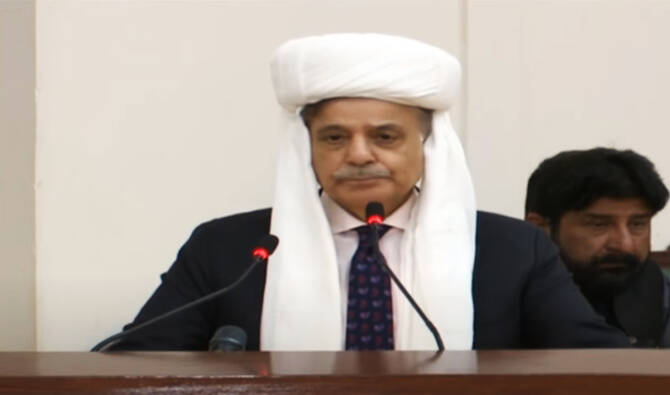
PM Sharif announces 25% federal development share for insurgency-hit Balochistan

The screengrab taken from a livestream shows Prime Minister Shehbaz Sharif addressing a grand jirga, an assembly of provincial elders and influential figures, in Quetta, Pakistan, on May 31, 2025. (Screengrab/PTV News)
Short Url
Updated 31 May 2025
Follow

PM Sharif announces 25% federal development share for insurgency-hit Balochistan

  • The prime minister calls for efforts to bring back ‘misguided’ individuals who have joined militant groups
  • He recognizes Balochistan’s history of economic deprivations but says ‘terrorists’ know nothing but brutality

ISLAMABAD: Prime Minister Shehbaz Sharif on Saturday said Pakistan’s restive southwestern province of Balochistan will receive 25% share from the Public Sector Development Program (PSDP) in the upcoming budget, as the government continues to grapple with a decades-long separatist insurgency that has surged in recent years.

Balochistan, Pakistan’s largest but least populated province, is strategically significant as the centerpiece of the multibillion-dollar China-Pakistan Economic Corridor (CPEC), a major infrastructure development and regional connectivity initiative linking western China to the Arabian Sea.

While the state touts CPEC as a game-changer for the region’s development, Baloch separatist groups accuse the government of exploiting the province’s vast mineral resources without benefiting the local population. Officials reject the narrative, pointing to ongoing investments in various sectors aimed at improving livelihoods.

Sharif announced the allocation while addressing a grand jirga, an assembly of provincial elders and influential figures alongside top military leadership, in Quetta, where he reaffirmed the government’s commitment to Balochistan’s development.

“I think that PSDP will be of Rs1,000 billion [in the next budget],” he told the gathering. “So, out of this [amount], a fund of approximately Rs250 billion is for Balochistan alone. That is, 25% of the total federal PSDP for Balochistan.”

The PSDP is Pakistan’s central development program used to fund infrastructure, energy, education and other long-term public investment projects across the country.

It includes both federal initiatives and financial support for provincial projects, particularly in underdeveloped regions like Balochistan.

The prime minister said the allocation was the province’s “right.”

“Along with this,” he continued, “these resources should be used transparently, whether it is Gwadar, whether it is Pasni, whether it is Chaman, whether it is Killa Saifullah, whether it is Quetta, whether it is Jhal Magsi or any other areas,” he continued. “Every single penny there should be used honestly for the development and prosperity of the people.”

Addressing the challenge of militancy in the province, Sharif said efforts must continue to bring back “misguided” individuals who had joined militant groups.

He acknowledged Balochistan’s history of economic deprivation, while reiterating that those engaged in violence offer no solutions.

“Terrorists do not know anything but brutality,” he said.

Calling for national unity, Sharif maintained: “Let’s sit together and talk. It is only by sitting together that a family becomes strong and prosperous. No evil eye can harm a united household.”


No casualties as blast derails Jaffar Express train in Pakistan’s south

Updated 26 January 2026
Follow

No casualties as blast derails Jaffar Express train in Pakistan’s south

  • Passengers were stranded and railway staffers were clearing the track after blast, official says
  • In March 2025, separatist militants hijacked the same train with hundreds of passengers aboard

QUETTA: A blast hit Jaffar Express and derailed four carriages of the passenger train in Pakistan’s southern Sindh province on Monday, officials said, with no casualties reported.

The blast occurred at the Abad railway station when the Peshawar-bound train was on its way to Sindh’s Sukkur city from Quetta, according to Pakistan Railways’ Quetta Division controller Muhammad Kashif.

No group immediately claimed responsibility for the bomb attack, but passenger trains have often been targeted by Baloch separatist outfits in the restive Balochistan province that borders Sindh.

“Four bogies of the train were derailed due to the intensity of the explosion,” Kashif told Arab News. “No casualty was reported in the latest attack on passenger train.”

The Jaffar Express stands derailed near Abad Railway Station in Jacobabad following a blast on January 26, 2026. (AN Photo/Saadullah Akhtar)

Another railway employee, who was aboard the train and requested anonymity, said the train was heading toward Sukkur from Jacobabad when they heard the powerful explosion, which derailed power van among four bogies.

“A small piece of the railway track has been destroyed,” he said, adding that passengers were now standing outside the train and railway staffers were busy clearing the track.

In March last year, fighters belonging to the Balochistan Liberation Army (BLA) separatist group had stormed Jaffar Express with hundreds of passengers on board and took them hostage. The military had rescued them after an hours-long operation that left 33 militants, 23 soldiers, three railway staff and five passengers dead.

The passenger train, which runs between Balochistan’s provincial capital of Quetta and Peshawar in the country’s northwest, had been targeted in at least four bomb attacks last year since the March hijacking, according to an Arab News tally.

The Jaffar Express stands derailed near Abad Railway Station in Jacobabad following a blast on January 26, 2026. (AN Photo/Saadullah Akhtar)

Pakistan Railways says it has beefed up security arrangements for passenger trains in the province and increased the number of paramilitary troops on Jaffar Express since the hijacking in March, but militants have continued to target them in the restive region.

Balochistan, Pakistan’s southwestern province that borders Iran and Afghanistan, is the site of a decades-long insurgency waged by Baloch separatist groups who often attack security forces and foreigners, and kidnap government officials.

The separatists accuse the central government of stealing the region’s resources to fund development elsewhere in the country. The Pakistani government denies the allegations and says it is working for the uplift of local communities in Balochistan.