

India’s military chief admits jets downed in recent clashes with Pakistan

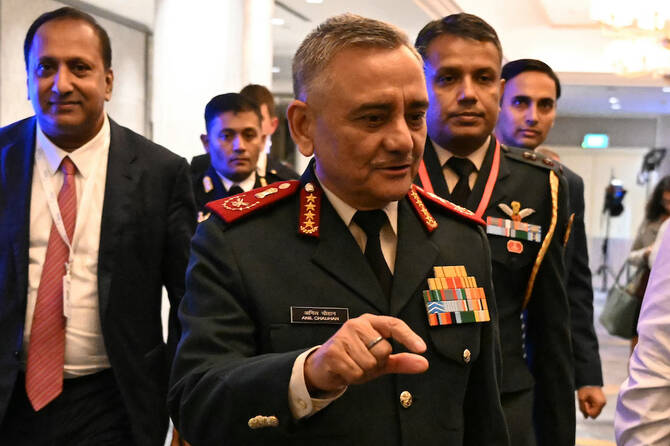
General Anil Chauhan, center, Chief of Defence Staff of Indian Armed Forces attends the Shangri-La Dialogue Summit in Singapore on May 31, 2025. (AFP)
Short Url
Updated 31 May 2025
Follow

India’s military chief admits jets downed in recent clashes with Pakistan

  • Islamabad previously claimed to have shot down 6 Indian jets in early May
  • Indian Air Force may have underestimated its Pakistani counterpart, says expert

NEW DELHI: India’s military chief Gen. Anil Chauhan has confirmed for the first time that the Indian Air Force lost jets in clashes with Pakistan in May.

Earlier this month, Pakistani Prime Minister Shehbaz Sharif said his country shot down six Indian jets, an assertion that Delhi had refrained from commenting on.

Chauhan, chief of defense staff of the Indian Armed Forces, is the first Indian official to make the most direct admission over the fate of the country’s fighter jets during the conflict that erupted on May 7.

“What is important is that, not the jet being downed, but why they were being downed,” Chauhan told Bloomberg TV in an interview on Saturday, while attending the Shangri-La Dialogue in Singapore.

“The good part is that we are able to understand the tactical mistake which we made, remedy it, rectify it and then implement it again after two days and fly all our jets again, targeting at long range.”

Pakistan’s claims of shooting down six Indian combat aircraft were “absolutely incorrect,” Chauhan said, without specifying how many jets India lost.

India and Pakistan recently saw their worst clashes in half a century, during which both sides traded air, drone and missile strikes, as well as artillery and small arms fire along their shared border.

It was triggered by a gruesome attack on tourists near the resort town of Pahalgam in Indian Kashmir on April 22, in which 26 people — 25 Indians and one Nepali citizen — were killed.

Bharat Karnad, an emeritus professor for National Security Studies at the Delhi-based Centre for Policy Research, said that the Indian Air Force may have underestimated its Pakistani counterpart.

“Initially, Indians were surprised. Maybe they underestimated the capacity of the Pakistani Air Force,” Karnad told Arab News on Saturday.

“I think what was surprising was that India did not use the airborne early warning (and) control system, the NETRA, which Pakistan has used very well,” he said. “I’m not sure how much the Indian Air Force expected this kind of tactical innovation. So, this is something that the Indian Air Force realized very quickly.”

According to Air Vice Marshal Kapil Kak, a retired officer of the Indian Air Force, Pakistan benefited from its Chinese-made weapons during the early May conflict.

“This brings us to the lessons which underscore that India was not fighting Pakistan on one front but two countries: Pakistan and China,” Kak told Arab News.

“Every single superior technology, capability, operationally and tactically, or in strategic terms, are made available to Pakistan. That must concern us: What kind of force structure we must have and what kind of capabilities we must build against the combo.”


Moscow made an offer to France regarding a French citizen imprisoned in Russia, says Kremlin

Updated 26 December 2025
Follow

Moscow made an offer to France regarding a French citizen imprisoned in Russia, says Kremlin

  • Laurent Vinatier, an adviser for Swiss-based adviser Center for Humanitarian Dialogue, Vinatier was arrested in Moscow in June 2024
  • He is accused of failing to register as a “foreign agent” while collecting information about Russia’s “military and military-technical activities” 

The Kremlin on Thursday said it was in contact with the French authorities over the fate of a French political scholar serving a three-year sentence in Russia and reportedly facing new charges of espionage.
Kremlin spokesman Dmitry Peskov told reporters that Russia has made “an offer to the French” regarding Laurent Vinatier, arrested in Moscow last year and convicted of collecting military information, and that “the ball is now in France’s court.” He refused to provide details, citing the sensitivity of the matter.
French President Emmanuel Macron is following Vinatier’s situation closely, his office said in a statement. French Foreign Ministry spokesperson Pascal Confavreux said Thursday that all government services are fully mobilized to pay provide consular support to Vinatier and push for his liberation as soon as possible.
Peskov’s remarks come after journalist Jérôme Garro of the French TF1 TV channel asked President Vladimir Putin during his annual news conference on Dec. 19 whether Vinatier’s family could hope for a presidential pardon or his release in a prisoner exchange. Putin said he knew “nothing” about the case, but promised to look into it.
Vinatier was arrested in Moscow in June 2024. Russian authorities accused him of failing to register as a “foreign agent” while collecting information about Russia’s “military and military-technical activities” that could be used to the detriment of national security. The charges carry a maximum penalty of five years in prison.
The arrest came as tensions flared between Moscow and Paris following French President Emmanuel Macron’s comments about the possibility of deploying French troops in Ukraine.
Vinatier’s lawyers asked the court to sentence him to a fine, but the judge in October 2024 handed him a three-year prison term — a sentence described as “extremely severe” by France’s Foreign Ministry, which called for the scholar’s immediate release.
Detentions on charges of spying and collecting sensitive data have become increasingly frequent in Russia and its heavily politicized legal system since Moscow invaded Ukraine in February 2022.
In addition to criticizing his sentence, the French Foreign Ministry urged the abolition of Russia’s laws on foreign agents, which subject those carrying the label to additional government scrutiny and numerous restrictions. Violations can result in criminal prosecution. The ministry said the legislation “contributes to a systematic violation of fundamental freedoms in Russia, like the freedom of association, the freedom of opinion and the freedom of expression.”
Vinatier is an adviser for the Center for Humanitarian Dialogue, a Switzerland-based nongovernmental organization, which said in June 2024 that it was doing “everything possible to assist” him.
While asking the judge for clemency ahead of the verdict, Vinatier pointed to his two children and his elderly parents he has to take care of.
The charges against Vinatier relate to a law that requires anyone collecting information on military issues to register with authorities as a foreign agent.
Human rights activists have criticized the law and other recent legislation as part of a Kremlin crackdown on independent media and political activists intended to stifle criticism of the war in Ukraine.
In August 2025, Russian state news agency Tass reported that Vinatier was also charged with espionage, citing court records but giving no details. Those convicted of espionage in Russia face between 10 and 20 years in prison.
Russia in recent years has arrested a number of foreigners — mainly US citizens — on various criminal charges and then released them in prisoner swaps with the United States and other Western nations. The largest exchange since the Cold War took place in August 2024, when Moscow freed journalists Evan Gershkovich and Alsu Kurmasheva, fellow American Paul Whelan, and Russian dissidents in a multinational deal that set two dozen people free.