

Pakistan PM says Indian bid to set ‘new norm’ thwarted, vows to focus on economy and governance

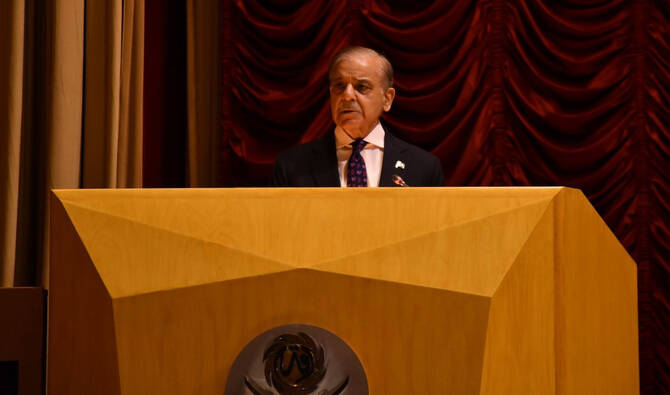
Pakistan Prime Minister Shehbaz Sharif addressing senior military officers at the Command and Staff College in Quetta, on May 31, 2025. (PTV News)
Short Url
Updated 31 May 2025
Follow

Pakistan PM says Indian bid to set ‘new norm’ thwarted, vows to focus on economy and governance

  • Shehbaz Sharif tells military officials in Quetta India suffered setbacks on battlefield and in diplomatic realm
  • He reiterates that New Delhi will not be allowed to ‘weaponize water,’ calling IWT suspension a ‘red line’

ISLAMABAD: Prime Minister Shehbaz Sharif on Saturday highlighted a range of security threats facing Pakistan days after a military standoff with India, saying New Delhi’s attempt to establish a “new norm” by targeting his country at will had been thwarted, though Pakistan must now focus on strengthening economy and governance.

The remarks came during a televised address to senior military officers at the Command and Staff College in Quetta, where the premier recounted the recent escalation between the two nuclear-armed neighbors.

The flare-up followed an April attack on tourists in Indian-administered Kashmir, which New Delhi blamed on a Pakistan. Islamabad denied the allegation and called for an impartial probe, but tensions rapidly escalated into four days of cross-border hostilities, ending after a US-brokered ceasefire on May 10.

“The threats we face are no longer limited to conventional battlefields,” Sharif said during his address. “They are multifaceted, ranging from kinetic warfare to cyberattacks, economic coercion to disinformation campaigns and hybrid threats that challenge both our borders and our ideological frontiers.”

“The recent Indian aggression against Pakistan, violating our territorial integrity and targeting our innocent civilians, was not merely countered successfully, but instead we succeeded in turning the tables on those who were dreaming of establishing a new norm,” he said.

Sharif added that Pakistan accepted the ceasefire offer “in the interest of peace, progress and prosperity in South Asia,” asserting that India’s claim of a new strategic precedent “was buried for all times to come by our brave armed forces.”

“In fact, it was Pakistan that established the new norm in its relations with India,” he said. “Henceforth, we will not allow her to behave in an arrogant and haughty manner.”

The prime minister said India had suffered “serious setbacks in both warfare and finest diplomacy” during the episode.

Turning to domestic matters, Sharif said while the military had fulfilled its responsibility, Pakistan still faced “major challenges in the field of economy and governance.”

He cited the dire financial situation when his administration took office, saying it compelled Pakistan to seek external assistance from lenders such as the International Monetary Fund (IMF).

However, he maintained the economy had since stabilized and was now on a positive trajectory.

The prime minister also criticized India’s recent move to suspend the Indus Waters Treaty (IWT), a World Bank-brokered water-sharing agreement signed in 1960, reiterating it was unacceptable to his country.

“We will not allow India to weaponize water by holding the Indus Waters Treaty in abeyance,” he said. “This is an absolute red line for us.”


Pakistan, Saudi Arabia agree to enhance cooperation in energy, mineral sectors

Updated 6 sec ago
Follow

Pakistan, Saudi Arabia agree to enhance cooperation in energy, mineral sectors

  • In recent years, Saudi Arabia has positioned itself as a leader in the global minerals and energy sectors
  • Both sides reaffirm commitment to enhance partnership and promote mutually beneficial investments

ISLAMABAD: Pakistan and Saudi Arabia have agreed to enhance cooperation in energy and mineral sectors, the Pakistani information ministry said on Friday, as the two sides seek to deepen economic ties and promote joint investment.

The development comes weeks after Pakistan’s Petroleum Minister Ali Pervaiz Malik met Saudi Arabia’s Minister of Industry and Mineral Resources Bandar Ibrahim Alkhorayef at the Future Minerals Forum (FMF) in Riyadh that saw participation from 13 public and private Pakistani firms.

Pakistan petroleum ministry said Alkhorayef had pointed out “vast opportunities” for cooperation between Pakistan and Saudi Arabia in the minerals sector, adding that the Kingdom would support the development of Pakistan’s mining industry through its knowledge and technical expertise.

On Friday, Malik held a meeting with Nawaf bin Said Al-Malki, ambassador of the Kingdom of Saudi Arabia to Pakistan, to discuss areas of mutual cooperation and further strengthen bilateral relations between the two brotherly countries, according to the information ministry.

“Both sides reviewed ongoing collaboration and explored new avenues for cooperation, particularly in the energy and minerals sectors,” it said in a statement. “They reaffirmed their commitment to enhancing economic partnership and promoting mutually beneficial investment opportunities.”

In recent years, Saudi Arabia has positioned itself as a leader in the global minerals and energy sectors and accelerated investments in green technologies, sustainable mining practices and international collaborations that are shaping the future of the mines and mineral industry.

Pakistan, on the other hand, organized a minerals summit in April 2025 that saw participation from major international companies, including the Canada-based Barrick Gold and officials from the US, Saudi Arabia, China, Türkiye, UK, Azerbaijan and other nations.

Malik expressed confidence that longstanding brotherly relations between Pakistan and Saudi Arabia would translate into tangible outcomes, fostering investment, technology exchange, and sustainable development initiatives for mutual benefit.

Ambassador Al-Malki appreciated Pakistan’s active participation in the Future Minerals Forum, which offered significant opportunities for regional collaboration, according to the statement.

“Both sides agreed to maintain close coordination to further strengthen economic and strategic cooperation in the coming period,” the information ministry added.