

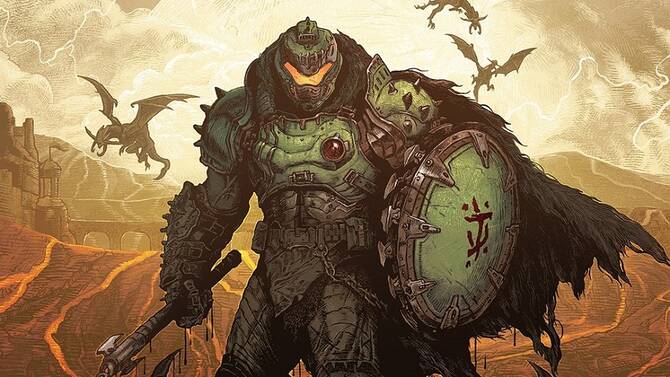
Review: ‘Doom: The Dark Ages’ sets new bar for first-person carnage

Boasting 22 adrenaline-soaked levels, “Doom: The Dark Ages” sticks to the classic formula of annihilating every enemy in the room before moving on. (Supplied)
Short Url
Updated 31 May 2025
Follow

Review: ‘Doom: The Dark Ages’ sets new bar for first-person carnage

LONDON: The first “Doom” game back in 1993 helped define the first-person shooter genre, spawning numerous sequels and even a Hollywood film. Now it is back, and in a crowded market packed with chaotic shooters and arena brawlers, this game slices its way into the pantheon with style — and a spinning shield saw.

Boasting 22 adrenaline-soaked levels, “Doom: The Dark Ages” sticks to the classic formula of annihilating every enemy in the room before moving on. Yet it rarely pauses for breath, charging through its campaign. While there are secrets to uncover and collectible toys to find, it always feels hurried, pushing players forward with breakneck urgency.

Where it stands out is in its innovative combat tools — a shield saw that doubles as a melee weapon, a flail for crowd control, and a shield charge that turns defense into offense. Combat is fast, demanding, and utterly satisfying, especially in boss fights where success hinges on timing and picking the right attack for the enemy.

The gunplay is awesomely brutal and weapons evolve through Sentinel Shrines, letting players fine-tune their arsenal to match the rising difficulty. This isn't just a shooter; it’s a metal-fueled ballet of aggression, where being passive is punished and staying alive means staying angry.

The music? Pure heavy metal fury, matching the gameplay beat for beat. Visuals run at a crisp 60 frames per second and every environment drips with cosmic dread, from crumbling hellscapes to star-forged citadels. The new cosmic realm adds visual diversity, while massive set-pieces like dragon-riding with autocannons and piloting giant sentinels crank the spectacle to 11.

This is bone-crunching mayhem at its finest. It’s Halo-esque in scope, “Doom”-like in execution, but ultimately a beast of its own making.


Art Cairo spotlights pioneering artist Inji Efflatoun

Updated 23 January 2026
Follow

Art Cairo spotlights pioneering artist Inji Efflatoun

CAIRO: Art Cairo 2026 returned to Egypt’s bustling capital from Jan. 23-26, with visitors treated to gallery offerings from across the Middle East as well as a solo museum exhibition dedicated to pioneering Egyptian artist Inji Efflatoun.

While gallery booths hailed from across the Arab world, guests also had the chance to explore the oeuvre of the politically charged artist, who died in 1989.

Many of the pieces in the 14-work exhibition were drawn from the collection of the Egyptian Museum of Modern Art and cover four main periods of the artist’s work, including her Harvest, Motherhood, Prison and Knoll series.

While gallery booths hailed from across the Arab world, guests also had the chance to explore the oeuvre of the politically charged artist, who died in 1989. (Supplied)

Efflatoun was a pivotal figure in modern Egyptian art and is as well known for her work as her Marxist and feminist activism.

“This is the third year there is this collaboration between Art Cairo and the Ministry of Culture,” Noor Al-Askar, director of Art Cairo, told Arab News.

“This year we said Inji because (she) has a lot of work.”

Born in 1924 to an affluent, Ottoman-descended family in Cairo, Efflatoun rebelled against her background and took part heavily in communist organizations, with her artwork reflecting her abhorrence of social inequalities and her anti-colonial sentiments.

Many of the pieces in the 14-work exhibition were drawn from the collection of the Egyptian Museum of Modern Art and cover four main periods of the artist’s work, including her Harvest, Motherhood, Prison and Knoll series. (Supplied)

One untitled work on show is a barbed statement on social inequalities and motherhood, featuring a shrouded mother crouched low on the ground, working as she hugs and seemingly protects two infants between her legs.

The artist was a member of the influential Art et Liberte movement, a group of staunchly anti-imperialist artists and thinkers.

In 1959, Efflatoun was imprisoned under Gamal Abdel Nasser, the second president of Egypt. The artist served her sentence for four years across a number of women’s prisons in the deserts near Cairo — it was a period that heavily impacted her art, leading to her post-release “White Light” period, marked dynamic compositions and vibrant tones.

Grouped together, four of the exhibited works take inspiration from her time in prison, with powerful images of women stacked above each other in cell bunkbeds, with feminine bare legs at sharp odds with their surroundings.

Art Cairo 2026 returned to Egypt’s bustling capital from Jan. 23-26. (Supplied)

The bars of the prison cells obstruct the onlooker’s view, with harsh vertical bars juxtaposed against the monochrome stripes of the prison garb in some of her works on show.

“Modern art, Egyptian modern art, most people, they really don’t know it very well,” Al-Askar said, adding that there has been a recent uptick in interest across the Middle East, in the wake of a book on the artist by UAE art patron Sultan Sooud Al-Qassemi.

“So, without any reason, all the lights are now on Inji,” Al-Askar added.

Although it was not all-encompassing, Art Cairo’s spotlight on Efflatoun served as a powerful starting point for guests wishing to explore her artistic journey.