

Review: ‘Doom: The Dark Ages’ sets new bar for first-person carnage

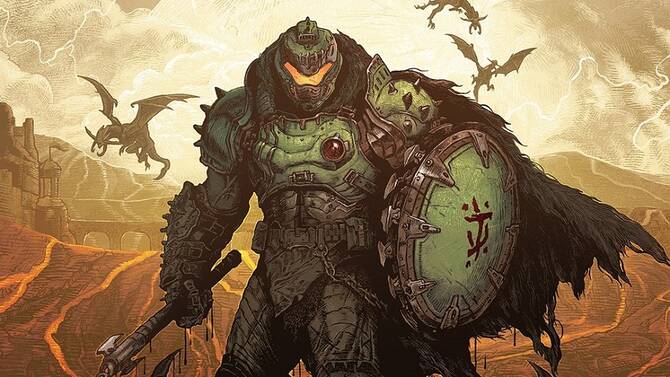
Boasting 22 adrenaline-soaked levels, “Doom: The Dark Ages” sticks to the classic formula of annihilating every enemy in the room before moving on. (Supplied)
Short Url
Updated 31 May 2025
Follow

Review: ‘Doom: The Dark Ages’ sets new bar for first-person carnage

LONDON: The first “Doom” game back in 1993 helped define the first-person shooter genre, spawning numerous sequels and even a Hollywood film. Now it is back, and in a crowded market packed with chaotic shooters and arena brawlers, this game slices its way into the pantheon with style — and a spinning shield saw.

Boasting 22 adrenaline-soaked levels, “Doom: The Dark Ages” sticks to the classic formula of annihilating every enemy in the room before moving on. Yet it rarely pauses for breath, charging through its campaign. While there are secrets to uncover and collectible toys to find, it always feels hurried, pushing players forward with breakneck urgency.

Where it stands out is in its innovative combat tools — a shield saw that doubles as a melee weapon, a flail for crowd control, and a shield charge that turns defense into offense. Combat is fast, demanding, and utterly satisfying, especially in boss fights where success hinges on timing and picking the right attack for the enemy.

The gunplay is awesomely brutal and weapons evolve through Sentinel Shrines, letting players fine-tune their arsenal to match the rising difficulty. This isn't just a shooter; it’s a metal-fueled ballet of aggression, where being passive is punished and staying alive means staying angry.

The music? Pure heavy metal fury, matching the gameplay beat for beat. Visuals run at a crisp 60 frames per second and every environment drips with cosmic dread, from crumbling hellscapes to star-forged citadels. The new cosmic realm adds visual diversity, while massive set-pieces like dragon-riding with autocannons and piloting giant sentinels crank the spectacle to 11.

This is bone-crunching mayhem at its finest. It’s Halo-esque in scope, “Doom”-like in execution, but ultimately a beast of its own making.


Review: ‘Sorry, Baby’ by Eva Victor

Eva Victor appears in Sorry, Baby by Eva Victor, an official selection of the 2025 Sundance Film Festival. (Supplied)
Updated 27 December 2025
Follow

Review: ‘Sorry, Baby’ by Eva Victor

  • Victor makes a deliberate narrative choice; we never witness the violence of what happens to her character

There is a bravery in “Sorry, Baby” that comes not from what the film shows, but from what it withholds. 

Written, directed by, and starring Eva Victor, it is one of the most talked-about indie films of the year, winning the Waldo Salt Screenwriting Award at Sundance and gathering momentum with nominations, including nods at the Golden Globes and Gotham Awards. 

The film is both incisive and tender in its exploration of trauma, friendship, and the long, winding road toward healing. It follows Agnes, a young professor of literature trying to pick up the pieces after a disturbing incident in grad school. 

Victor makes a deliberate narrative choice; we never witness the violence of what happens to her character. The story centers on Agnes’ perspective in her own words, even as she struggles to name it at various points in the film. 

There is a generosity to Victor’s storytelling and a refusal to reduce the narrative to trauma alone. Instead we witness the breadth of human experience, from heartbreak and loneliness to joy and the sustaining power of friendship. These themes are supported by dialogue and camerawork that incorporates silences and stillness as much as the power of words and movement. 

The film captures the messy, beautiful ways people care for one another. Supporting performances — particularly by “Mickey 17” actor Naomi Ackie who plays the best friend Lydia — and encounters with strangers and a kitten, reinforce the story’s celebration of solidarity and community. 

“Sorry, Baby” reminds us that human resilience is rarely entirely solitary; it is nurtured through acts of care, intimacy and tenderness.

A pivotal scene between Agnes and her friend’s newborn inspires the film’s title. A single, reassuring line gently speaks a pure and simple truth: “I know you’re scared … but you’re OK.” 

It is a reminder that in the end, no matter how dark life gets, it goes on, and so does the human capacity to love.