

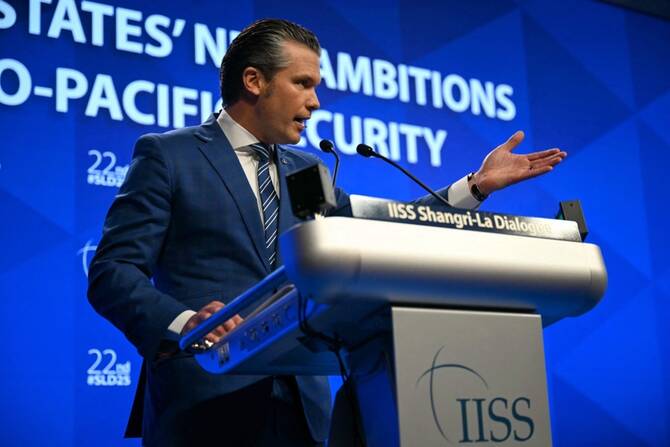

SINGAPORE: US Secretary of Defense Pete Hegseth warned Saturday that China was “credibly preparing” to use military force to upend the balance of power in Asia, vowing the United States was “here to stay” in the Indo-Pacific region.
The Pentagon chief made the remarks at an annual security forum in Singapore as the administration of US President Donald Trump spars with Beijing on trade, technology, and influence over strategic corners of the globe.
Since taking office in January, Trump has launched a trade war with China, sought to curb its access to key AI technologies and deepened security ties with allies such as the Philippines, which is engaged in escalating territorial disputes with Beijing.
“The threat China poses is real and it could be imminent,” Hegseth said at the Shangri-La Dialogue attended by defense officials from around the world.
Beijing is “credibly preparing to potentially use military force to alter the balance of power in the Indo-Pacific,” he added.
Hegseth warned the Chinese military was building the capabilities to invade Taiwan and “rehearsing for the real deal.”
Beijing has ramped up military pressure on Taiwan and held multiple large-scale exercises around the island, often described as preparations for a blockade or invasion.
The United States was “reorienting toward deterring aggression by communist China,” Hegseth said, calling on US allies and partners in Asia to swiftly upgrade their defenses in the face of mounting threats.
Hegseth described China’s conduct as a “wake-up call,” accusing Beijing of endangering lives with cyberattacks, harassing its neighbors, and “illegally seizing and militarizing lands” in the South China Sea.
Beijing claims almost the entire disputed waterway, through which more than 60 percent of global maritime trade passes, despite an international ruling that its assertion has no merit.
It has clashed repeatedly with the Philippines in the strategic waters in recent months, with the flashpoint set to dominate discussions at the Singapore defense forum, according to US officials.
As Hegseth spoke in Singapore, China’s military announced that its navy and air force were carrying out routine “combat readiness patrols” around the Scarborough Shoal, a chain of reefs and rocks Beijing disputes with the Philippines.
“China’s assertiveness in the South China Sea has only increased in recent years,” Casey Mace, charge d’affaires at the US embassy in Singapore, told journalists ahead of the meeting.
“I think that this type of forum is exactly the type of forum where we need to have an exchange on that.”
Beijing has not sent any top defense ministry officials to the summit, dispatching a delegation from the People’s Liberation Army National Defense University instead.
Hegseth’s hard-hitting address drew a critical reaction from Chinese analysts at the conference.
Da Wei, director of the Center for International Security and Strategy at Tsinghua University told reporters the speech was “very unfriendly” and “very confrontational,” accusing Washington of double standards in demanding Beijing respect its neighbors while bullying its own – including Canada and Greenland.
Former Senior Col. Zhou Bo, from the Center for International Security and Strategy at Tsinghua University said that training drills did not mean China would invade Taiwan, saying the government wanted “peaceful reunification.”
Hegseth’s comments came after Trump stoked new trade tensions with China, arguing that Beijing had “violated” a deal to de-escalate tariffs as the two sides appeared deadlocked in negotiations.
The world’s two biggest economies had agreed to temporarily lower eye-watering tariffs they had imposed on each other, pausing them for 90 days.
Reassuring US allies on Saturday, Hegseth said the Indo-Pacific was “America’s priority theater,” pledging to ensure “China cannot dominate us – or our allies and partners.”
He said the United States had stepped up cooperation with allies including the Philippines and Japan, and reiterated Trump’s vow that “China will not invade (Taiwan) on his watch.”
But he called on US partners in the region to ramp up spending on their militaries and “quickly upgrade their own defenses.”
“Asian allies should look to countries in Europe for a newfound example,” Hegseth said, citing pledges by NATO members including Germany to move toward Trump’s spending target of five percent of GDP.
“Deterrence doesn’t come on the cheap.”
EU foreign policy chief Kaja Kallas, also in Singapore, said the Trump administration’s “tough love” had helped push the continent to beef up its defenses.
“It’s love nonetheless, so it’s better than no love,” Kallas quipped when asked about Hegseth’s speech.


