

The world’s most unpopular president? Peru’s leader clings to power

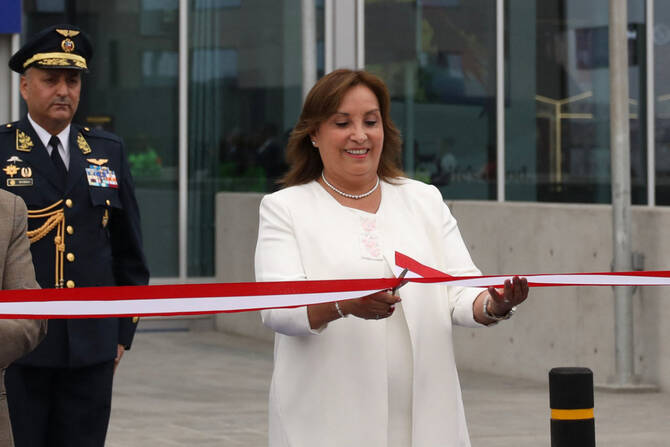
Peru's President Dina Boluarte cuts the ribbon during the official inauguration of the new Jorge Chavez International Airport, in Callao, Metropolitan Lima, on May 30, 2025. (AFP)
Short Url
Updated 31 May 2025
Follow

The world’s most unpopular president? Peru’s leader clings to power

  • The Ipsos polling agency found Dina Boluarte had a two-percent approval rating, down from 21 percent when she took office
  • The 63-year-old is the target of a dozen probes, including for her alleged failure to declare gifts of luxury jewels and watches

LIMA: With an approval rating of just two percent, Peru’s President Dina Boluarte may be the world’s most unpopular leader, according to pollsters.
Protests greeted her rise to power 29 months ago, and have marked her entire term — joined by assorted scandals, investigations, controversies and a surge in gang violence.
The 63-year-old is the target of a dozen probes, including for her alleged failure to declare gifts of luxury jewels and watches, a scandal inevitably dubbed “Rolexgate.”
She is also under the microscope for a two-week undeclared absence for nose surgery — which she insists was medical, not cosmetic — and is being investigated for her role in a police crackdown that caused the deaths of 50 protesters.
Against that bleak backdrop, Boluarte’s never-high popularity hit rock bottom this month.
The Ipsos polling agency found she had a two-percent approval rating, down from 21 percent when she took office.
“We might be talking about a world record of sustained presidential disapproval,” Ipsos Peru president Alfredo Torres told AFP.
It is the lowest score Ipsos has measured in any of the other 90 countries it surveys, Torres said.
Yet as far as recent Peruvian presidents go, she is not just a survivor, but positively an elder stateswoman.
The South American nation has had six presidents in eight years and if Boluarte lasts to the end of her term next year, she would be the longest-serving of them all.

Backed by corrupt majority rightwing parties
Despite not having a party in Congress, she has managed to stay in power with the backing of Peru’s majority right-wing parties.
Analysts say voter lethargy and political expediency have so far helped Boluarte buck the trend of prematurely ousted Peruvian leaders.
“In Peru, there is a political paradox: Boluarte is the weakest president of the last decade,” political analyst Augusto Alvarez of the University of the Pacific told AFP.
But her weakness is “also her strength,” he said, explaining that a lame-duck president is politically useful for Congress.
“It is a great business to have a fragile president whom they (lawmakers) use” to entrench their own power and pass laws beneficial to allies and backers, said Alvarez.
Transparency International’s Peruvian chapter Proetica has cited Congress for “counter-reforms, setbacks in anti-corruption instruments... and shielding of members of Congress who are ethically questioned.”
Boluarte has other factors counting in her favor.
Congress is seemingly keeping her around for lack of a better, consensus, candidate.
Another plus for Boluarte: Peru’s economy has been performing well, with GDP growing 3.3 percent last year and 3.9 percent in the first quarter of 2025 — a steep improvement from the 2020 recession blamed on Covid pandemic lockdowns.
Peru’s inflation rate is one of the lowest in the region.
“The economy continues to function, there is enormous resilience, and the population’s income is growing,” said Alvarez.
But this may have little to do with policy, observers say, and more with external factors such as rising copper prices. Peru is one of the top producers of the metal.

Little love for her from the street
On the street, there is little love for Boluarte, as Peru battles a surge in gang violence characterized by a wave of killings linked to extortion rackets.
Boluarte “has no empathy, she is an incapable president, she does not solve the security problem,” Saturnino Conde, a 63-year-old teacher, told AFP.
At frequent marches against the president, the catchphrase: “Dina, Asesina!” (Dina, Murderer!) has become a popular refrain.
But a full-out rebellion appears unlikely, say analysts.
Peruvians “feel it’s not worth it: if she resigns or is dismissed, she would be replaced by a member of Congress, but Congress also has a terrible image,” said Ipsos manager Torres.
In addition, “there is no other candidate that captivates, which is why people are not in a hurry to remove her from power.”


UK pays Guantanamo detainee ‘substantial’ compensation over US torture questions

Updated 12 January 2026
Follow

UK pays Guantanamo detainee ‘substantial’ compensation over US torture questions

  • Abu Zubaydah has been held at Guantanamo Bay without charge for 20 years
  • British security services knew he was subjected to ‘enhanced interrogation’ but failed to raise concerns for 4 years

LONDON: A Saudi-born Palestinian being held without trial by the US has received a “substantial” compensation payment from the UK government, the BBC reported.

Abu Zubaydah has been imprisoned at Guantanamo Bay in Cuba for almost 20 years following his capture in Pakistan in 2002, and was subjected to “enhanced interrogation” techniques by the CIA.

He was accused of being a senior member of Al-Qaeda in the aftermath of the Sept. 11 terror attacks on the US. The allegations were later dropped but he remains in detention.

The compensation follows revelations that UK security services submitted questions to the US to be put to Abu Zubaydah by their US counterparts despite knowledge of his mistreatment.

He alleged that MI5 and MI6 had been “complicit” in torture, leading to a legal case and the subsequent compensation.

Dominic Grieve, the UK’s former attorney general, chaired a panel reviewing Abu Zubaydah’s case.

He described the compensation as “very unusual” but said the treatment of Abu Zubaydah had been “plainly” wrong, the BBC reported.

Grieve added that the security services had evidence that the “Americans were behaving in a way that should have given us cause for real concern,” and that “we (UK authorities) should have raised it with the US and, if necessary, closed down co-operation, but we failed to do that for a considerable period of time.”

Abu Zubaydah’s international legal counsel, Prof. Helen Duffy, said: “The compensation is important, it’s significant, but it’s insufficient.”

She added that more needs to be done to secure his release, stating: “These violations of his rights are not historic, they are ongoing.”

Duffy said Abu Zubaydah would continue to fight for his freedom, adding: “I am hopeful that the payment of the substantial sums will enable him to do that and to support himself when he’s in the outside world.”

He is one of 15 people still being held at Guantanamo, many without charge. Following his initial detention, he arrived at the prison camp having been the first person to be taken to a so-called CIA “black site.”

He spent time at six such locations, including in Lithuania and Poland, outside of US legal jurisdiction. 

Internal MI6 messages revealed that the “enhanced interrogation” techniques he was subjected to would have “broken” the resolve of an estimated 98 percent of US special forces members had they been subjected to them.

CIA officers later decided he would be permanently cut off from the outside world, with then-President George W. Bush publicly saying Abu Zubaydah had been “plotting and planning murder.”

However, the US has since withdrawn the allegations and no longer says he was a member of Al-Qaeda.

A report by the US Senate Select Committee on Intelligence said Abu Zubaydah had been waterboarded at least 83 times, was locked in a coffin-like box for extended periods, and had been regularly assaulted. Much of his treatment would be considered torture under UK law.

Despite knowledge of his treatment, it was four years before British security services raised concerns with their American counterparts, and their submission of questions within that period had “created a market” for the torture of detainees, Duffy said.

A 2018 report by the UK Parliament’s Intelligence and Security Committee was deeply critical of the behavior of MI5 and MI6 in relation to Abu Zubaydah. 

It also criticized conduct relating to Guantanamo detainee Khalid Sheikh Mohammed, widely regarded as a key architect of the Sept. 11 attacks, warning that the precedent set by Abu Zubaydah’s legal action could be used by Mohammed to bring a separate case against the UK.

MI5 and MI6 failed to comment on Abu Zubaydah’s case. Neither the UK government nor Mohammed’s legal team would comment on a possible case over his treatment.