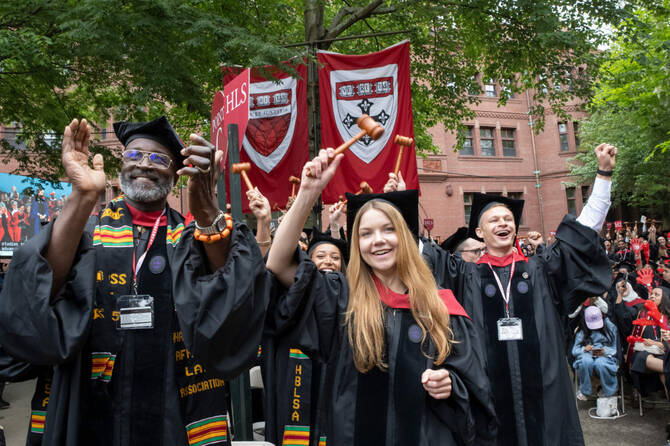
CAMBRIDGE, Massachusetts: A day after her emotional speech at Harvard University’s commencement, Yurong “Luanna” Jiang kept running into classmates who praised her message that people should see everyone’s common humanity rather than demonize others for their differences.
“We’re starting to believe those who think differently, vote differently or pray differently — whether they’re across the ocean or sitting right next to us — are not just wrong. We mistakenly see them as evil. But it doesn’t have to be this way,” she said in her address, which drew wide applause.
“The message itself, if I have to put it into one sentence, will be humanity rises and falls as one,” Jiang told The Associated Press on Friday. “We are living in a very difficult time. There’s a lot of divisions in terms of ideas, ethnicities, identities. This is a time where we can use a little bit more moral imagination and imagine ourselves being connected with one another.”
The 25-year-old Jiang’s speech never directly mentioned the Trump administration nor its multi-pronged attack on the nation’s oldest and richest university. But she said the turmoil beyond their campus and its impact on her classmates was on her mind as she delivered her speech.
“Students can be very emotionally charged because they care deeply about a lot of issues,” said Jiang, who comes from China and graduated with a masters degree in public administration in international development. “When you are emotionally charged and activated, it’s very easy to demonize another person.”
She said the relentless attacks from the Trump administration on the school’s funding and threats to detain and deport people studying in the US on student visas have left her unsettled, adding huge uncertainty to her future plans.
“In terms of the plan going forward, I would say everything is up in the air at this point,” Jiang said, who had hoped to remain in the United States for a few years but now is open to working in international development overseas. “At this point, it’s difficult to say what will happen.”
This week, the Trump administration asked federal agencies to cancel about $100 million in contracts with the university. The government already canceled more than $2.6 billion in federal research grants, moved to cut off Harvard’s enrollment of international students and threatened its tax-exempt status. Then it widened the pressure campaign, suspending visa applications worldwide and threatening to deny US visas to thousands of Chinese students nationwide.
These actions resonate with Jiang and her classmates — about 30 percent of Harvard’s students are international, and China has among the highest numbers.
“The anxiety is real,” said Jiang, who knows two international students from China who are weighing whether to travel for work in Kenya and Rwanda.
“Because of the uncertainty of their visas, they are facing a very tricky situation,” she said. “They can either go abroad, go to Kenya and Rwanda to do their internship and work on poverty alleviation and public health but risking not being able to make it back to campus safely. Or they can stay on campus and do their internships remote.”
“It’s pretty heartbreaking,” she continued“They wanted to help humanity and, to see them entangled in politics they didn’t choose, is hard.”
Jiang, who went to high school in the United Kingdom and earned her undergraduate degree at Duke University, said there should be more, not fewer, academic exchanges between China and the United States.
“Humanity is facing a lot of crisis,” she said. “There are conflicts. There is climate. There are a lot things that not only one country can tackle. China and the US are the two most powerful economies or countries in the world. They have to work with each other to be able to combat the problems or the issues that affect every single human being.”
Jiang also defended the importance of international students at Harvard, recalling how 60 percent of the students stood up at the Kennedy School of Government commencement when the dean, Jeremy Weinstein, asked how many came from outside the United States. Then he asked if they had learned something from their international classmates, and most everyone stood.
“A lot of us clapped and cheered. A lot of us were in tears,” she said, as Weinstein told them to “look around, this is your school.”
Without international students, it would be a challenge for Harvard to achieve its mission, Jiang said. Campus culture depends on its globally diverse student body, studying and hanging out together.
“Harvard wants its students to go and change the world and you can’t change the world without understanding the world,” she said. “You can’t understand the world without truly having a personal connection with people from all sorts of countries.”


![]()

Chinese student struck a chord emphasizing humanity during Harvard commencement speech
Short Url
https://arab.news/m8gng
Chinese student struck a chord emphasizing humanity during Harvard commencement speech
- Without international students, it would be a challenge for Harvard to achieve its mission, Yurong Jiang said
- Trump's attacks on Harvard’s funding and threats to deport people studying in the US have left many foreign students unsettled


Latest updates


© 2026 SAUDI RESEARCH & PUBLISHING COMPANY, All Rights Reserved And subject to Terms of Use Agreement.