Elon Musk's effort to dramatically cut government spending is expected to fall far short of his grand early pronouncements, and perhaps even his most modest goals.
It didn't have to be that way.
According to experts across the ideological spectrum, a major problem was a failure to deploy people who understood the inner workings of government to work alongside his team of software engineers and other high-wattage technology talent.
Even that might not have achieved Musk’s original target of $2 trillion, which is roughly the size of the entire federal deficit.
Musk, whose last day spearheading the Department of Government Efficiency is Friday, slashed his goal for savings from $2 trillion to $1 trillion to finally only $150 billion.
The current DOGE results put Musk's efforts well short of President Bill Clinton's initiative to streamline the federal bureaucracy, which saved the equivalent of $240 billion by the time his second term ended. The effort also reduced the federal workforce by more than 400,000 employees.
It also seems clear that Musk was unable to change the overall trajectory of federal spending, despite eliminating thousands of jobs. The Yale Budget Lab, in an analysis of Treasury data, shows money is flowing out of government coffers at an even faster pace than the previous two years.
“It was an impossible goal they were trying to achieve. They kept lowering the standards of success," said Alex Nowrasteh, vice president for economic and social policy studies for the Cato Institute, a libertarian think tank. "A more knowledgeable DOGE team wouldn’t have made insane promises that would be impossible to keep. They set themselves up for failure.”
At a White House event with Trump on Friday, Musk said his team would stay in place and renewed the goal of reaching at least $1 trillion in cost savings.
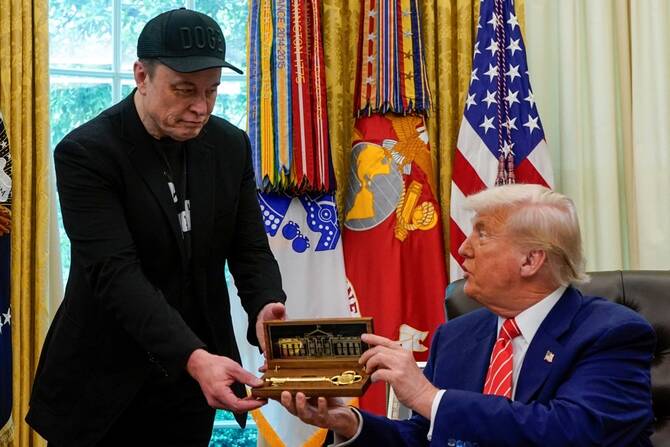
“This is not the end of DOGE, but really the beginning. The DOGE team will only grow stronger over time. It’s permeating throughout the government,” Musk said in the Oval Office, wearing a black blazer over a T-shirt emblazoned with “The Dogefather.” “We do expect over time to achieve the $1 trillion.” The early evidence suggests that the goal will be exceedingly difficult to reach.
By relying chiefly on information technology experts, Musk ended up stumbling through Washington and sometimes cutting employees vital to President Donald Trump’s own agenda.
Immigration judges were targeted at the same time the administration was trying to accelerate deportations of people in the U.S. illegally. Likewise, technologists with the Bureau of Land Management were purged from the Department of Interior, despite their significance to clearing the way for petroleum exploration, a Trump administration priority.
In many cases, fired employees were rehired, adding administrative costs to an effort aimed at cutting expenditures.
Had Musk’s team been staffed with experts on what positions are required under federal law to continue efforts such as drilling and immigration enforcement, it could have avoided similar mistakes across multiple departments, Nowrasteh said.
“I just think there were a lot of unforced errors that a more knowledgeable DOGE team would have avoided,” Nowrasteh said.
Grover Norquist, president and founder of the conservative Americans for Tax Reform, had a more favorable perspective on Musk's work, saying it should be judged not only by the total dollars saved but his ability to spotlight the issues.
“When you find the problem, you don’t know how far the cancer has spread. You just found a cancer cell,” Norquist said.
Norquist said it’s up to Congress to take the baton and set up a permanent structure to continue where Musk is leaving off.
“I just think it’s going to be seen five to 10 years from now as something very big and very permanent,” Norquist said, “and that was done only because of a guy like Musk, who can come in and shake things up.”
Elaine Kamarck, a key figure in Clinton's government efficiency effort, said its efforts were guided by more modest fiscal targets than DOGE. The initiative was led by Vice President Al Gore, and it was aimed at making the government more responsive to people who used it, and focused heavily on updating antiquated hiring and purchasing procedures.
It took years and carried into Clinton’s second term.
“We went about it methodically, department by department and, yes, used some outside analysts, but they were seasoned government civil servants who knew about government in general,” Kamarck said.
Clinton’s effort saved $136 billion by the end of Clinton’s second term, the equivalent of more than $240 billion today, and contributed to budget surpluses for each of the final four fiscal years he was in office.
Kamarck said she expects what she called Musk's “chaotic” approach will reveal mistakes or oversights that could create crises down the road, such as a transportation problem, response to a natural disaster, or delivery of entitlement benefits.
“These are the things that really hurt presidents, and they are increasing the probability that something is going to happen,” Kamarck said.


![]()

Musk put a spotlight on federal spending, but cut less than he wanted
Short Url
https://arab.news/6uh6e
Musk put a spotlight on federal spending, but cut less than he wanted
- Musk, whose last day spearheading the Department of Government Efficiency is Friday, slashed his goal for savings from $2 trillion to $1 trillion to finally only $150 billion


Latest updates



Recommended


© 2026 SAUDI RESEARCH & PUBLISHING COMPANY, All Rights Reserved And subject to Terms of Use Agreement.