

Pakistan formally initiates talks with US on ‘reciprocal tariffs’ amid export concerns

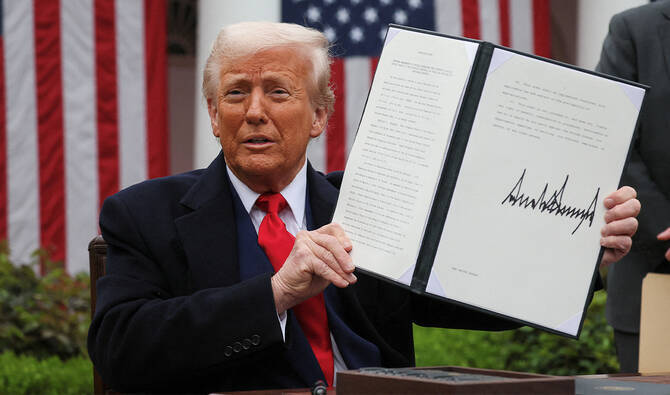
US President Donald Trump holds a signed executive order on tariffs, in the Rose Garden at the White House in Washington, DC, US, April 2, 2025. (REUTERS/File)
Short Url
Updated 30 May 2025
Follow

Pakistan formally initiates talks with US on ‘reciprocal tariffs’ amid export concerns

  • US imposed a 29% tariff on Pakistani goods as Islamabad pushes for export-led growth
  • Pakistan says it sees the move as both a challenge and an opportunity to reset trade ties

KARACHI: Pakistan has formally begun negotiations with the United States over newly imposed “reciprocal tariffs,” an official statement said on Friday, with Finance Minister Muhammad Aurangzeb holding a conference call with US Trade Representative Ambassador Jamieson Greer to launch the process.

The talks come after US President Donald Trump imposed steep tariffs on a number of countries earlier this year, a move widely viewed as a setback for the global economy still recovering from the coronavirus pandemic. Defending the action, Trump said the tariffs were necessary to correct trade imbalances and counter what he described as unfair treatment of American goods abroad.

Pakistan was among the countries affected, with a 29 percent tariff placed on its goods at a time when Islamabad is pushing for export-driven growth.

Aurangzeb called the development both a challenge and an opportunity to reset trade ties in April, adding that a high-level delegation would soon travel to Washington to pursue the matter further.

“Pakistan’s formal negotiations on US reciprocal tariffs kick-started between Mr. Muhammad Aurangzeb, Pakistan’s Finance Minister and Ambassador Jamieson Greer, United States Trade Representative through a telephonic/conference call on 30th May, 2025,” the finance ministry said.

“The two sides exchanged their viewpoint through a constructive engagement with the understanding that technical level detailed discussions would follow in the coming few weeks,” it added.

The ministry said both sides expressed confidence in advancing the negotiations toward a successful conclusion at the earliest.

The US is Pakistan’s largest export destination, and the newly imposed duties threaten to undermine Islamabad’s fragile economic recovery.

According to Pakistan’s central bank, the country exported $5.44 billion worth of goods to the US in 2024. From July to February of the current fiscal year, exports to the US reached $4 billion, up 10 percent from the same period last year.

Nearly 90 percent of those exports are textiles, which analysts say will be hardest hit.

Experts have also warned previously the tariffs could reduce Pakistan’s competitiveness, especially if regional exporters such as China, Bangladesh and Vietnam redirect more goods to Europe, intensifying competition in alternative markets.


Deputy PM Dar, Etisalat chairman discuss investment, stake in Pakistan’s PTCL

Updated 24 January 2026
Follow

Deputy PM Dar, Etisalat chairman discuss investment, stake in Pakistan’s PTCL

  • The development comes against backdrop of a long-running dispute over PTCL privatization
  • The issue has resurfaced in recent years as Pakistan seeks to advance privatization plans

ISLAMABAD: Pakistan’s Deputy Prime Minister and Foreign Minister Ishaq Dar met with Jassem Mohammed Bu Ataba Al Zaabi, chairman of Etisalat (e&) and the Abu Dhabi Department of Finance, and discussed with him investment prospects, including Etisalat’s stake in Pakistan Telecommunication Company Limited (PTCL), the Pakistani foreign ministry said on Saturday.

The planned meeting with the Etisalat chairman comes against the backdrop of a long-running dispute over the privatization of PTCL. The UAE-based telecom group has withheld a final payment of about $800 million linked to its 2005 acquisition of a 26 percent stake in PTCL, citing delays in the transfer of properties included in the deal, a position disputed by Pakistan.

The issue has resurfaced in recent years as Pakistan seeks to revive investor confidence, advance privatization plans and stabilize its finances under a program backed by the International Monetary Fund (IMF).

“The meeting reviewed Pakistan-UAE trade & economic cooperation, explored opportunities to enhance investment, and discussed e&’s pending issues and ongoing engagement in Pakistan, including through its stake in PTCL,” the Pakistani foreign ministry said.

Pakistan and the UAE maintain close political and economic ties, with Abu Dhabi providing critical financial support to Islamabad in recent years through deposits, loans and investment commitments as Pakistan navigates a fragile economic recovery.

“DPM/FM highlighted the Government of Pakistan’s commitment to facilitating investment by the private sector and partner countries, and to further strengthening economic cooperation between the two brotherly countries,” the foreign ministry said after the meeting.

The Pakistani deputy PM arrived in the UAE on Friday on an official visit following his participation in the World Economic Forum in Davos, according to his ministry. He will also hold meetings with other UAE officials during the visit.