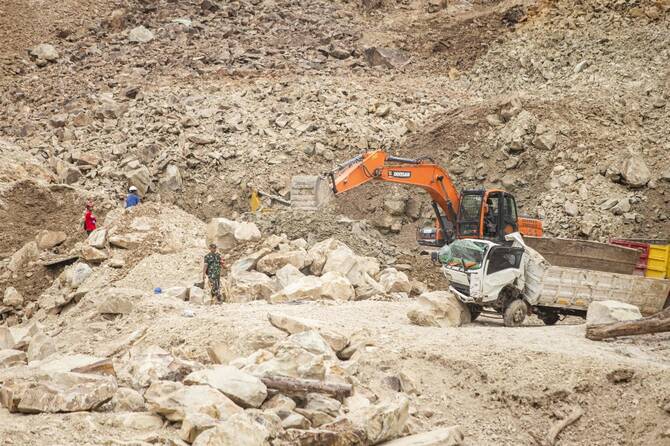
CIREBON: At least eight people were killed and a dozen injured Friday in a rockfall at a limestone quarry on Indonesia’s Java island, police said.
The company overseeing the mine was operating legally but safety standards were lacking, according to West Java governor Dedi Mulyadi, who said he has ordered its closure following the collapse.
Workers and heavy equipment were buried when rocks suddenly crumbled at the mining site in the city of Cirebon in West Java province at around 09:30 am local time (0230 GMT).
“We are now focusing on evacuating victims. Until now, eight people have been found dead, and 12 others were injured and have been taken to hospitals,” local police chief, Sumarni, who like many Indonesians has one name told AFP.
Rescuers were still scouring the site to find more victims who might still be trapped under the debris, deploying excavators for the search effort.
Friday’s incident was the second time the quarry collapsed. Parts of the mine collapsed in February but there were no casualties reported.
“I decided to shut down the pit permanently, not just this pit but also other pits nearby,” Dedi told Metro TV.
Mining accidents are common across the mineral-rich Southeast Asian archipelago, especially in unlicensed sites where safety protocols are often ignored.
In 2023, eight workers died after being trapped in an illegal gold mine in Central Java.
In July, last year, at least 23 people died and 35 others were missing when a landslide hit a remote village near an illegal gold mine on the central island of Sulawesi.

Rockfall at Indonesian limestone quarry kills eight
Short Url
https://arab.news/wyh3e
Rockfall at Indonesian limestone quarry kills eight
Australian bushfires raze homes in two states; firefighter dies
- Sixteen homes lost on Central Coast region in New South Wales
- Tasmania 700-hectare blaze destroys 19 homes at Dolphin Sands
SYDNEY/WELLINGTON: An Australian firefighter was killed overnight after he was struck by a tree while trying to control a bushfire that had destroyed homes and burnt large swathes of bushland north of Sydney, authorities said on Monday.
Emergency crews rushed to bushland near the rural town of Bulahdelah, 200 kilometers north of Sydney, after reports that a tree had fallen on a man. The 59-year-old suffered a cardiac arrest and died at the scene, officials said.
Prime Minister Anthony Albanese said the “terrible news is a somber reminder” of the dangers faced by emergency services personnel as they work to protect homes and families.
“We honor that bravery, every day,” Albanese said in a statement.
A fast-moving fire over the weekend destroyed 16 homes in New South Wales state’s Central Coast region, home to about 350,000 people and a commuter region just north of Sydney.
Resident Rouchelle Doust, from the hard-hit town of Koolewong, said she and her husband tried to save their home as flames advanced.
“He’s up there in his bare feet trying to put it out, and he’s trying and trying, and I’m screaming at him to come down,” Doust told the Australian Broadcasting Corp.
“Everything’s in it: his grandmother’s stuff, his mother’s stuff, all my stuff — everything, it’s all gone, the whole lot.”
Conditions eased overnight, allowing officials to downgrade fire danger alerts, though the weather bureau warned some inland towns in the state could hit more than 40 degrees Celsius (104 Fahrenheit) on Tuesday, raising fire dangers.
More than 50 bushfires were burning across New South Wales as of Monday.
On the island state of Tasmania, a 700-hectare blaze at Dolphin Sands, about 150km northeast of the state capital of Hobart, destroyed 19 homes and damaged 40. The fire has been contained, but residents have been warned not to return as conditions remain dangerous, officials said.
Authorities have warned of a high-risk bushfire season during Australia’s summer months from December to February, with increased chances of extreme heat across large parts of the country following several relatively quiet years.
New Zealand national park fire
In neighboring New Zealand, five helicopters and multiple crews were working to put out a fire near the country’s oldest national park, a month after a wildfire burnt through 2,589 hectares of alpine bush there.
Police said they had closed a road near the state highway and advised motorists to avoid the area and expect delays, after the blaze near Tongariro National Park, a popular hiking spot, spread to 110 hectares by Monday afternoon.
Emergency crews rushed to bushland near the rural town of Bulahdelah, 200 kilometers north of Sydney, after reports that a tree had fallen on a man. The 59-year-old suffered a cardiac arrest and died at the scene, officials said.
Prime Minister Anthony Albanese said the “terrible news is a somber reminder” of the dangers faced by emergency services personnel as they work to protect homes and families.
“We honor that bravery, every day,” Albanese said in a statement.
A fast-moving fire over the weekend destroyed 16 homes in New South Wales state’s Central Coast region, home to about 350,000 people and a commuter region just north of Sydney.
Resident Rouchelle Doust, from the hard-hit town of Koolewong, said she and her husband tried to save their home as flames advanced.
“He’s up there in his bare feet trying to put it out, and he’s trying and trying, and I’m screaming at him to come down,” Doust told the Australian Broadcasting Corp.
“Everything’s in it: his grandmother’s stuff, his mother’s stuff, all my stuff — everything, it’s all gone, the whole lot.”
Conditions eased overnight, allowing officials to downgrade fire danger alerts, though the weather bureau warned some inland towns in the state could hit more than 40 degrees Celsius (104 Fahrenheit) on Tuesday, raising fire dangers.
More than 50 bushfires were burning across New South Wales as of Monday.
On the island state of Tasmania, a 700-hectare blaze at Dolphin Sands, about 150km northeast of the state capital of Hobart, destroyed 19 homes and damaged 40. The fire has been contained, but residents have been warned not to return as conditions remain dangerous, officials said.
Authorities have warned of a high-risk bushfire season during Australia’s summer months from December to February, with increased chances of extreme heat across large parts of the country following several relatively quiet years.
New Zealand national park fire
In neighboring New Zealand, five helicopters and multiple crews were working to put out a fire near the country’s oldest national park, a month after a wildfire burnt through 2,589 hectares of alpine bush there.
Police said they had closed a road near the state highway and advised motorists to avoid the area and expect delays, after the blaze near Tongariro National Park, a popular hiking spot, spread to 110 hectares by Monday afternoon.
© 2025 SAUDI RESEARCH & PUBLISHING COMPANY, All Rights Reserved And subject to Terms of Use Agreement.


