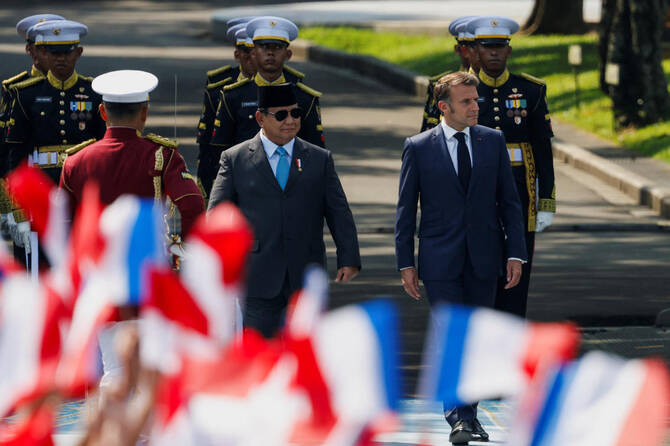
JAKARTA: French President Emmanuel Macron met with his Indonesian counterpart Prabowo Subianto on Wednesday in a visit aimed at boosting defense and trade cooperation as part of his roughly week-long trip to Southeast Asia focused on strengthening regional ties in an increasingly unstable global landscape.
Macron arrived in Indonesia’s capital, Jakarta, on Tuesday evening with French First Lady Brigitte Macron for a three-day visit to Southeast Asia’s largest economy. It was the second stop in his tour of the region after Vietnam, where Macron signed a deal to sell Hanoi 20 Airbus planes.
“We are very excited to meet again with my brother, President Prabowo,” Macron told reporters shortly after arriving at Jakarta’s Halim Perdanakusuma air force base late Tuesday, “He is a great friend of mine and the relationship with your country is a very strategic and friendly one.”
Military cooperation between Indonesia and France has grown in recent years, while Subianto was serving as Indonesia’s defense minister.
The two leaders met last November on the sidelines of the 2024 G20 Summit in Brazil, where they discussed Indonesia’s plans to buy fighter jets and submarines from France.
Indonesia finalized an order for 42 French Dassault Rafale fighter jets in January 2024, and the first delivery is expected in early 2026. The country also announced the purchase of two French Scorpene Evolved submarines and 13 Thales ground control interception radars. Five of the radar systems are expected to be installed in the country’s new capital, Nusantara.
Indonesian Defense Minister Sjafrie Sjamsoeddin said the two leaders will oversee the signing of letter of intent for the procurement of strategic weapons systems including fighter planes and submarines.
“The essence of this (visit) is to strengthen defense cooperation between Indonesia and France,” Sjamsoeddin told reporters after welcoming Macron and his wife at the air force base on Tuesday.
On Wednesday, Subianto hosted Macron and Brigitte in a ceremony at Merdeka Palace in Jakarta before the two leaders led a bilateral meeting.
Indonesia has embarked on a drive to upgrade and modernize its arsenal and strengthen its domestic defense industry.
Subianto has crisscrossed the globe since he was appointed as defense minister in 2019, traveling to China, France, Russia, Turkiye and the United States in a bid to acquire new military weapon systems as well as surveillance and territorial defense capabilities.
The Indonesian Air Force currently operates a mix of fighter jets made in various countries, including the United States, Russia and Britain. Some of those aircraft have reached or will soon reach their end-of-life phase and need to be replaced or upgraded.
During the visit, Macron is also scheduled to meet with ASEAN Secretary-General Kao Kim Hourn to discuss regional issues, and to give public lectures at Jakarta State University.
On Thursday, Macron and his wife are expected visit Borobudur, a 9th century Buddhist temple in the center of Indonesia’s Java island and to visit a military academy before heading to Singapore, where he will speak at Asia’s top defense conference, the annual Shangri-La Dialogue.

Indonesian and French leaders meet for defense and trade talks
https://arab.news/peee3
Indonesian and French leaders meet for defense and trade talks
- Emmanuel Macron is on a week-long trip to Southeast Asia focused on strengthening regional ties
- Military cooperation between Indonesia and France has grown in recent years
Venezuela’s acting president calls for oil industry reforms to attract more foreign investment
- In her speech, Rodríguez said money earned from foreign oil sales would go into two funds: one dedicated to social services for workers and the public health care system, and another to economic development and infrastructure projects
CARACAS, Venezuela: Venezuela’s acting President Delcy Rodriguez used her first state of the union address on Thursday to promote oil industry reforms that would attract foreign investment, an objective aggressively pushed by the Trump administration since it toppled the country’s longtime leader less than two weeks ago.
Rodríguez, who has been under pressure from the US to fall in line with its vision for the oil-rich nation, said sales of Venezuelan oil would go to bolster crisis-stricken health services, economic development and other infrastructure projects.
While she sharply criticized the Trump administration and said there was a “stain on our relations,” the former vice president also outlined a distinct vision for the future between the two historic adversaries, straying from her predecessors, who have long railed against American intervention in Venezuela.
“Let us not be afraid of diplomacy” with the US, said Rodriguez, who must now navigate competing pressures from the Trump administration and a government loyal to former President Nicolás Maduro.
The speech, which was broadcast on a delay in Venezuela, came one day after Rodríguez said her government would continue releasing prisoners detained under Maduro in what she described as “a new political moment” since his ouster.
Trump on Thursday met at the White House with Venezuelan opposition leader María Corina Machado, whose political party is widely considered to have won 2024 elections rejected by Maduro. But in endorsing Rodríguez, who served as Maduro’s vice president since 2018, Trump has sidelined Machado.
In her speech, Rodríguez said money earned from foreign oil sales would go into two funds: one dedicated to social services for workers and the public health care system, and another to economic development and infrastructure projects.
Hospitals and other health care facilities across the country have long suffered. Patients are asked to provide practically all supplies needed for their care, from syringes to surgical screws. Economic turmoil, among other factors, has pushed millions of Venezuelans to migrate from the South American nation in recent years.
In moving forward, the acting president must walk a tightrope, balancing pressures from both Washington and top Venezuelan officials who hold sway over Venezuela’s security forces and strongly oppose the US Her recent public speeches reflect those tensions — vacillating from conciliatory calls for cooperation with the US, to defiant rants echoing the anti-imperialist rhetoric of her toppled predecessor.
American authorities have long railed against a government they describe as a “dictatorship,” while Venezuela’s government has built a powerful populist ethos sharply opposed to US meddling in its affairs.
For the foreseeable future, Rodríguez’s government has been effectively relieved of having to hold elections. That’s because when Venezuela’s high court granted Rodríguez presidential powers on an acting basis, it cited a provision of the constitution that allows the vice president to take over for a renewable period of 90 days.
Trump enlisted Rodríguez to help secure US control over Venezuela’s oil sales despite sanctioning her for human rights violations during his first term. To ensure she does his bidding, Trump threatened Rodríguez earlier this month with a “situation probably worse than Maduro.”
Maduro, who is being held in a Brooklyn jail, has pleaded not guilty to drug-trafficking charges.
Before Rodríguez’s speech on Thursday, a group of government supporters was allowed into the presidential palace, where they chanted for Maduro, who the government insists remains the country’s president. “Maduro, resist, the people are rising,” they shouted.