

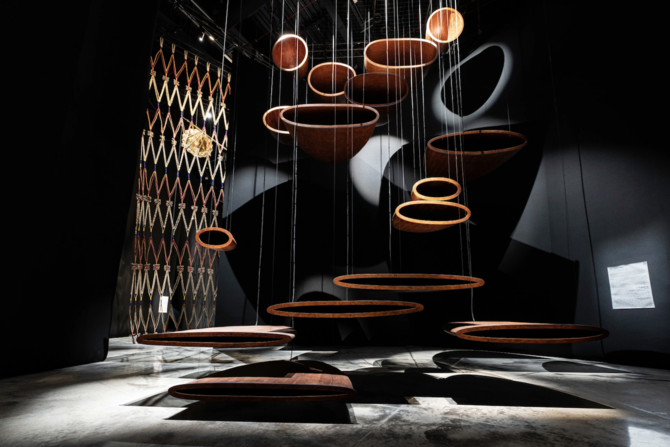

RIYADH: Seasoned Saudi artist Basmah Felemban’s work will make you think. In her latest solo exhibition, “Vessel of Wreckage,” which runs at ATHR Gallery in Riyadh until June 26, she combines elements that many of us can relate to while being authentically, fully herself.
“In the past five or six years, my practice has been really an investigation of my family roots from Indonesia and — kind of as a result of getting into sci-fi — to have some imaginary explanations of those reasons why they came from Indonesia to Saudi, because I failed at the factual research, really,” Felemban, who lives and works between London and Jeddah, tells Arab News.
“When did my family move? This is one of the mysteries — part of the myth of the family. I have no idea. I’d say that my granddad came to Saudi for work, probably in the Seventies. But I’d learned that Felemban, our last name, comes from an island called Palembang, so in kindergarten I used to tell people I was a princess because I’m used to, like, the Al-Saud family and Saudi Arabia, so I thought since I’m Felemban from Palembang, I must be a princess.”
Growing up, Felemban assumed that they had no Saudi relatives, until her brother serendipitously found out that they had cousins in town.
“I realized, ‘Oh! We do have extended family here; we’re just not connected to them.’ And that’s also part of the myth and the lore of our family story. Once I realized that, it kind of clicked with me that our identities are really just a construct — it doesn’t really matter if they’re factual. I don’t think my family intentionally tried to lie. I think they believed this was the story.”
All of this was part of Felemban’s world building.
“I think, in Hejaz in general, people came from all over and there was this whole umbrella under which we wanted to identify as ‘Saudi’ for a lot of time. Like, if you speak to me about anything Indonesian, I would have no idea, because my family really assimilated,” she says, adding that she hopes to visit Indonesia soon.
“I wouldn’t say I feel like I’m part of a diaspora, even if I am, factually. But I think Saudi is a very specific, special case in terms of identity. I feel like I’m more interested in the family story and why their connections are the way they are.
“I didn’t grow up in an environment where ours was a weird story,” she adds. “Even my friends that are Bedouin are still also away from where they are from.”
Here, Felemban talks us through several works from the show.
‘Pulang (To Go Home)’
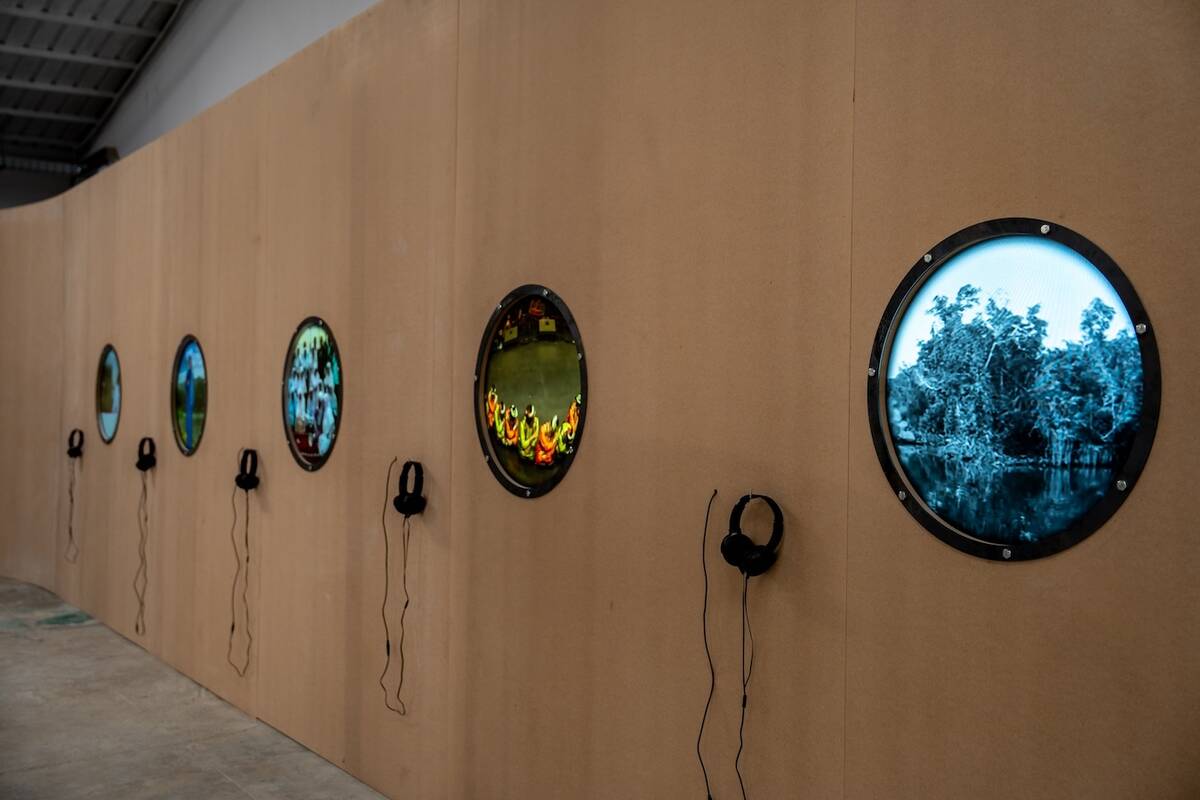
Photo: AN/Huda Bashatah
There are five ship windows looking out on five different topics that I researched, from facts to absurd sci-fi stories. They’re videos collected from YouTube — just rabbit holes I fell into. I really like to document my research and my notes, then my work grows like a mind map — I connect words and then try to connect concepts between those words and visuals. The first window starts with a propaganda documentary about the colonial history of Indonesia and its impact on folklore dances and music. Then a scene that a lot of my world is based on; Indonesian pilgrims reciting a religious song about the prophet.
I realized that another connection between Indonesia and Saudi is catfish — another creature of myth. A few years ago, people realized that there’s a lot of huge catfish in Wadi Hanifa and they started to ask: How did they come here? I like that, as a myth. In Indonesia, the catfish is a really huge asset, but also has some negative connotations.
‘Fish from the Ground’

This work talks about the catfish myth. They are an invasive species and tend to be really vicious and really quick to adapt, so in less than a couple of hundreds of years it was able to evolve from swimming to being able to ‘walk,’ almost on land. That’s likely where the term ‘catfishing’ comes from.
‘Wave Catcher’

When I was approached by the Islamic Arts Biennale (in 2023), I thought, ‘My work is quite futuristic, very colorful and digital, so how can (make it fit) in?’ I think of this work like an ancient machine used by the catfish to collect data by listening to sounds of the calls to prayer from countries around the Red Sea. And by hearing it, the fish are able to measure distances, and study the water and such. That thought was based on research from lectures from scientists.
‘The Gömböc, the Turtle and the Evolution of Shape’

Photo: AN/Huda Bashatah
This is a game based on a lecture by a scientist. If you put the headphones on, you can hear the lecture and then when you reach the top of this fish mountain, there’s a room that has a table that also existed in the lecture and you can interact with that. It’s a video game I made with my husband. He’s an economist so he helps me a lot with conceptualizing what data could be like — that kind of geeky aspect of my work. It’s very experimental and it’s a little bit janky — in the best way possible!
‘Elemental Sprite’ series

These AI works — “Sphere,” “Rod,” “Disc,” and “Blade” (shown here) — are based on some of the same research as “Wave Catcher,” which is some sort of mathematical study of pebbles and the way that pebbles change in nature. But also, if you scan one of the squares, it animates. I’m very much a digital artist at heart and AI is something I’m really interested in, but I have to say that I don’t use AI in engines; I use sort of ‘offline AI.’ I use the modules themselves, the interfaces. Every six months, AI completely changes in quality because it really develops, and I learn more too. This is almost like a documentation of my learning curve, and of the technology itself.
‘Before Asphalt’

These are pictures that I stole from my dad before he passed away. He used to work at the municipality, and these were pictures from the Nineties documenting some of the potholes around Jeddah. I like to think of the city as a galaxy and the potholes as portals. The yellow looks like slime — I’m definitely a cartoon girl and this is like “(Teenaged Mutant) Ninja Turtles” sludge. I think maybe it’ll appear again in another work and I’ll get more into this portal idea.


