

Rescued giant moths emerge from cocoons in Mexico’s sprawling capital

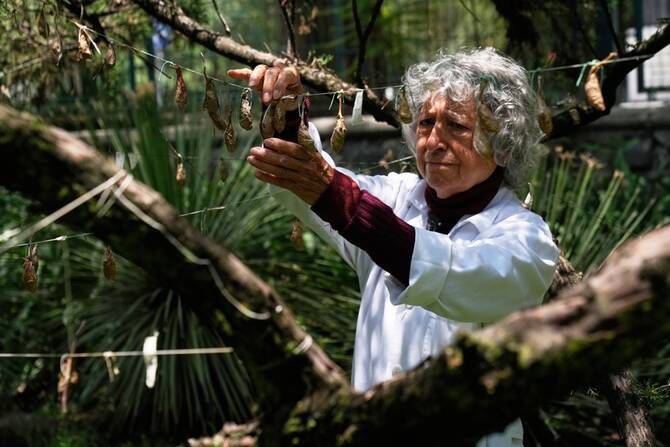
Maria Eugenia Diaz Batres, a biologist, touches cocoons of moths hanging from a clothesline in the gardens of the Natural History Museum in Mexico City. (AP Photos)
Short Url
Updated 30 May 2025
Follow

Rescued giant moths emerge from cocoons in Mexico’s sprawling capital

MEXICO CITY: Two moths the size of a hand, their wings patterned with brown and pink around four translucent sections, mate for hours hanging from a line alongside cocoons like the ones they emerged from just hours earlier.
“When I get here and find this, I jump with delight,” said María Eugenia Díaz Batres, who has been caring for insects at the Museum of Natural History and Environmental Culture in Mexico City for nearly six decades.
The mating pair of “four mirrors” moths as they’re popularly known in Mexico, or scientifically as Rothschildia orizaba, are evidence that the museum’s efforts to save some 2,600 cocoons rescued from an empty lot were worth the trouble.


The moths, whose numbers have fallen in Mexico City due to urbanization, have cultural relevance in Mexico.
“The Aztecs called them the ‘butterfly of obsidian knives,’ Itzpapalotl,” Díaz Batres said. “And in northern Mexico they’d fill many of these cocoons with little stones and put them on their ankles for dances.”
These cocoons arrived at the museum in late December.
“They gave them to us in a bag and in a box, all squeezed together with branches and leaves, so my first mission was to take them out, clean them,” Díaz Batres said.
Mercedes Jiménez, director of the museum in the capital’s Chapultepec park, said that’s when the real adventure began since they had never received anything like this before.
Díaz Batres had the cocoons hung in any place she thought they might do well, including her office where they hang from lines crisscrossing above her table. It has allowed her to watch each stage of their development closely.


The moths only survive for a week or two as adults, but they give Díaz Batres tremendous satisfaction, especially when she arrives at her office and new moths “are at the door, on the computer.”
So she tries to help them “complete their mission” and little by little their species recovers.


Thai coffee chains cut default sugar content in coffee and tea drinks in a new health push

Updated 11 February 2026
Follow

Thai coffee chains cut default sugar content in coffee and tea drinks in a new health push

  • The Health Department says Thais consume 21 teaspoons of sugar daily, far exceeding the World Health Organization’s recommended six teaspoons
  • Officials warn this increases obesity and diabetes risks. A survey found iced coffee and bubble tea contain high sugar levels

BANGKOK: For many Thais, a meal doesn’t feel complete without an iced coffee or tea so sugary it could pass for dessert. The government, concerned about the health consequences, wants them to dial it back.
Starting Wednesday, nine major coffee chains across the country have pledged to cut the default sugar content in some of their drinks by half in a government initiative aimed at tackling excessive sugar consumption.
According to the Health Department, Thais consume an average of 21 teaspoons of sugar per day, more than three times the World Health Organization’s recommended limit of six teaspoons. Health officials warn that such high intake increases the risk of obesity, diabetes and other diseases.
The initiative is the first significant step to change consumers’ sugar consumption behavior, said Amporn Benjaponpitak, the director general of the department.
Pakorn Tungkasereerak, the department’s deputy, said 2025 data show that about 45 percent of Thais aged 15 and older are obese, while 10 percent of the population has diabetes.
A survey by the Bureau of Nutrition found that a 22-ounce (650-milliliter) iced coffee contains an average of nine teaspoons of sugar, while a 10-ounce (300-milliliter) serving of bubble milk tea — an iced milk tea with tapioca pearls known as boba — can contain as much as 12 teaspoons.
Sirinya Kuiklang, an office worker, said she approves of the changes. She already orders her drinks at just 25 percent of the standard sugar level, but she is aware that many others consume too much sugar.
“It’s good for Thai people,” she said.
Another office worker, Porwares Tantikanpanit, said he has enjoyed his non-coffee beverages at their current sugar levels but is willing to adjust if shops reduce the sweetness.
However, putting the policy into practice may prove challenging. Officials have said each brand can apply the initiative as they see fit.
Some customers have expressed confusion in response to social media posts promoting the initiative, asking how to order drinks with the level of sweetness that they prefer. Several brands said that the reduction applies only to certain menu items.