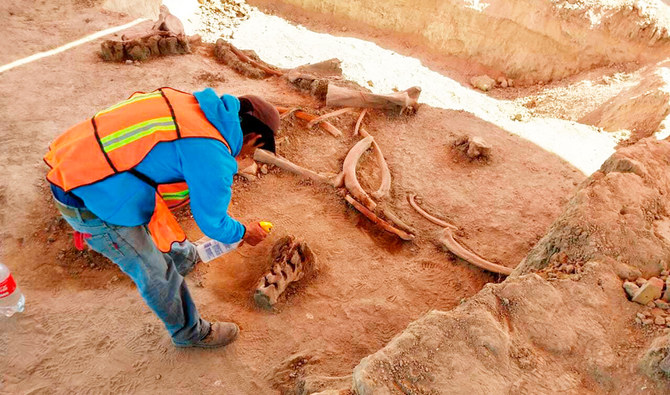
MEXICO CITY: Archaeologists have found the bones of about 60 mammoths at an airport under construction just north of Mexico City, near human-built ‘traps’ where more than a dozen mammoths were found last year.
Both discoveries reveal how appealing the area — once a shallow lake — was for the mammoths, and how erroneous was the classic vision of groups of fur-clad hunters with spears chasing mammoths across a plain. Humans may have been smarter — and mammoths clumsier — than people had previously thought.
For the momement, however, Mexican archaeologists are facing a surfeit of mammoths, almost too many to ever excavate.
“There are too many, there are hundreds,” said archaeologist Pedro Sánchez Nava, of the National Institute of Anthropology and History.
The institute began digging in three large but shallow areas in October, when work started to convert an old military air base into a civilian airport. In about six months, the bones of 60 of the huge, extinct herbivores were found, and Sánchez Nava said that pace — about 10 mammoths a month — may continue. The airport project is scheduled for completion in 2022, at which the dig will end.
The excavations were conducted on the shores of an ancient lake, once known as Xaltocan and now disappeared. The shallow lake apparently produced generous quantities of grasses and reeds, which attracted mammoths who often ate 150 klograms (330 pounds) of the stuff every day. “It was like paradise for them,” Sánchez Nava said.
The excavations are about 6 miles (10 kilometers) away from the mammoth pits found last year in the hamlet of San Antonio Xahuento, There, two human-built pits were dug about 15,000 years ago to trap mammoths, which apparently couldn’t clamber out of the 6-foot (2-meter) deep traps.
Those pits, found during excavations for a garbage dump, were filled with bones from at least 14 mammoths, and some of the animals appeared to have been butchered.
The institute said hunters may have chased mammoths into the traps. Remains of two other species that disappeared in the Americas — a horse and a camel — were also found in the sediments, at layers corresponding to 15,000 to 20,000 years ago.
The newert excavations at the air base have not yet turned up any of the distinct cut marks that would suggest human butchering of the animals.
Sánchez Nava said the most recently discovered mammoths had apparently got stuck in the mud of the ancient lake and died, or were eaten by other animals.
But the bones will be subject to further study because Sánchez Nava said humans might have carved up the mammoths once they got stuck.
And, he said, ancient human could possibly have used the mud pools and flats around the lake shore as a sort of natural trap. “It’s possible they may have chased them into the mud,” he noted, adding, “They (ancient humans) had a very structured and organized division of labor” for getting mammoth meat.
The huge number of mammoths being discovered may also change scientists’ views of how frequently mammoth turned up on the dinner menu of our ancestors. “They used to think it was very chance, sporadic,” Sánchez Nava said of a mammoth meal. “In fact, it may have been part of their daily diet.”
Mammoth bones have always been so numerous in the area that the Aztecs, who ruled the Mexico Valley between 1325 and 1521, recorded having found the enormous bones; Sánchez Nava said the Aztecs interpreted them as proof of legends that giants had once populated the valley.
Sánchez Nava said the large numbers of remains will allow scientists to research how mammoths fed and whether they were already suffering genetic inbreeding or decline, which could have contributed — along with human hunting — to their extinction on the mainland about 10,000 years ago.
Sánchez Nava said nothing had been found that would require halting work on the airport project, in which the old military base is being converted into a civilian terminal.


![]()

In Mexico City, experts find bones of dozens of mammoths
Short Url
https://arab.news/9kkz6
In Mexico City, experts find bones of dozens of mammoths
- The excavations were conducted on the shores of an ancient lake, once known as Xaltocan and now disappeared


Latest updates


© 2026 SAUDI RESEARCH & PUBLISHING COMPANY, All Rights Reserved And subject to Terms of Use Agreement.