

Trump’s tariffs to remain in effect after appeals court grants stay

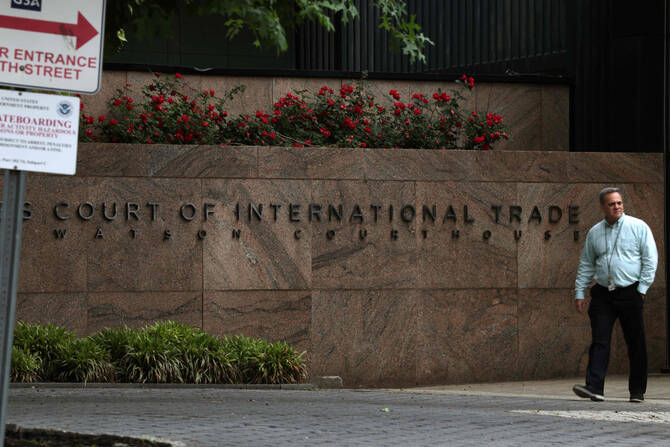
A view of the US Court of International Trade, Watson Courthouse in lower Manhattan in New York City, which ruled in an opinion on Thursday that Trump exceeded his authority by imposing retaliatory tariffs worldwide. (Getty Images via AFP)
Short Url
Updated 30 May 2025
Follow

Trump’s tariffs to remain in effect after appeals court grants stay

  • Trade court ruled Trump exceeded authority under IEEPA
  • Uncertainty over tariffs impacts trade talks and market reactions

WASHINGTON: A federal appeals court temporarily reinstated the most sweeping of President Donald Trump’s tariffs on Thursday, a day after a trade court had ruled Trump had exceeded his authority in imposing the duties and ordered an immediate block on them.
The United States Court of Appeals for the Federal Circuit in Washington said it was pausing the lower court’s ruling to consider the government’s appeal, and ordered the plaintiffs in the cases to respond by June 5 and the administration by June 9.
Wednesday’s surprise ruling by the US Court of International Trade had threatened to kill or at least delay the imposition of Trump’s so-called Liberation Day tariffs on imports from most US trading partners and additional tariffs on goods from Canada, Mexico and China. The latter was related to his accusation that the three countries were facilitating the flow of fentanyl into the US.
The trade court’s three-judge panel ruled that the Constitution gave Congress, not the president, the power to levy taxes and tariffs, and that the president had exceeded his authority by invoking the International Emergency Economic Powers Act, a law intended to address threats during national emergencies.
Senior Trump administration officials had said they were undeterred by the trade court’s ruling, saying they expected either to prevail on appeal or employ other presidential powers to ensure they go into effect.
Trump has used the threat of charging US importers costly tariffs for goods from almost every other country in the world as leverage in international trade talks, a strategy the trade court’s ruling would upend. The trade court ruling had not interfered with any negotiations with top trading partners that are scheduled in the days ahead, Trump’s administration said.
US trading partners “are coming to us in good faith and trying to complete the deals before the 90-day pause ends,” Treasury Secretary Scott Bessent said in a Fox News interview. “So we’ve seen no change in their attitude in the past 48 hours. In fact I have a very large Japanese delegation coming to my office first thing tomorrow morning.”
Many US trading partners offered careful responses. The British government said the trade court’s ruling was a domestic matter for the US administration and noted it was “only the first stage of legal proceedings.” Both Germany and the European Commission said they could not comment on the decision.
Canadian Prime Minister Mark Carney welcomed the trade court’s finding, saying it was “consistent with Canada’s longstanding position” that Trump’s tariffs were unlawful.
Financial markets, which have whipsawed wildly in response to every twist and turn in Trump’s chaotic trade war, had reacted with cautious optimism to the trade court ruling, though gains in stocks on Thursday were largely limited by expectations that the court’s ruling faced a potentially lengthy appeals process. Indeed, analysts said broad uncertainty remained regarding the future of Trump’s tariffs, which have cost companies more than $34 billion in lost sales and higher costs, according to a Reuters analysis.
Some sector-specific tariffs, such as those on imports of steel, aluminum and automobiles, were imposed by Trump under separate authorities on national security grounds and were unaffected by the ruling.
The Liberty Justice Center, the nonprofit group representing five small businesses that sued over the tariffs, said the appeals court’s temporary stay was a procedural step.
Jeffrey Schwab, senior counsel for the center, said the appeals court would ultimately agree with the small businesses that faced irreparable harm of “the loss of critical suppliers and customers, forced and costly changes to established supply chains, and, most seriously, a direct threat to the very survival of these businesses.”
A separate federal court earlier on Thursday had also found Trump overstepped his authority in using the International Emergency Economic Powers Act for what he called reciprocal tariffs of at least 10 percent on goods from most US trading partners and for the separate 25 percent levies on goods from Canada, Mexico and China related to fentanyl.
That ruling was much narrower, however, and the relief order stopping the tariffs applied only to the toy company that brought the case. The administration has appealed that ruling as well.

Uncertainty persists
Following a market revolt after his major tariff announcement on April 2, Trump paused most import duties for 90 days and said he would hammer out bilateral deals with trade partners. But apart from a pact with Britain this month, agreements remain elusive, and the trade court’s ruling on the tariffs and the uncertainty of the appeals process may dissuade countries like Japan from rushing in to deals, analysts said.
“Assuming that an appeal does not succeed in the next few days, the main win is time to prepare, and also a cap on the breadth of tariffs — which can’t exceed 15 percent for the time being,” said George Lagarias, chief economist at Forvis Mazars international advisers.
The trade court ruling would have lowered the overall effective US tariff rate to about 6 percent, but the appellate court’s emergency stay means it will remain at about 15 percent, according to estimates from Oxford Research. That is the level it has been since Trump earlier this month struck a temporary truce that reduced punishing levies on Chinese goods until late summer. By contrast, the effective tariff rate had been between 2 percent and 3 percent before Trump returned to office in January. Trump’s trade war has shaken makers of everything from luxury handbags and sneakers to household appliances and cars as the price of raw materials has risen. Drinks company Diageo and automakers General Motors and Ford are among those that have abandoned forecasts for the year ahead.
Non-US companies including Honda, Campari , Roche and Novartis have said they are considering moving operations or expanding their US presence to mitigate the impact of tariffs.


Federal agents must limit tear gas for now at protests outside Portland ICE building, judge says

Updated 7 sec ago
Follow

Federal agents must limit tear gas for now at protests outside Portland ICE building, judge says

  • The ruling came in response to a lawsuit filed by the ACLU of Oregon on behalf of protesters and freelance journalists covering demonstrations at the flashpoint US Immigration and Customs Enforcement building

PORTLAND, Oregon: A judge in Oregon on Tuesday temporarily restricted federal officers from using tear gas at protests at the US Immigration and Customs Enforcement building in Portland, just days after agents launched gas at a crowd of demonstrators including young children that local officials described as peaceful.
US District Judge Michael Simon ordered federal officers not to use chemical or projectile munitions on people who pose no imminent threat of physical harm, or who are merely trespassing or refusing to disperse. Simon also limited federal officers from firing munitions at the head, neck or torso “unless the officer is legally justified in using deadly force against that person.”
Simon, whose temporary restraining order is in effect for 14 days, wrote that the nation “is now at a crossroads.”
“In a well-functioning constitutional democratic republic, free speech, courageous newsgathering, and nonviolent protest are all permitted, respected, and even celebrated,” he wrote. “In helping our nation find its constitutional compass, an impartial and independent judiciary operating under the rule of law has a responsibility that it may not shirk.”
Ruling follows a lawsuit filed by the ACLU of Oregon
The ruling came in response to a lawsuit filed by the ACLU of Oregon on behalf of protesters and freelance journalists covering demonstrations at the flashpoint US Immigration and Customs Enforcement building.
The suit names as defendants the Department of Homeland Security and its head Kristi Noem, as well as President Donald Trump. It argues that federal officers’ use of chemical munitions and excessive force is a retaliation against protesters that chills their First Amendment rights.
The Department of Homeland Security said federal officers have “followed their training and used the minimum amount of force necessary to protect themselves, the public, and federal property.”
“DHS is taking appropriate and constitutional measures to uphold the rule of law and protect our officers and the public from dangerous rioters,” spokesperson Tricia McLaughlin said.
Courts consider question of tear gas use
Cities across the country have seen demonstrations against the administration’s immigration enforcement surge.
Last month, a federal appeals court suspended a decision that prohibited federal officers from using tear gas or pepper spray against peaceful protesters in Minnesota who aren’t obstructing law enforcement. An appeals court also halted a ruling from a federal judge in Chicago that restricted federal agents from using certain riot control weapons, such as tear gas and pepper balls, unless necessary to prevent an immediate threat. A similar lawsuit brought by the state is now before the same judge.
The Oregon complaint describes instances in which the plaintiffs — including a protester known for wearing a chicken costume, a married couple in their 80s and two freelance journalists — had chemical or “less-lethal” munitions used against them.
In October, 83-year-old Vietnam War veteran Richard Eckman and his 84-year-old wife Laurie Eckman joined a peaceful march to the ICE building. Federal officers then launched chemical munitions at the crowd, hitting Laurie Eckman in the head with a pepper ball and causing her to bleed, according to the complaint. With bloody clothes and hair, she sought treatment at a hospital, which gave her instructions for caring for a concussion. A munition also hit her husband’s walker, the complaint says.
Jack Dickinson, who frequently attends protests at the ICE building in a chicken suit, has had munitions aimed at him while posing no threat, according to the complaint. Federal officers have shot munitions at his face respirator and at his back, and launched a tear-gas canister that sparked next to his leg and burned a hole in his costume, the complaint says.
Freelance journalists Hugo Rios and Mason Lake have similarly been hit with pepper balls and tear gassed while marked as press, the complaint says.
“Defendants must be enjoined from gassing, shooting, hitting and arresting peaceful Portlanders and journalists willing to document federal abuses as if they are enemy combatants,” the complaint states.
The owner and residents of the affordable housing complex across the street from the ICE building has filed a separate lawsuit, similarly seeking to restrict federal officers’ use of tear gas because its residents have been repeatedly exposed over the past year.
Local officials have also spoken out against use of chemical munitions. Portland Mayor Keith Wilson demanded ICE leave the city after federal officers used such munitions Saturday at what he described as a “peaceful daytime protest where the vast majority of those present violated no laws, made no threat, and posed no danger to federal forces.”
“To those who continue to work for ICE: Resign. To those who control this facility: Leave,” Wilson wrote in a statement Saturday night.
The protest was one of many similar demonstrations nationwide against the immigration crackdown in cities like Minneapolis, where in recent weeks federal agents killed two people, Alex Pretti and Renee Good.